In 1987, 20th Century Fox struck box-office gold with Predator, an action blockbuster dripping with the testosterone-fuelled excess that only the 1980s could deliver. Starring the decade’s hottest action hero, Arnold Schwarzenegger, as an elite commando whose heavily armed team found themselves outmatched by a technologically advanced extraterrestrial hunter. The movie established the Predator as one of cinema’s most memorable monsters, and its success caught the attention of the software industry, with Activision releasing a home computer adaptation that same year.
Three years later, 20th Century Fox brought its alien hunter back to the big screen in Predator 2, trading the jungles of Central America for the sweltering streets of 1997 Los Angeles, gripped by gang warfare. Starring Danny Glover as Lieutenant Mike Harrigan, the film pitted the LAPD against the heavily armed Jamaican Posse and Colombian Cartel, while an altogether deadlier threat moved unseen through the chaos. With a new movie and a new hunting ground, the Predator was ready for another encounter with the home computer market.
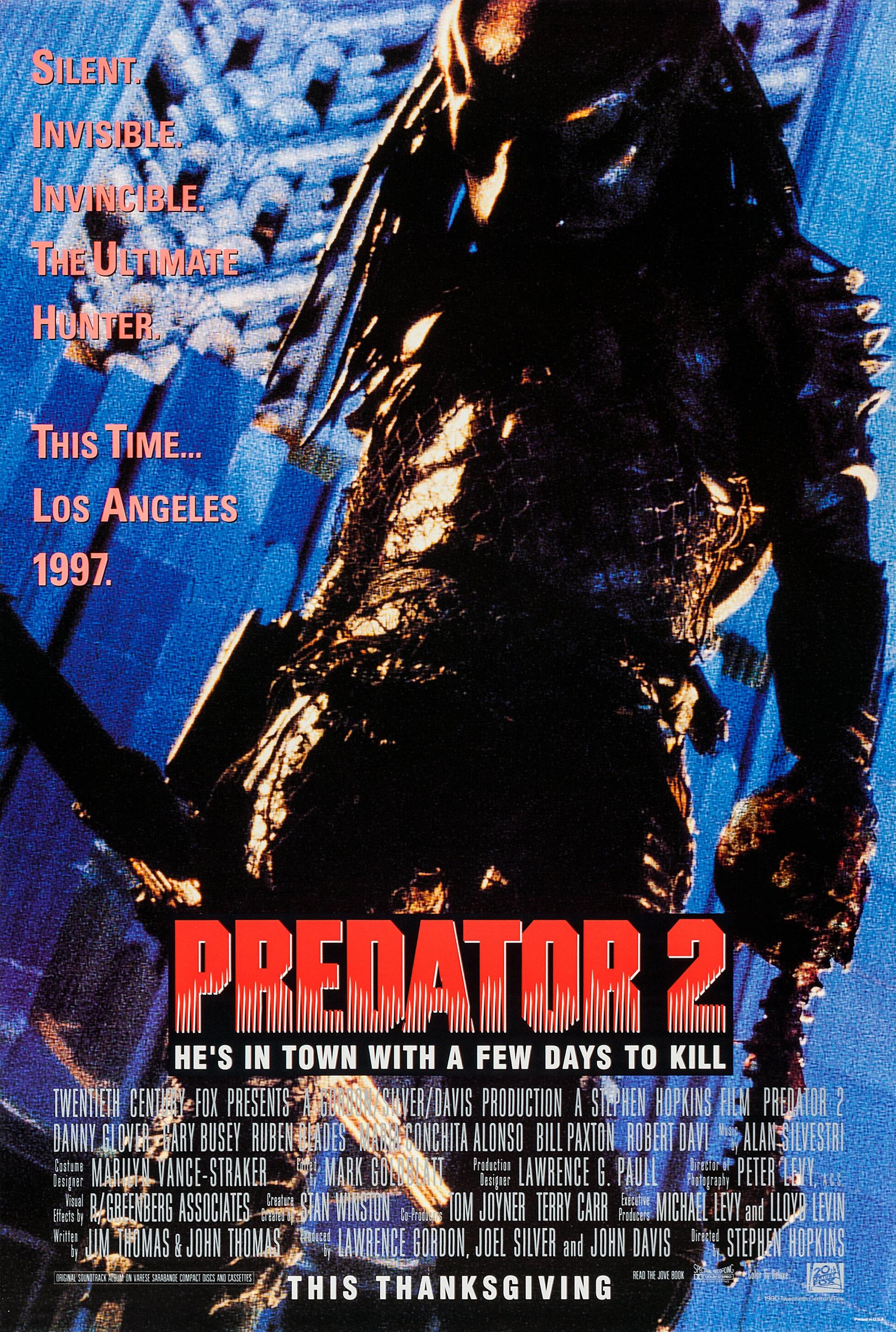
The official 1990 theatrical poster for Predator 2, capturing the movie’s vision of Los Angeles as a violent urban jungle where a deadly alien hunter stalks its prey.
By 1990, Hollywood’s relationship with the home computer industry had changed considerably. Computer games were no longer regarded as an afterthought or a promotional gimmick, but as a valuable marketing asset capable of extending a film’s commercial reach. Publishers were expected to bring major Hollywood properties to home computers with increasingly sophisticated graphics and gameplay, all while working within ever tighter production schedules designed to coincide with a movie’s theatrical release.
The software rights to Predator 2 were ultimately secured by Image Works, the action and arcade publishing label of British company Mirrorsoft. Keen to move beyond the relatively simple side-scrolling templates that had defined many licensed games in the past, Image Works looked for a development team capable of delivering a more sophisticated experience that could capture the gritty atmosphere and tension of the new movie.
Image Works turned to Arc Developments, a small company based in Walsall, England. The company had already established a reputation for producing conversions and ports for major publishers such as Ocean, U.S. Gold, and Activision. The Predator 2 contract came about almost by accident. Arc had been working on another project for Mirrorsoft when it was unexpectedly put on hold. With a team to keep busy and a need for new work, Arc co-founder and graphic artist Paul Walker approached Image Works to see whether any other projects were available. The result was a deal to develop Predator 2 for the Amiga, Atari ST, and IBM PCs.
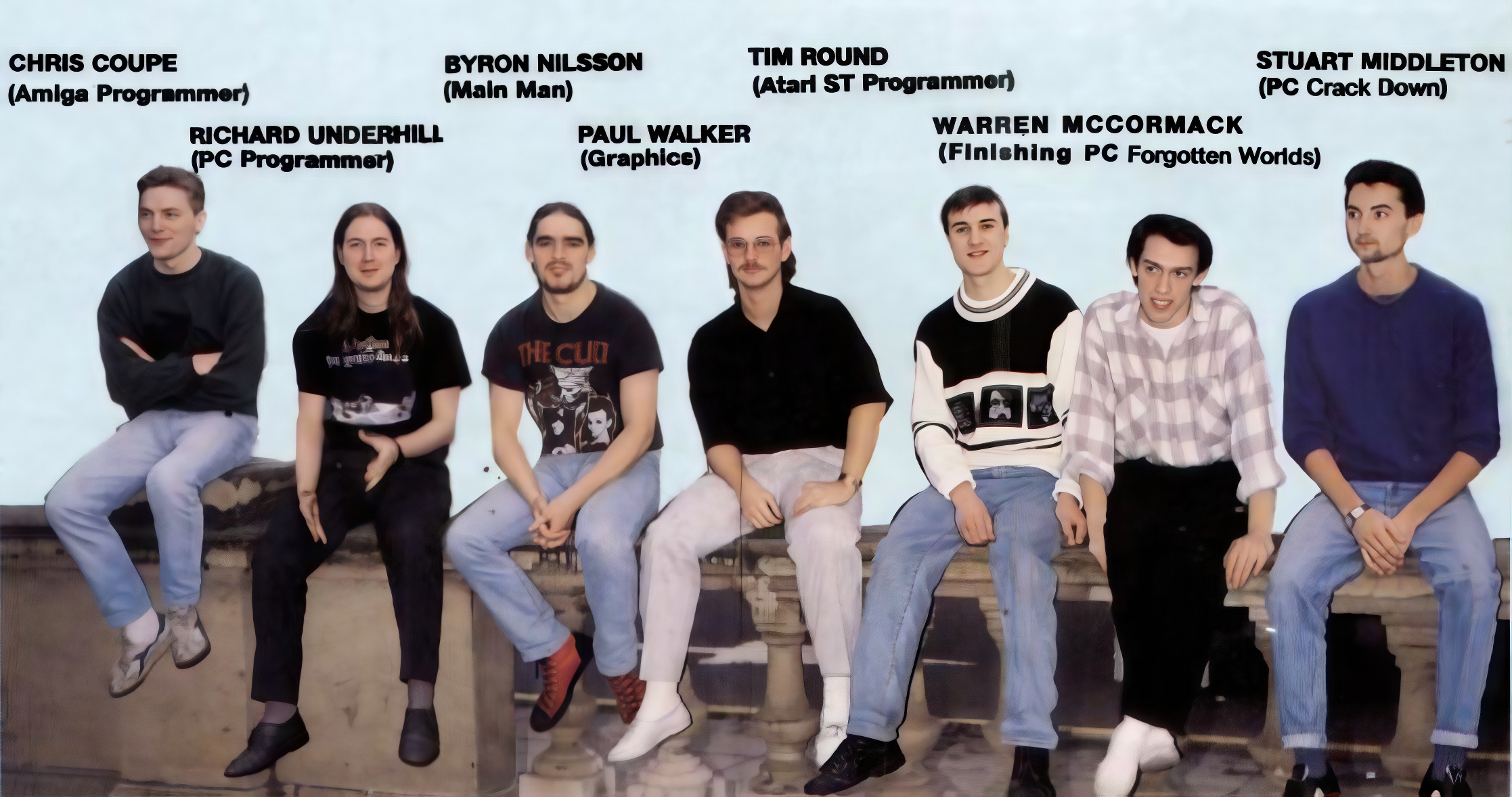
A team photograph of Arc Developments from 1989, with Predator 2 graphics artist Paul Walker as the fourth person from the left.
The company was founded in 1988 by former Elite Systems employees, initially operating out of Walker’s bedroom before growing into an established developer of home computer and console games.
Image from The One, issue 7, April 1989.
Work began in July 1990, with an uncompromising deadline as the game had to be completed by December 1 that same year. Leaving the team with barely five months to turn a major Hollywood licence into a finished commercial product.
Walker took charge of the game’s design and graphics, working alongside programmer Julian Scott, a newcomer to Arc who was responsible for the Amiga and Atari ST versions. Recognising that the workload was too demanding for a single artist, Arc brought in veteran graphics artist Jon Harrison, who had previously worked for rival developers Elite and Gremlin Graphics. Harrison helped divide the considerable artistic workload, while the external development team Oxford Mobius handled the parallel programming effort for the PC version.
The team looked to Taito‘s arcade hit Operation Wolf for inspiration. Its combination of fast-paced shooting, advancing enemies, and on-screen action provided a natural blueprint for a game based on Predator 2’s relentless urban warfare. To help Arc capture the atmosphere of the movie, the developers were given a rough-cut VHS copy approximately six months before its theatrical debut. It offered an early glimpse of the world they were being asked to recreate, giving the team a reference point for the characters, environments, and visual tone of the finished film.
But translating the violence of Predator 2 into a computer game proved more complicated than simply recreating the action on screen. Despite the film’s R-rated classification and brutal subject matter, 20th Century Fox wanted the game to appeal to a younger audience. This presented Arc with somewhat of an awkward dilemma. They needed to capture the essence of a franchise built around over-the-top vicious action while adhering to the studio’s strict content restrictions. Fox insisted on approving all the game’s graphics and prohibited depictions of blood and death, restrictions that would force the developers to find creative ways of toning down the violence without sacrificing the action. Walker later described the restrictions as extremely difficult to work around, recalling that Fox effectively treated the game as a children’s product.
The solution was to tone down much of the violence without abandoning the basic structure of the gameplay. When gang members were hit, they simply fell backwards and disappeared from the screen. Even the player’s defeat was handled in a similarly sanitised fashion. If Harrigan’s energy was depleted, the character did not die, but instead, an ambulance appeared to indicate that he had been injured. It was a compromise that allowed the game to retain its action-oriented mechanics while satisfying the demands of the movie’s copyright holders.
The licensing restrictions extended beyond the game’s violence. Using the likenesses of the film’s actors required approval from their respective representatives, adding another layer of administration to an already demanding production. According to Walker, the team soon learned that some actors were more protective of their digital likenesses than others.
In the finished game, however, Lieutenant Harrigan bears little resemblance to Glover. Rather than attempting to recreate the actor’s appearance in detail, Arc represented the protagonist as a simple silhouette. The approach avoided the additional expense of licensing Glover’s likeness while allowing players to see the action and scenery behind Harrigan’s figure. With the December deadline approaching, such practical considerations were an important part of getting the game finished on time.
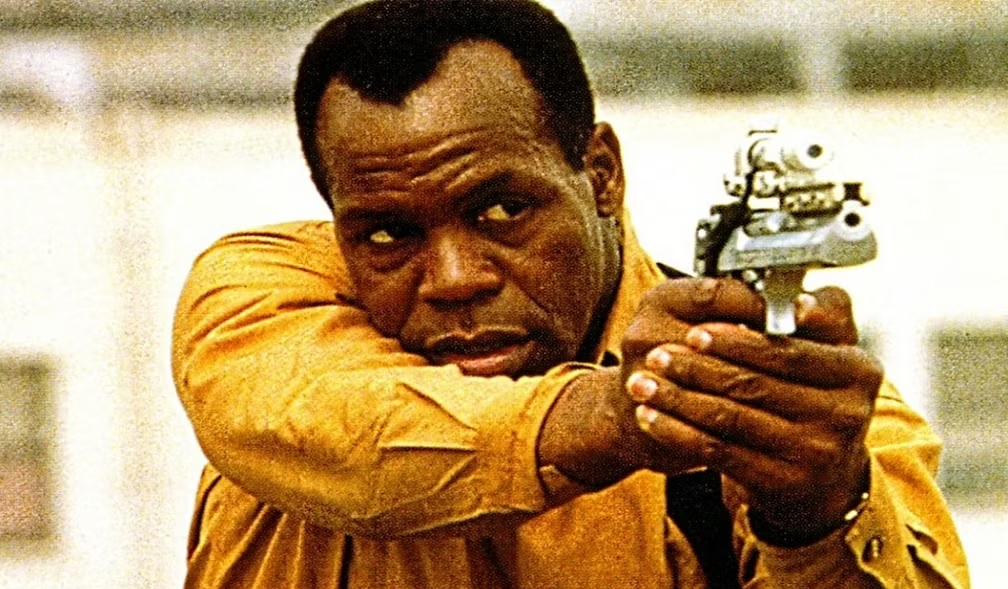
Danny Glover, who had earned widespread recognition in the 1987 blockbuster hit Lethal Weapon, stars as Lieutenant Mike Harrigan, a tough, streetwise LAPD officer who finds himself facing a very different kind of adversary in Predator 2.
Behind the scenes, the project also reflected the changing role of PC hardware in game development. Rather than relying entirely on the individual target machines for their artwork, Walker created the game’s graphics on a Compaq 386 Deskpro running Windows 3.0 and the MS-DOS version of Deluxe Paint II Enhanced. The setup allowed him to take advantage of the emerging Windows environment to organise his work and manage graphics for different versions of the game.
Working from a common PC-based environment also made it easier to transfer data between the developers. Graphics and other assets could be exchanged using serial cables or floppy disks before being incorporated into the relevant versions of the game. For a small company working across three platforms under a punishing deadline, such practical efficiencies were valuable.
As development was underway, the challenge was getting the game into shops around the world. Producing a licensed game was only part of the equation. Manufacturing, marketing, and distribution all required established commercial partners, particularly when the property in question belonged to a major Hollywood studio.
In Europe, the game was released under the Image Works label, which Mirrorsoft had established to distinguish its action-oriented titles, arcade conversions, and cinematic licences from its broader catalogue of educational software and strategy games. Owned by British media mogul Robert Maxwell, Mirrorsoft was seeking to capitalise on the growing commercial appeal of licensed entertainment properties.
While Image Works had the European publishing operation in place, reaching American retailers required access to an established domestic distribution network. For that, the company turned to Konami, the Japanese arcade and console giant whose North American operation had become a major force in the games industry.
The relationship between Mirrorsoft and Konami was already well established. Earlier in 1990, Mirrorsoft had secured the European computer publishing rights for Konami’s hugely successful arcade hit Teenage Mutant Hero Turtles, releasing conversions across a range of 8-bit and 16-bit home systems. The arrangement proved commercially successful and demonstrated that the two companies could work together to bring major arcade properties to European computer audiences.
The Predator 2 deal extended the relationship in the opposite direction, allowing Image Works to benefit from Konami’s established North American distribution network. Both companies could exploit their regional strengths without having to build entirely new retail channels from scratch.
The arrangement also highlighted the differences between the two markets. In the United Kingdom and much of Europe, home computers such as the Amiga and Atari ST occupied a significant position in the games market, providing Image Works with a natural audience for the conversion. In North America, dedicated consoles played a much more prominent role, requiring a different approach to marketing and distribution. Even with a recognisable Hollywood property behind it, a home computer game faced a different commercial landscape on the other side of the Atlantic.
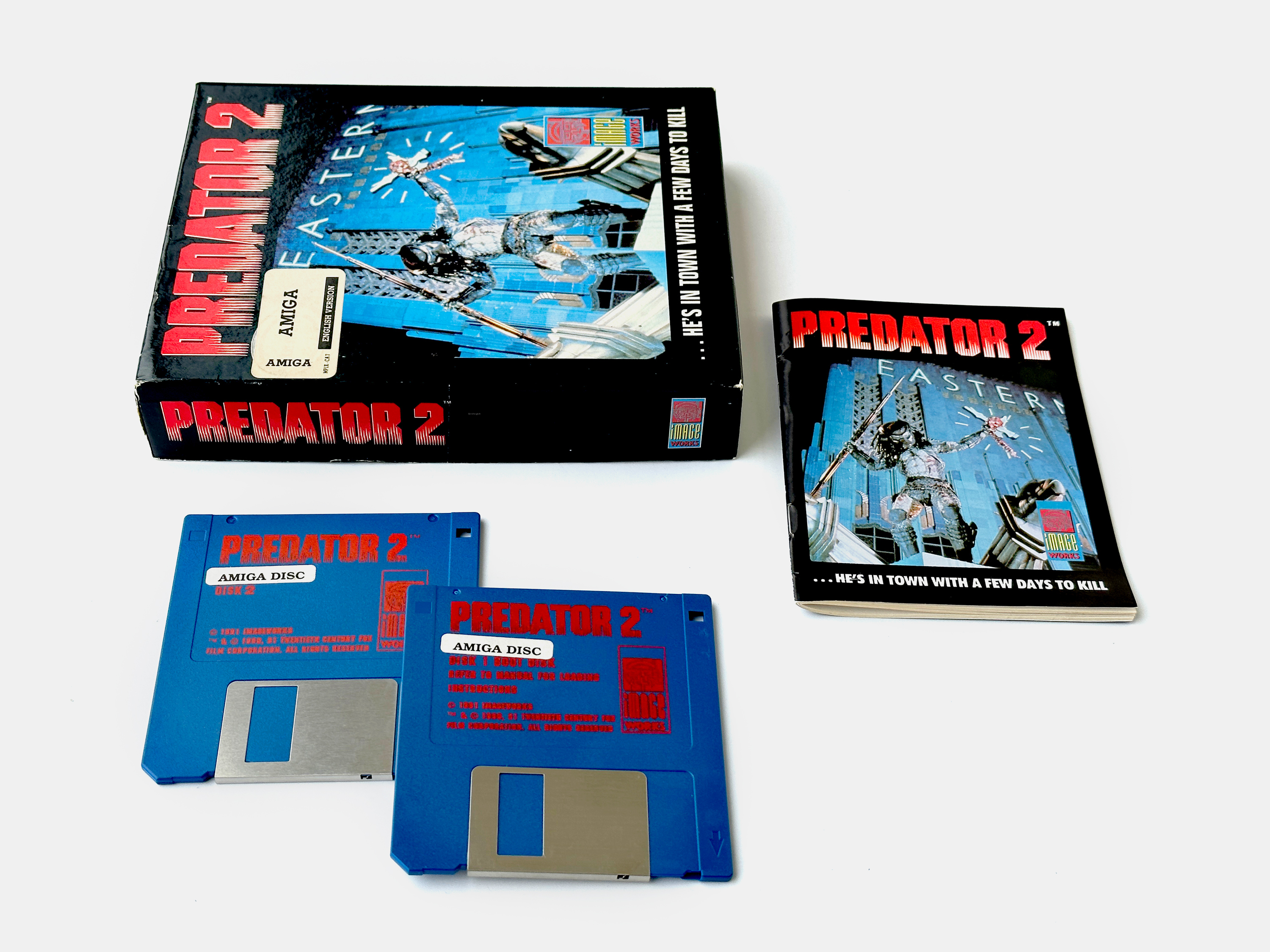
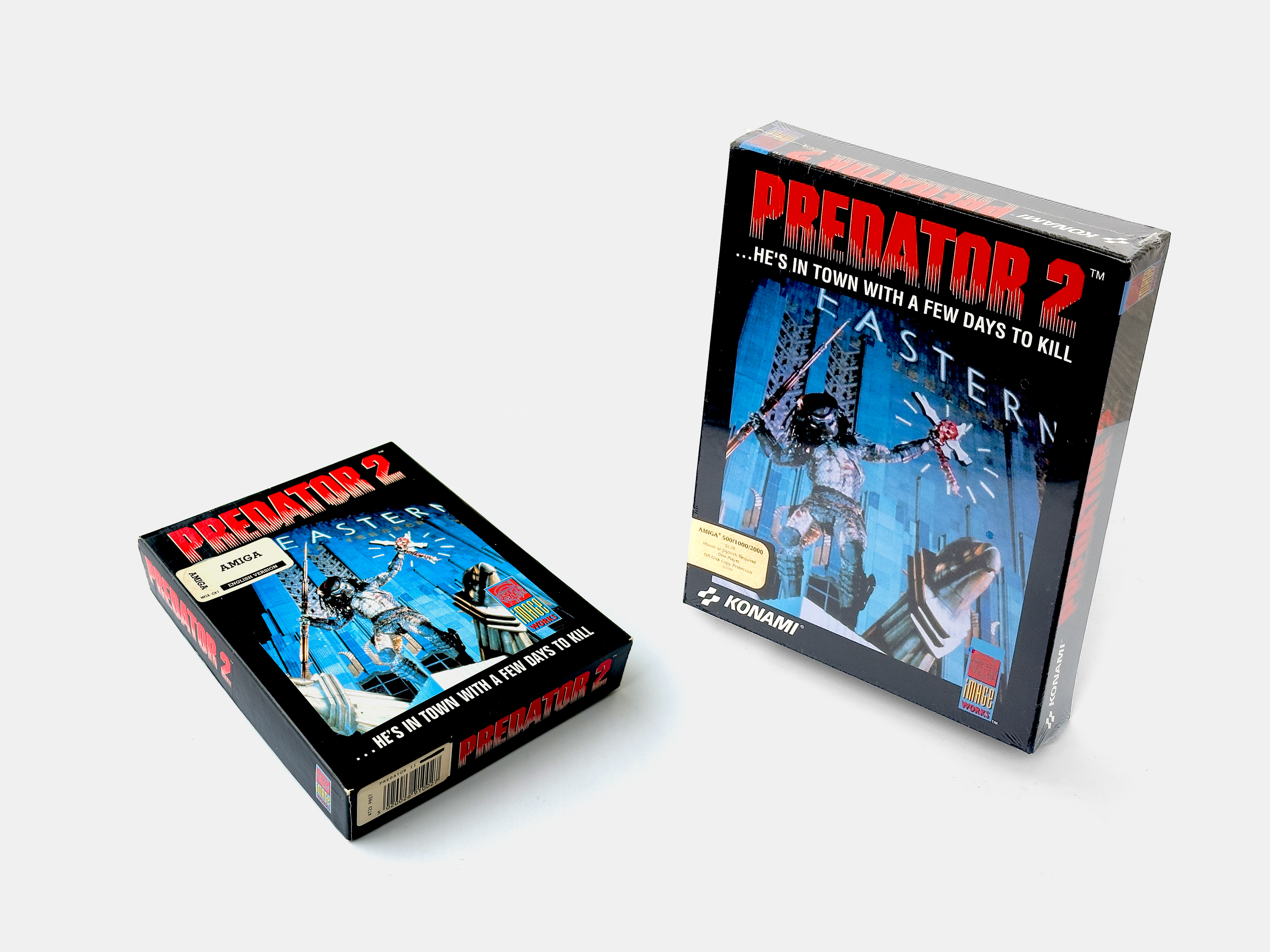
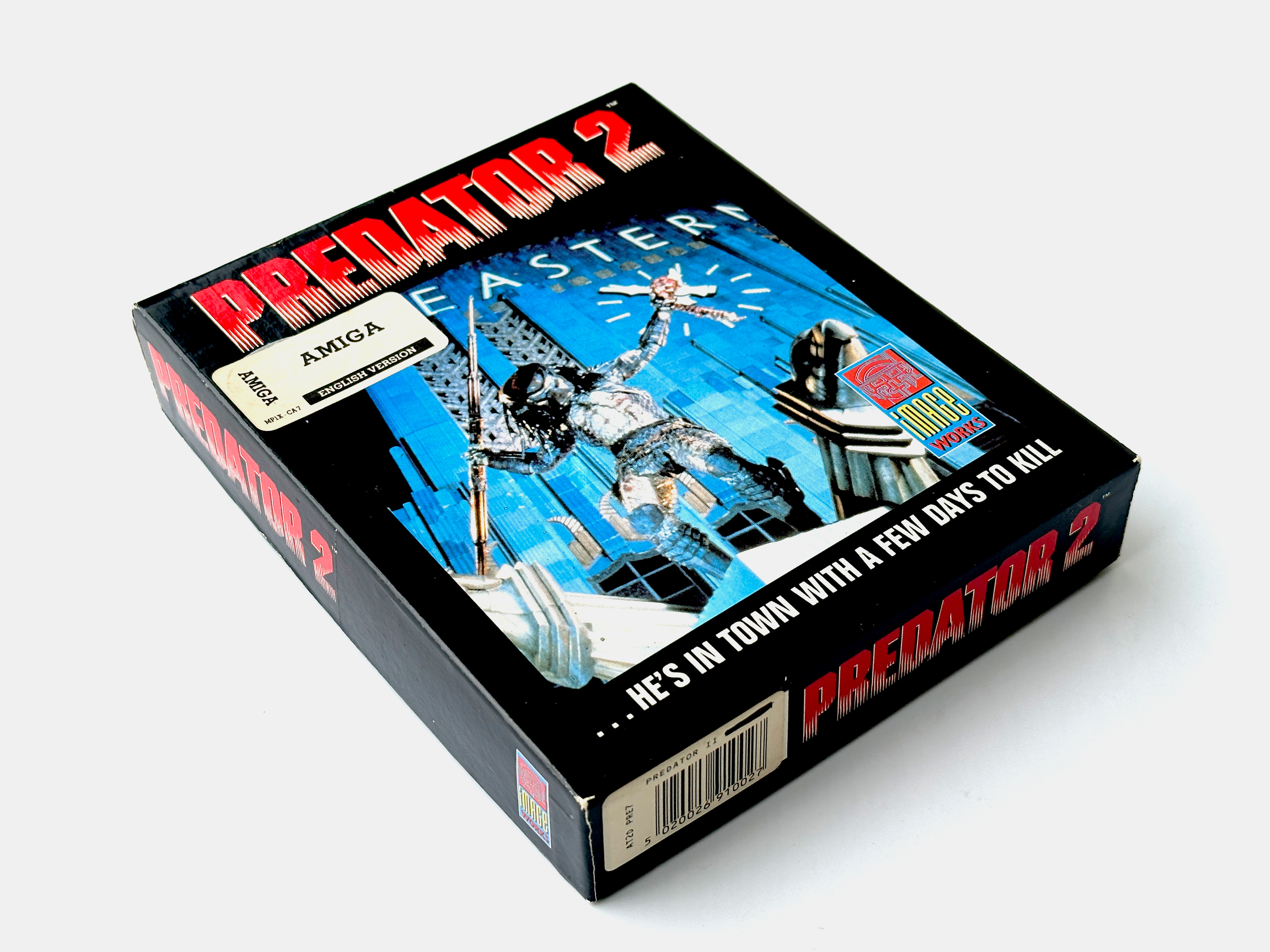
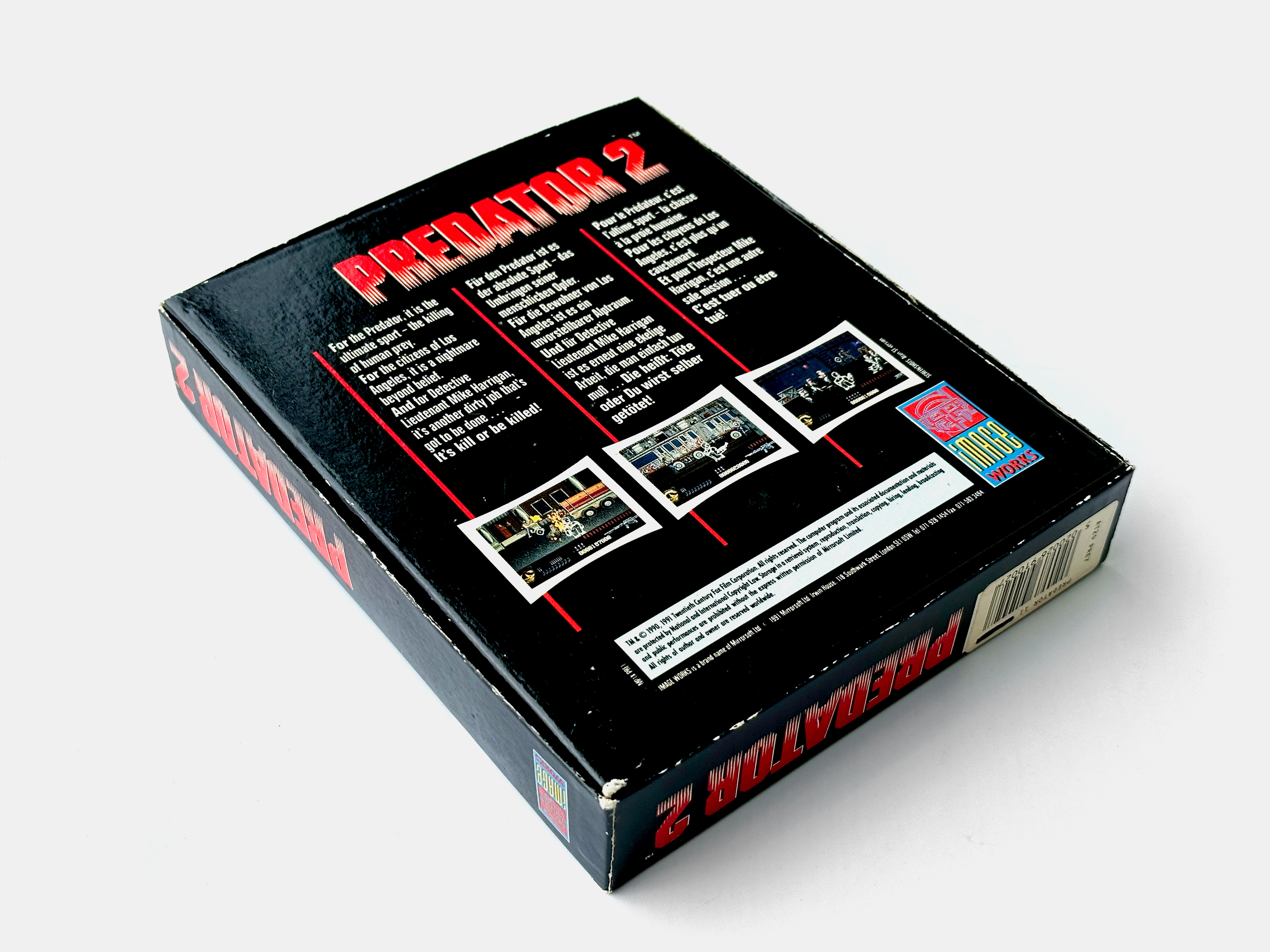
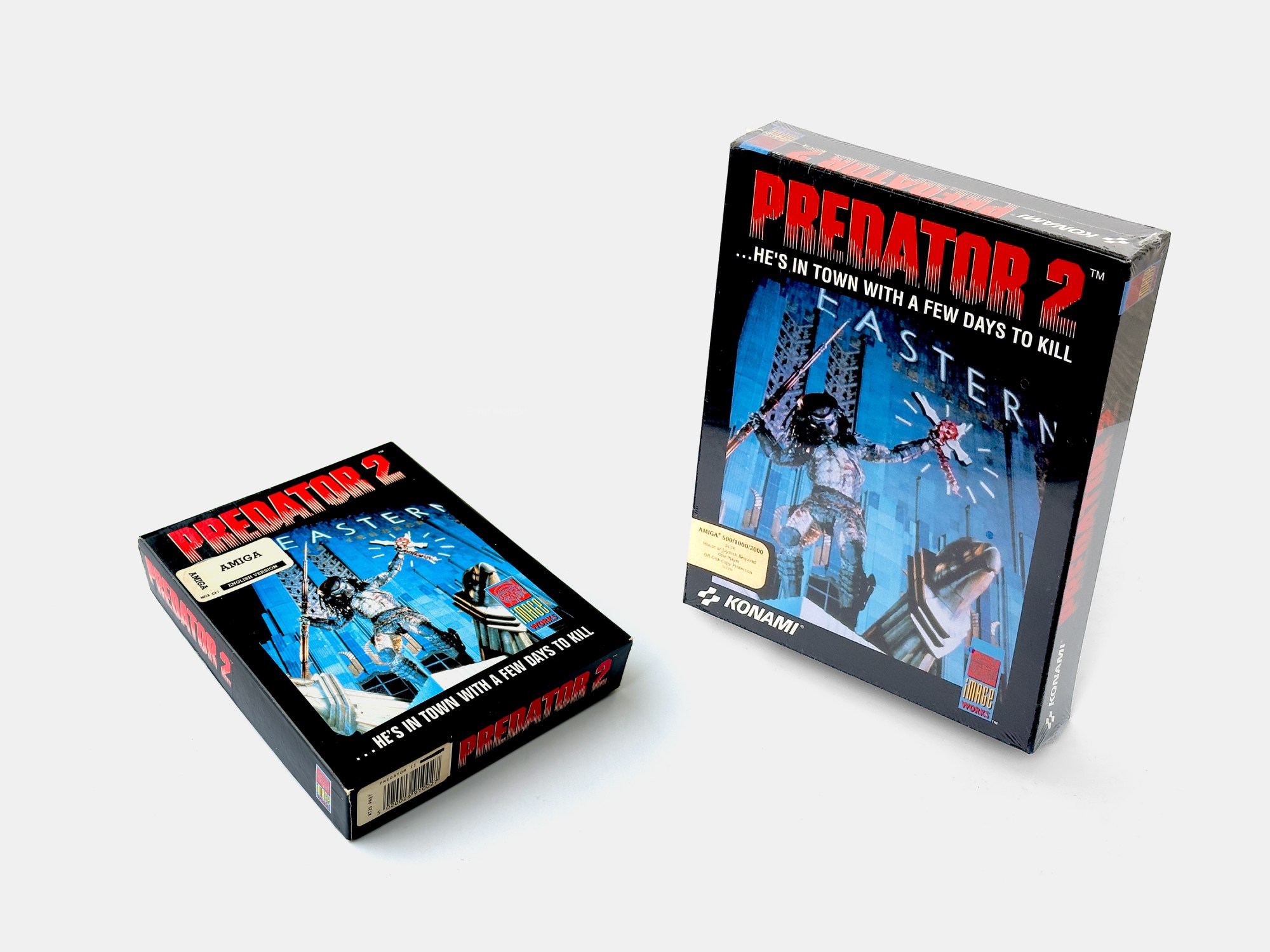
Image Works, the publishing label of British company Mirrorsoft, released Predator in the spring of 1991 in the United Kingdom and Europe.
The home computer adaptation brought the Hollywood action thriller to a range of popular systems, including the Commodore Amiga, Atari ST, and IBM-compatible PCs.
With its recognisable movie licence and promise of fast-paced urban combat, the game was part of a growing wave of Hollywood properties making the leap from the silver screen to the home computer.
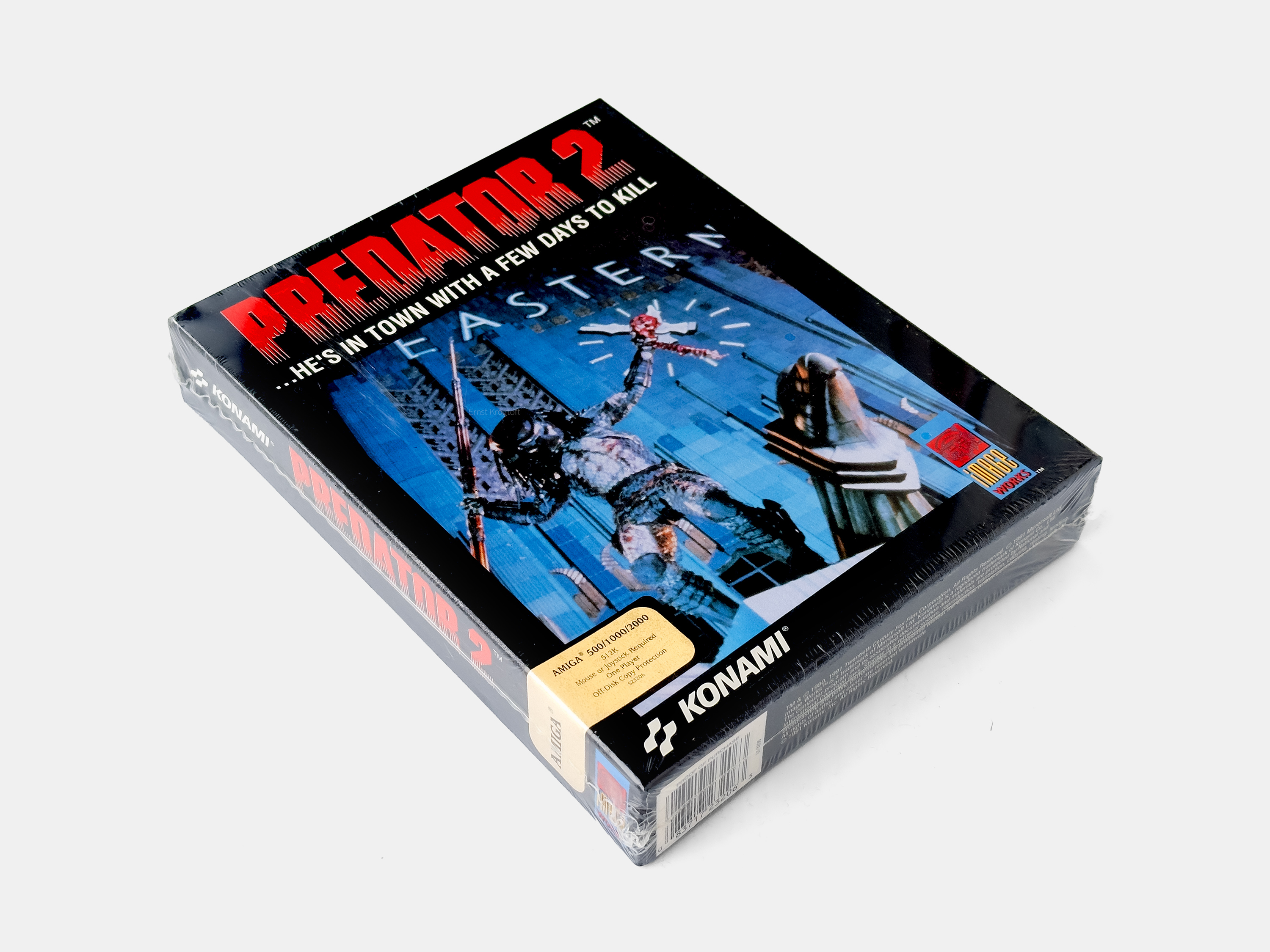
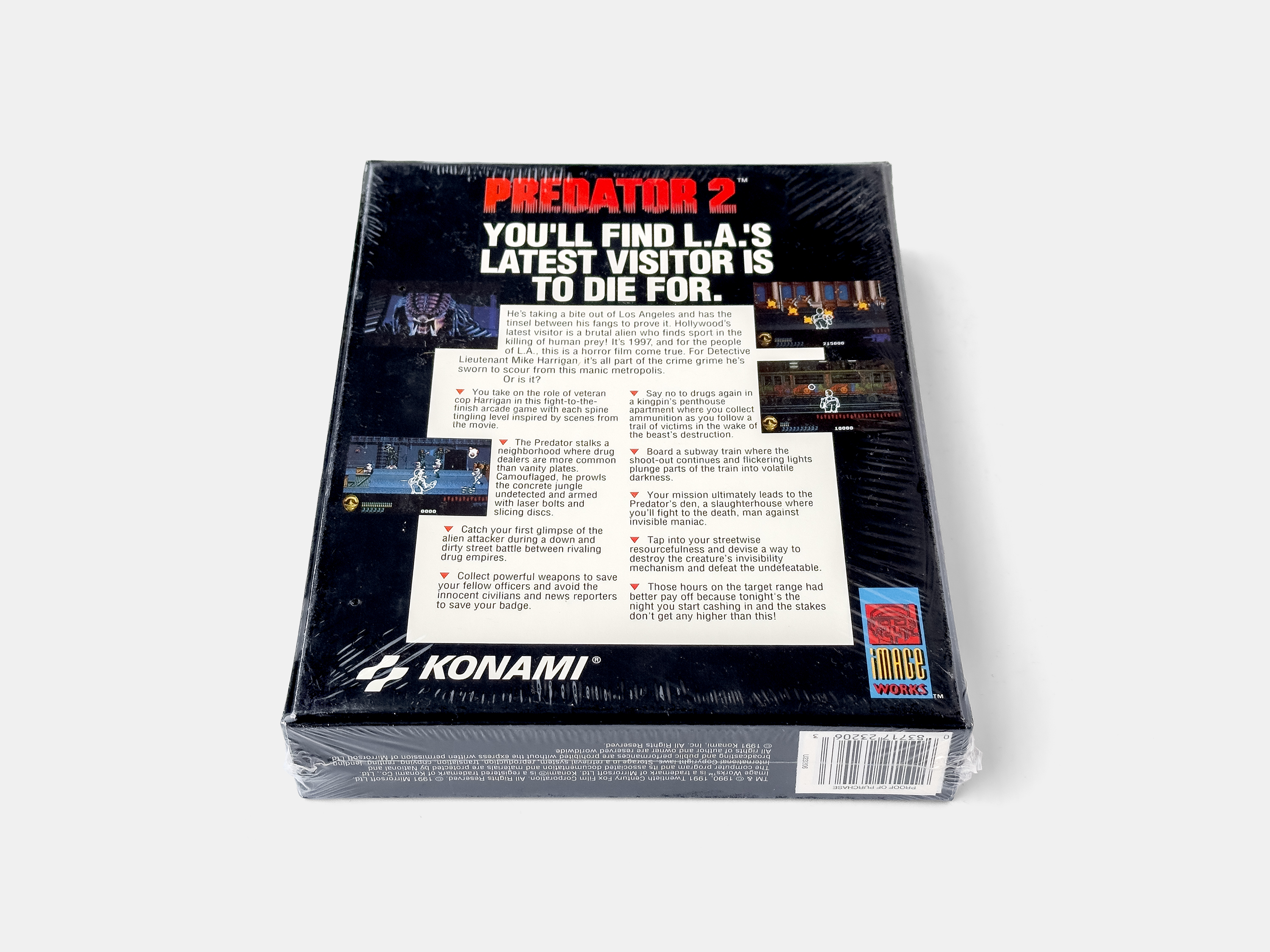
Japanese games publisher Konami handled the release of Predator 2 in North America, drawing on its established and growing distribution network.
The arrangement extended the partnership between Konami and Mirrorsoft, allowing Image Works to reach beyond its traditional European market.
Predator 2 was a first-person rail shooter in which players aimed a crosshair at enemies as the action scrolled automatically across the screen. Image Works had originally requested five levels, but developer Paul Walker compromised by creating four, making the opening level roughly twice as long as the others. Reflecting the movie’s gradual build-up, the Predator remained largely in the background during the first three levels as Harrigan battled the city’s drug cartels. However, stray shots hitting the cloaked alien could provoke a deadly retaliation with its disc, shoulder-mounted cannon, or net gun.
Arc Developments also introduced civilians, including a news reporter trying to interview Harrigan and a Japanese camera crew wandering into the crossfire. Shooting bystanders reduced Harrigan’s police badge meter, which could not be replenished; if it reached zero, he was fired and the game ended. As with many computer games of the period, players also had to choose between music and sound effects, rather than having both play simultaneously.
When Predator 2 finally reached players, the critical response was mixed. The Amiga version received praise from some quarters for its detailed arcade-like graphics and atmospheric presentation. Across reviews, one recurring criticism was the absence of a save-game or password system. With no convenient way to resume progress, players were forced to tackle the game’s steep difficulty curve in a single sitting, making an already demanding experience considerably more frustrating.
Despite the efforts to tone down its violence, Predator 2 encountered further obstacles in Germany. On October 8, 1991, the country’s Federal Department for Media Harmful to Young Persons (Bundesprüfstelle für jugendgefährdende Schriften) ordered the Amiga version to be placed on its Index of Media Harmful to Young Persons, with the decision published later that month. The authorities were less concerned with the absence of blood than with the underlying gameplay, in which shooting and killing recognisably human opponents was central to the experience. They also criticised the lack of peaceful alternatives, such as arresting suspects, and argued that the graphics and sound created a convincing impression of real combat. The listing restricted the game’s sale to minors and its advertising in Germany, presenting another obstacle for Image Works in an important European market.
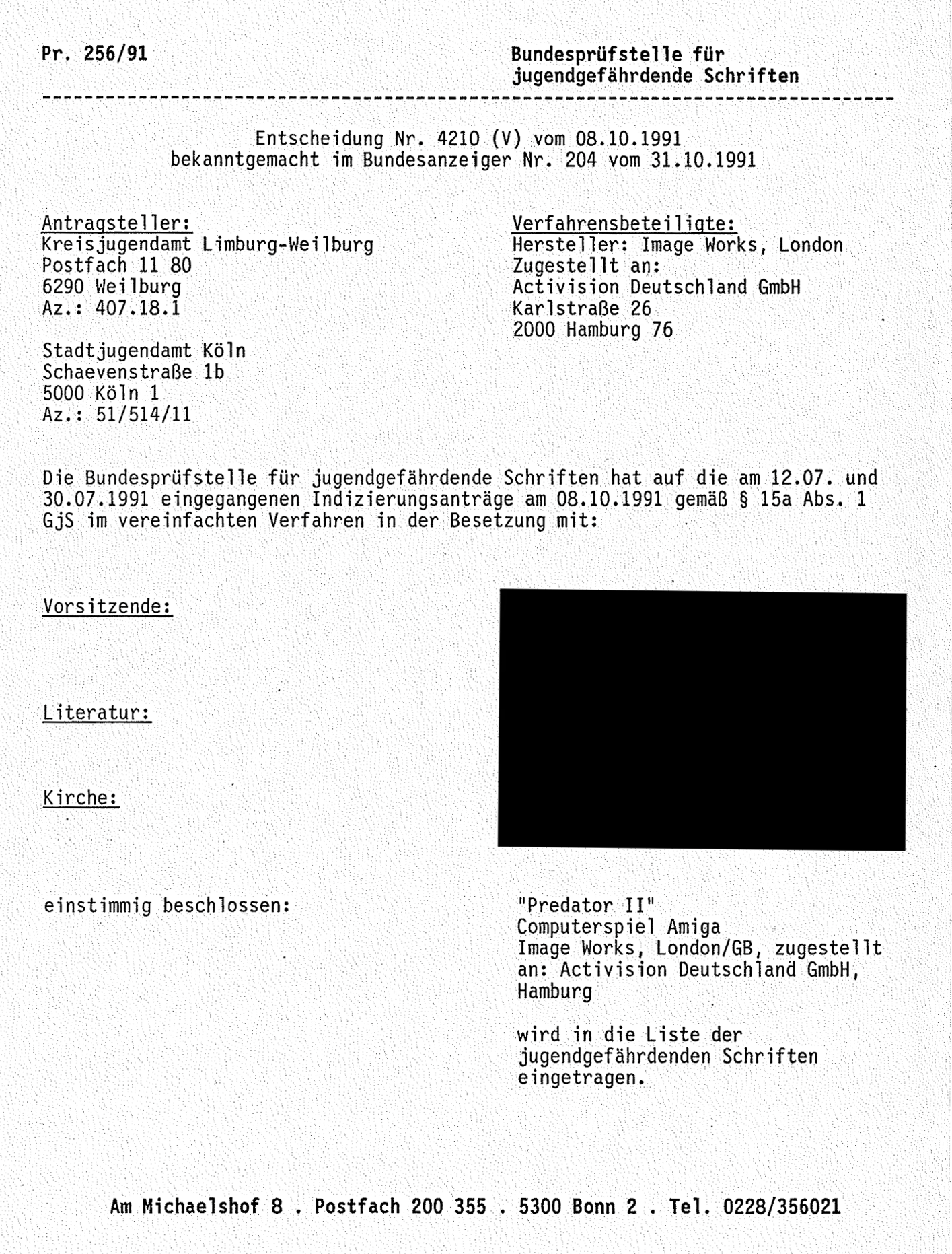
The first page of the German Federal Review Board’s decision to place Predator II on the index of media considered harmful to minors, dated 8 October 1991. The ruling, published later that month, argued that the game’s depiction of a police officer systematically killing human opponents made it unsuitable for young players.
Arc Developments continued working on home-computer conversions and licensed games throughout the 1990s, gradually moving into newer hardware as the industry shifted towards 32-bit consoles. In 1996, the Walsall-based studio invested heavily in the next generation, purchasing Silicon Graphics workstations and establishing a motion-capture studio in Telford. Despite these ambitions, the company went into liquidation in January 1998.
Image Works, meanwhile, disappeared for reasons largely beyond the games it published. Established as the games label of British publisher Mirrorsoft in 1988, it had built a catalogue that reached well beyond film tie-ins. The label was closely associated with The Bitmap Brothers, publishing games such as Speedball and Xenon 2: Megablast, alongside titles including Cadaver, Back to the Future Part II and Teenage Mutant Hero Turtles. Predator 2 was one part of a much broader portfolio that mixed original games, arcade conversions and adaptations of popular film and television properties
The turning point came in November 1991, when Mirrorsoft’s owner, Robert Maxwell, died. His business empire soon unravelled, and the resulting financial crisis led to Mirrorsoft’s closure in 1992. Its assets were sold off, with several acquired by American publisher Acclaim Entertainment. Image Works vanished along with its parent company, bringing an end to a label that had helped bring some of the era’s most recognisable home-computer games to European players.
For Arc Developments, Predator 2 was one of many projects in a career that spanned the transition from 8-bit home computers to more powerful machines and consoles. For Image Works, it remains a snapshot of a particular moment in British games publishing, when Hollywood licences, arcade conversions and original productions shared shelf space in a rapidly changing market.
Sources: The One Magazine, Computer Gaming World, Wikipedia, IMDb, Time Extension, Gears of Games’ interview with Paul Walker, Bundesanzeiger, RetroGamer Magazine…