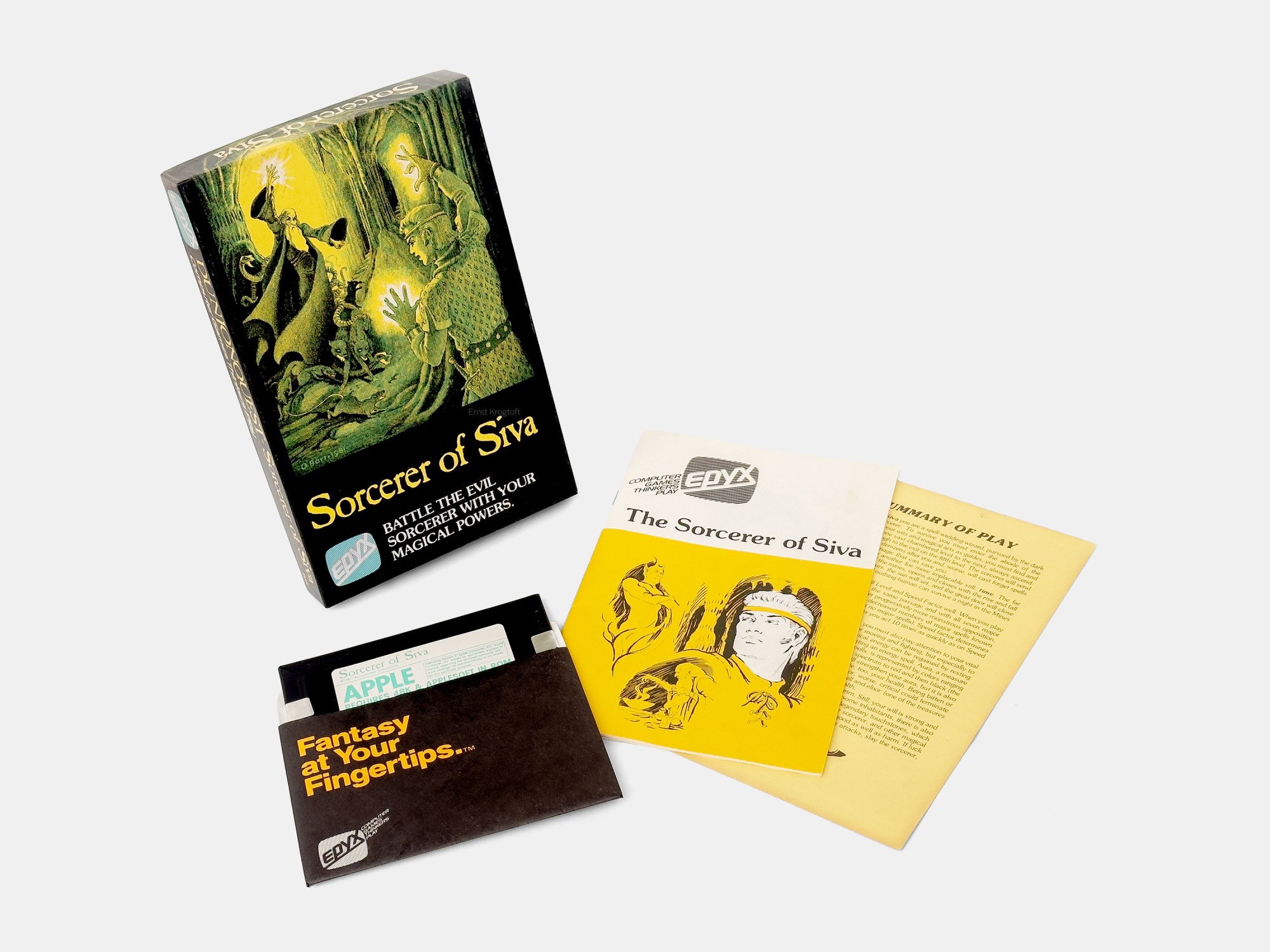
By 1981, changes were on their way inside the Mountain View, California, offices of Automated Simulations. The company, which would soon abandon its nerdy, academic name for the slicker, more commercial branding of Epyx, found itself trapped in a bitter, corporate stand-off. For the previous two years, its legendary Dunjonquest series, anchored by the massive commercial success of its 1979 flagship title, Temple of Apshai, had served as the undisputed gold standard for dungeon crawl role-playing games on early home computers. Co-founders Jim Connelley and Jon Freeman had successfully miniaturized the complex mechanics of Dungeons & Dragons into something that could run reliably inside a modest household machine.
But as the industry entered the new decade, the early hacker summer-camp charm was rapidly wearing off, replaced by a cutthroat era of commercial competition. Sleek, advanced competitors like Ultima and Wizardry were about to burst onto the scene, utilizing fast machine code to render worlds that made Automated Simulations look dangerously obsolete.
The reality became an invisible battle line dividing the company, with Freeman looking out at a landscape where competitor titles were evolving overnight, all while Connelley stubbornly protected his slow, rigid, and already antiquated Dunjonquest engine, utterly refusing to entertain a major update or rewrite.
As the internal arguments increasingly grew, the company’s actual audience was slowly checking out. Players were growing weary of guiding the same faceless warriors through endless, identical corridors. Yet, with Connelley digging in his heels, management was stuck in a bind. Desperate to keep the franchise breathing and the cash flowing while the future could be ironed out, they went looking for an original title that could eke out one final deployment of their foundational engine before, in Freeman’s mind, closing the book on it for good.
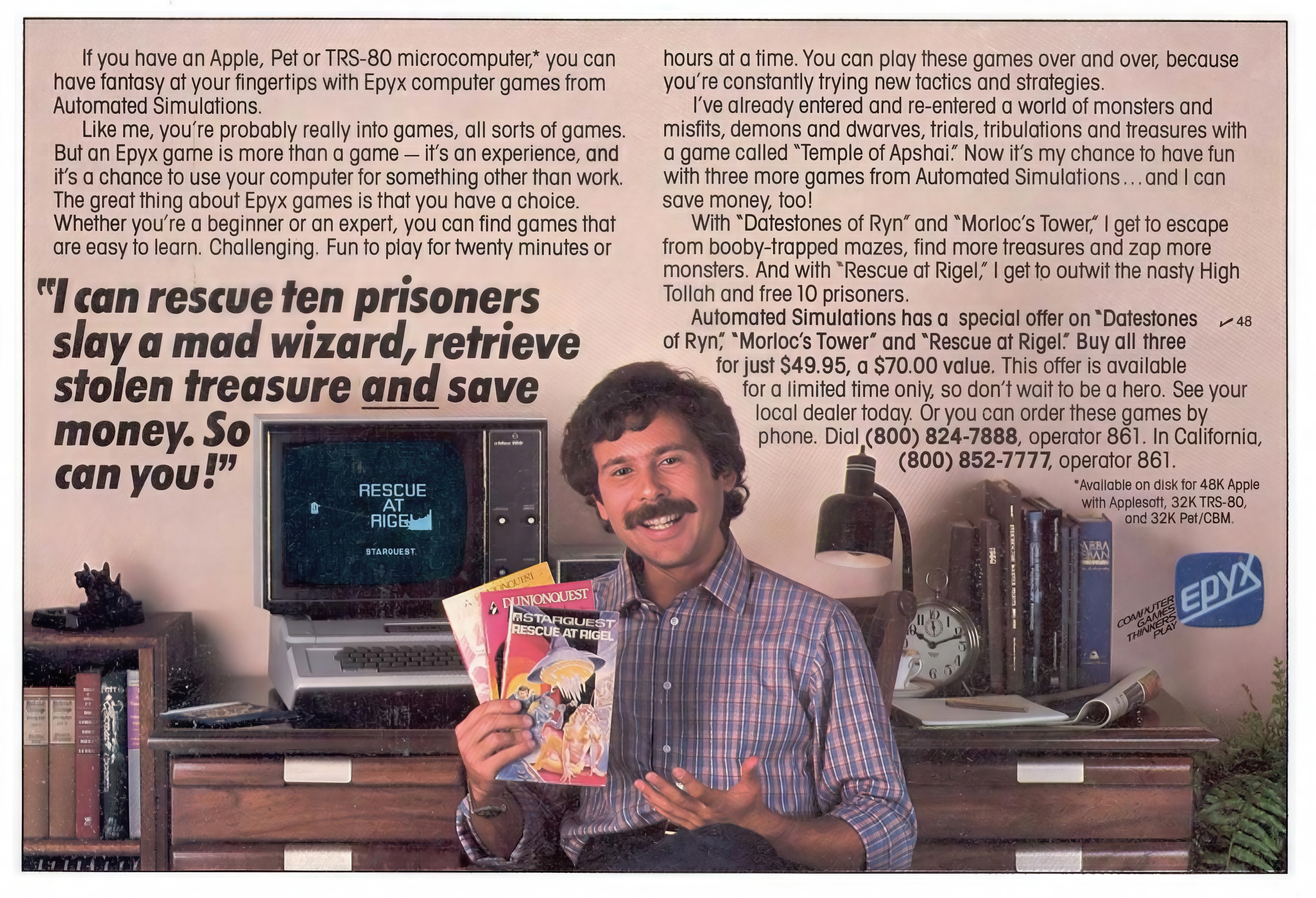
Automated Simulations, advertising in 1981 for its only two Microquest titles, Morloc’s Tower and Datestones of Ryn, alongside the StarQuest title Rescue at Rigel—all built on Jim Connelley’s Dunjonquest engine.
Image from The Dot Eaters.
Gene Rice, a quiet but highly capable programmer who had operated largely behind the scenes, got his chance. Unlike the high-profile founders, Rice belonged to the early wave of dedicated, late-night playtesters who spent their evenings breaking code and hunting bugs before earning their way into the designer’s chair. He knew exactly where Connelley’s boundaries lay because he had spent the better part of two years bumping into them while logging data and stress-testing the fragile code.
When management handed him the reins for what would become the final original Dunjonquest title, they intended the project to be a brief, minor release, something in the line of the company’s budget-priced “MicroQuest” series, to satisfy lingering fans while the company was working out its heading.
Rice’s creative ambition quickly took over, and the project ballooned. It skipped the short budget line entirely, eventually expanding into a work that spanned six interconnected, fixed levels containing more than 300 tile-based screens. He strayed from the earlier titles, forbidding players from stepping into the boots of a fighter. Instead, players were cast as a weary, physically frail wizard who had been stripped of his memories and herded deep within the perilous, six-level Mines of Siva by the minions of an evil rival sorcerer.
The game was developed on Radio Shack’s TRS-80, the rudimentary machine that served as the primary development platform for Automated Simulations’ early coding staff. Attempting to render an organic, ancient subterranean mine layout on the system, however, was a task that required an immense amount of aesthetic imagination, along with a heavy dose of forgiveness from the player. The machine possessed a notoriously blocky, low-resolution black-and-white display, where the core engine vertically scaled all screen pixels by a factor of two to save precious memory. This left Rice with an effective graphics window of just 48×48 blocks. The system’s strict limitations completely precluded advanced features like saving progress mid-game, forcing players to finish a session in a single sitting and rely on manual, agonizing pen-and-paper mapping.
To ensure the game could somewhat compete against the visually interesting new wave of home computer games, Automated Simulations assigned a team to simultaneously assemble a 48K Apple II disk port. Programmed by Michael Farren with distinct, higher-resolution graphics drawn by artist Toni Thompson, the Apple II version acted as a much-needed aesthetic facelift. While the original TRS-80 version forced players to look at generic, identical shapes for all entities, Thompson introduced uniquely styled graphics for different treasure types, such as healing elixirs, rings, and amulets. For the first time in the history of the series, a player could visually inspect a treasure chest from across and deduce whether fighting through a rapidly respawning horde of up to 19 different monster types was actually worth risking their precious, limited Aura.
As technical hurdles mounted, systems programmer Anne Westfall was brought in to help Rice hardcode the game’s rules and spell interactions. Westfall, who had joined the company and married Freeman in 1980, was a formidable software engineer, but her work on the grueling code placed her directly at the epicenter of the bitter power struggle between her new husband and an unyielding Connelley.
Connelley was not just the co-founder and majority shareholder of Automated Simulations, he was the master architect of its technical foundation. From the company’s inception in his dining room, Connelley’s absolute core philosophy was standardizing the production line. He had purposely designed the Dunjonquest framework in BASIC for maximum portability, specifically so it could run on a one-size-fits-all, lowest-common-denominator machine with at least 16K of memory.
Freeman saw a clunky, archaic system that was actively being surpassed by advanced assembly-language games, while Connelley saw an incredibly cost-effective setup that allowed them to churn out endless new scenarios and expansions without rewriting a single line of baseline source code. When Freeman and Westfall aggressively pushed to completely abandon BASIC and embrace assembly language to exploit the superior capabilities of newer hardware like the Atari 800, Connelley flatly refused. He viewed their demands as a direct threat to his authority and a reckless waste of company resources.
As the autumn of 1981 progressed, the creative partnership was completely shattered. Rather than trying to smooth over the growing divide in the office, Connelley used his corporate leverage to lock down control of the company assets. The dispute quickly devolved into bitter, toxic legal battles over shares, royalties, and the rights to upcoming software titles.
By the time Thanksgiving Day arrived, Connelley had made it entirely clear that Automated Simulations would continue to be run according to his rigid, lowest-common-denominator technical blueprint. He effectively forced the hand of the creative faction. On Thanksgiving Day, 1981, just weeks before Sorcerer of Siva was officially shipped out to store shelves, Freeman and Westfall had finally had enough. They jointly resigned from Automated Simulations, walking out the door together alongside a small camp of supportive design partisans.
Connelley was reportedly unfazed by the sudden holiday exodus. He firmly believed he had won the war. He retained the company name, the lucrative intellectual property rights to Temple of Apshai, and his beloved reusable engine. He immediately turned to available internal staff like Rice to finish ongoing projects, confident that the market would continue to buy whatever the Dunjonquest engine produced.
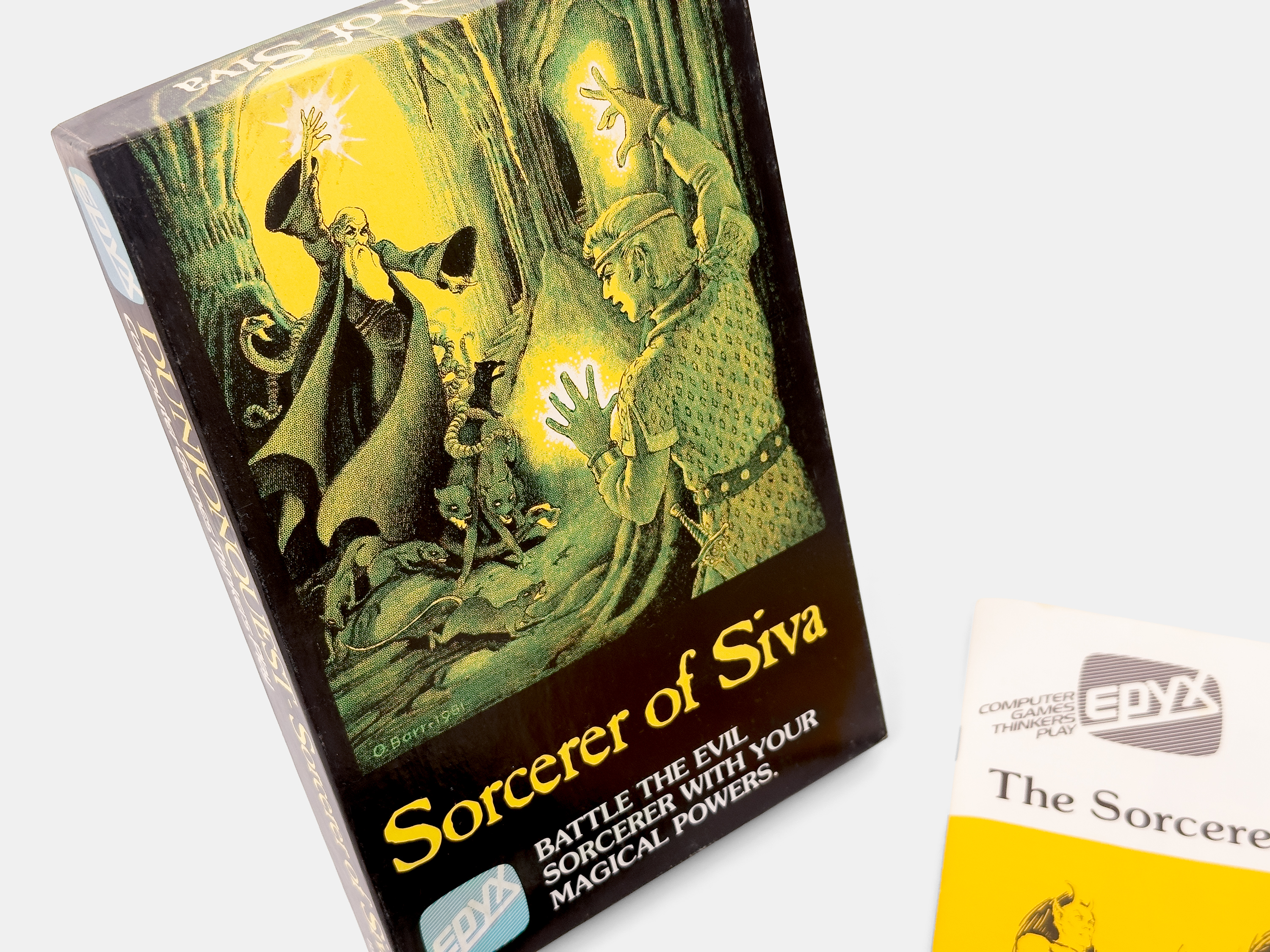
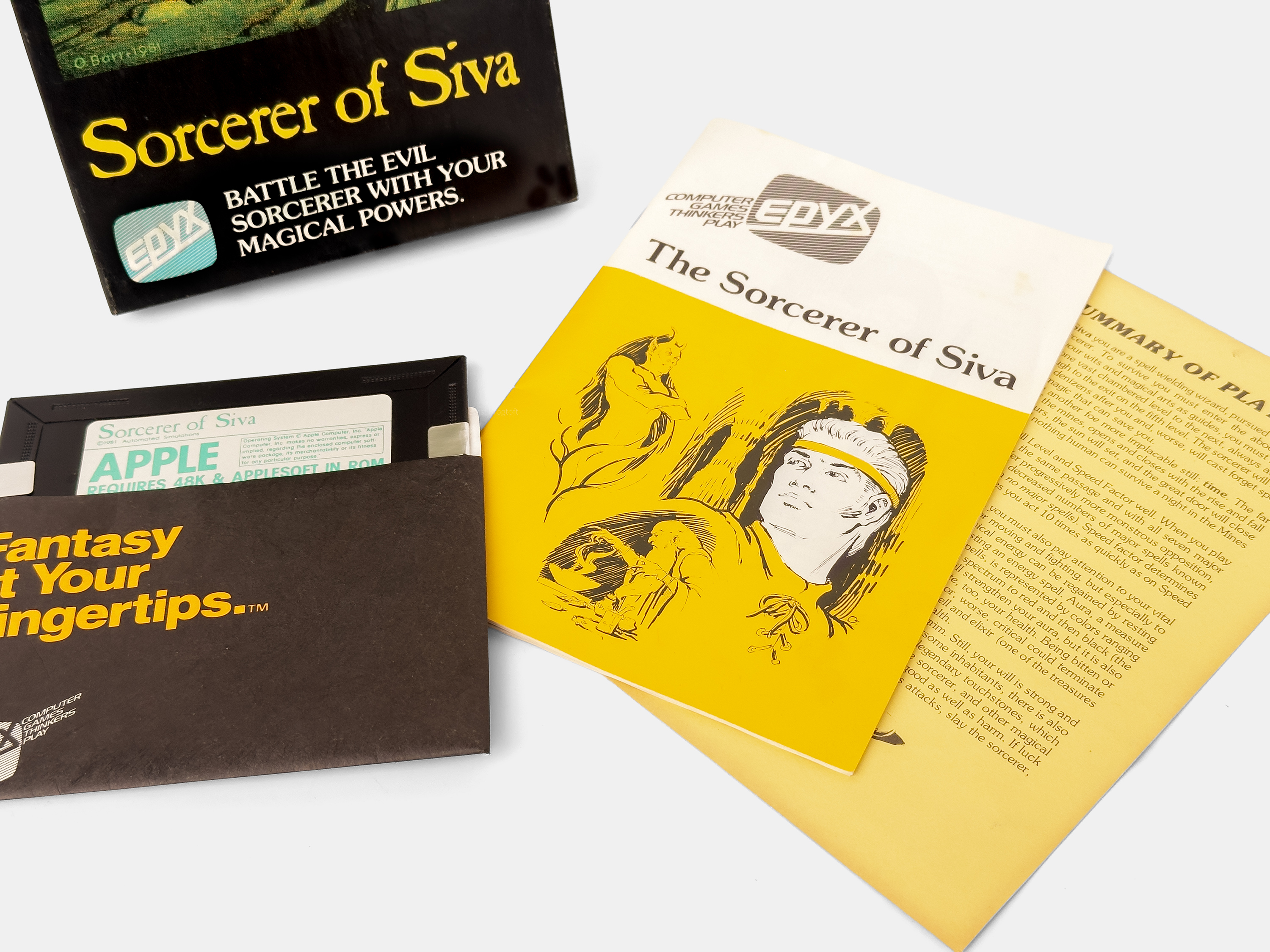
When Sorcerer of Siva hit retail shelves in late 1981, packaged inside a proper, illustrated cardboard retail box featuring cover art by renowned fantasy artist George Barr, it was accompanied by an extensive, narrative-heavy “Book of Lore” manual co-authored by Freeman before his departure.
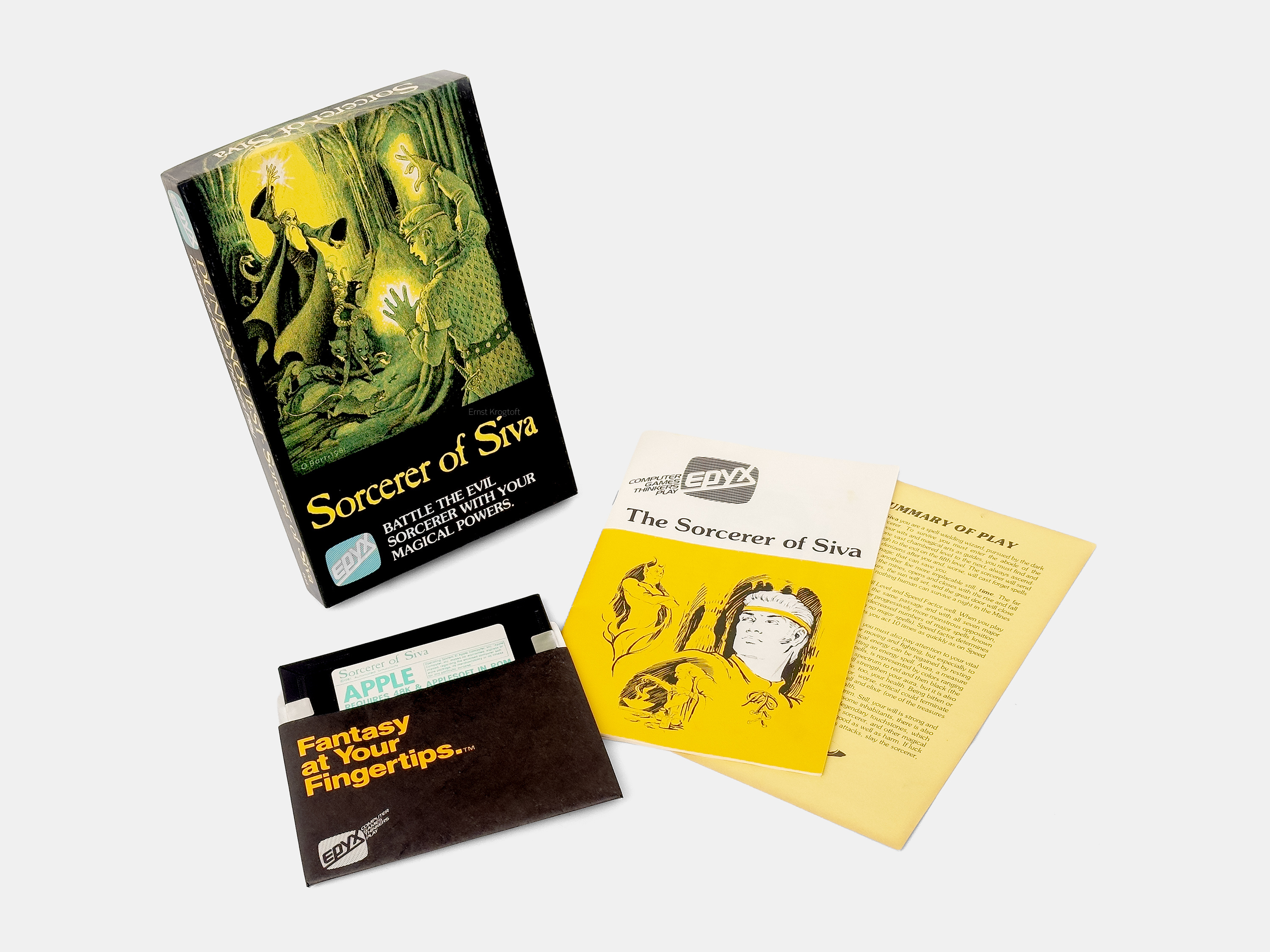
Sorcerer of Siva was published by Automated Simulations / Epyx in late 1981, showcasing cover art by fantasy artist George Barr.
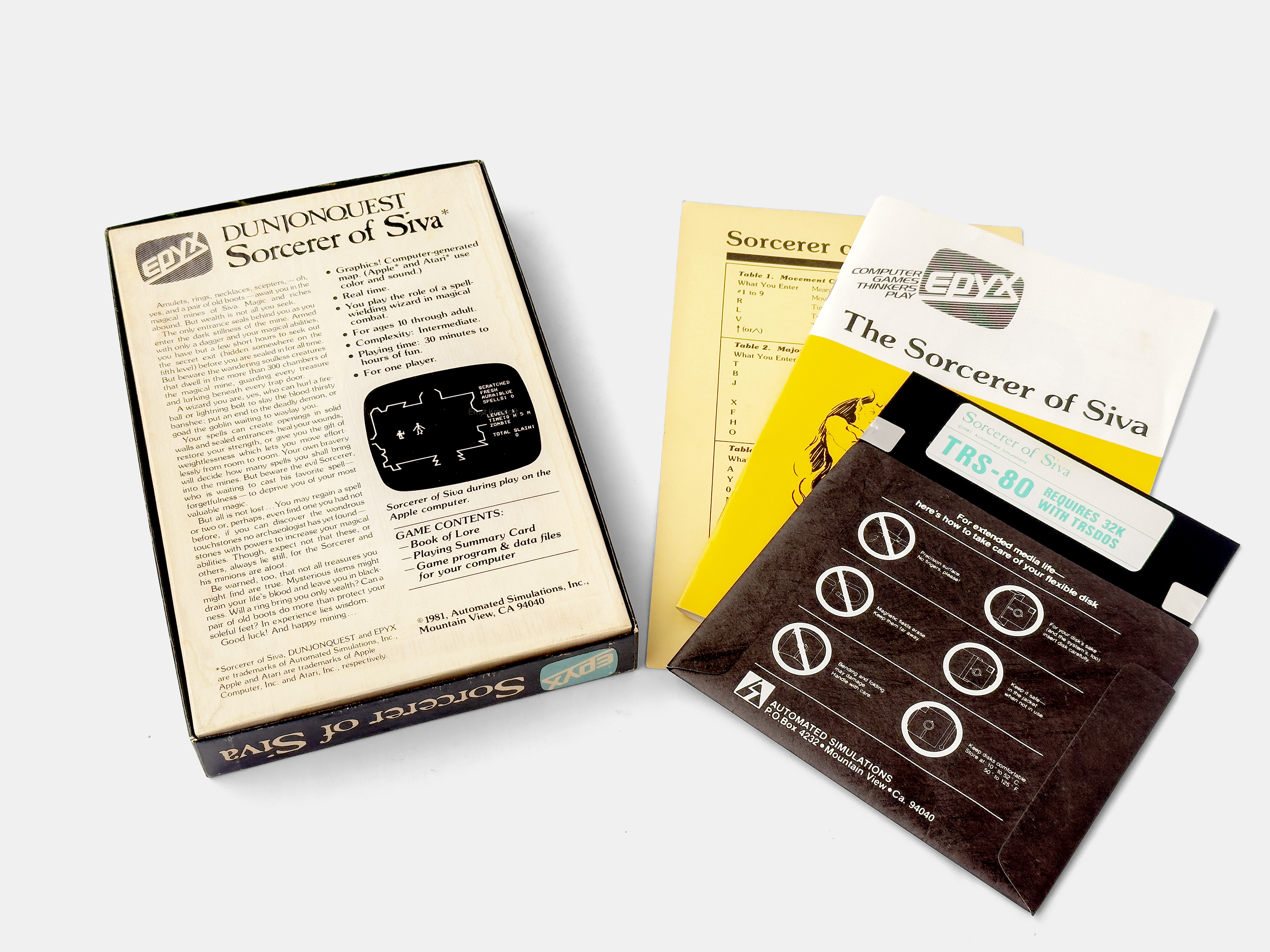
The game was released on cassette for the TRS-80 in both 16K and 32K versions. To optimize production costs, the floppy disk variant pulled double-duty, containing playable versions for both the TRS-80 (32K) and the Apple II (48K) on a single 5.25″ floppy.
Sorcerer of Siva presented home computer users with a notoriously brutal challenge that imposed an uncompromising race against the clock. The mechanics explicitly warned players that the primary exit door of the mines closed permanently at sunset, leaving them with exactly four in-game hours of real-time exploration to ascend through the chambers, locate the cowardly sorcerer, and escape.
Players wielded a specialized repertoire of up to seven major spells, ranging from offensive fireballs and lightning bolts to teleportation and a command specifically designed to locate stairways. Actions like movement and casting depleted your energy, forcing players to monitor status indicators tracking health and fatigue.
Slaying the arch-nemesis wasn’t a matter of simple hacking. His death demanded the tactical preservation and execution of a specific Lightning Bolt spell during the final confrontation.
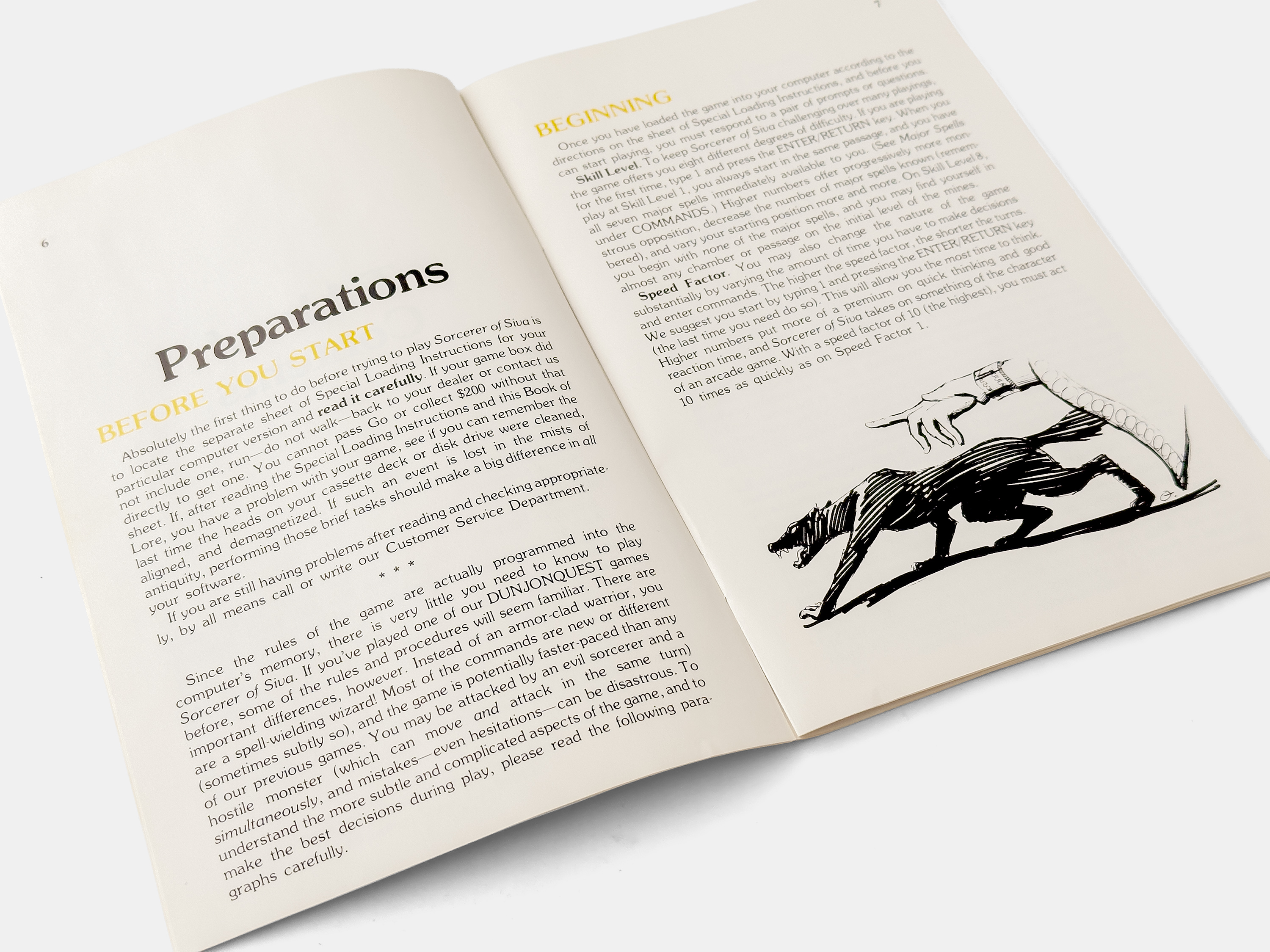
To help players survive, the game supported adjustable difficulty settings, featuring eight skill levels that influenced starting spells, and ten speed factors to strictly limit decision time per turn. Replayability was heavily driven by a final scoring system that calculated performance based on the skill level selected, speed, treasures collected, remaining health, and whether the wizard successfully liquidated the sorcerer before escaping.
The reception from the gaming public and contemporary tech journals was mixed, leaning heavily on how fatigued the market had become with Automated Simulations’ rigid, turn-based movement mechanics that lacked modern visuals and even joystick support. In a 1982 review for The Space Gamer, prominent critic Bruce Webster offered a remarkably split verdict: “If you’ve never played any of Epyx’s adventure games, then I can easily recommend Sorcerer to you… If you’ve played most of them, you won’t find anything all that new or exciting here.”
Ultimately, Connelley’s rigid victory proved to be a short-lived illusion. The market moved on with brutal speed. As 1982 unfolded, sales of Automated Simulations’ increasingly archaic-looking, slow-moving games plummeted as consumers demanded the flashy, fast-paced action of next-generation systems. Sorcerer of Siva was no exception, quickly fading into obscurity, marking the final standalone Dunjonquest title, and the only title to bear Rice’s name as a game creator.
In a twist of corporate irony, the resulting financial crisis forced a massive, humiliating change of direction within the very company Connelley had fought so hard to control. To survive, the company was forced to pivot entirely toward action games for platforms like the newly introduced Commodore 64, officially adopting the catchy name Epyx that Freeman had helped conceptualize. Even worse for Connelley, the incoming financial instability forced the company to take on heavy infusions of external venture capital. The new investors quickly installed outside corporate management to clean up the company, stripping Connelley of his absolute operational control. Finding himself under the same corporate pressures he had once inflicted on others, Connelley ultimately clashed with the new executives and walked out of Epyx himself just a year later, taking his remaining loyal programmers with him to form an independent group.
For Rice, the corporate shift brought a quiet, bittersweet conclusion. In 1982, he found himself back where his career had begun, relegated to play-testing Dunjonquest: Danger in Drindisti, an expansion to Hellfire Warrior, the sequel to Temple of Apshai. Because his technical expertise was entirely rooted in optimizing and tweaking Connelley’s old, unvarnished BASIC code, there was simply no place for him in the new, high-speed corporate pipeline. Along with the rest of the original, unkempt developer guard, Rice left the company by late 1982, vanishing from the commercial software landscape entirely.
Meanwhile, Freeman and Westfall utilized their hard-won technical freedom at Free Fall Associates to design Archon: The Light and the Dark. Released in 1983 by a fledgling Electronic Arts, the game became an absolute critical and commercial blockbuster.
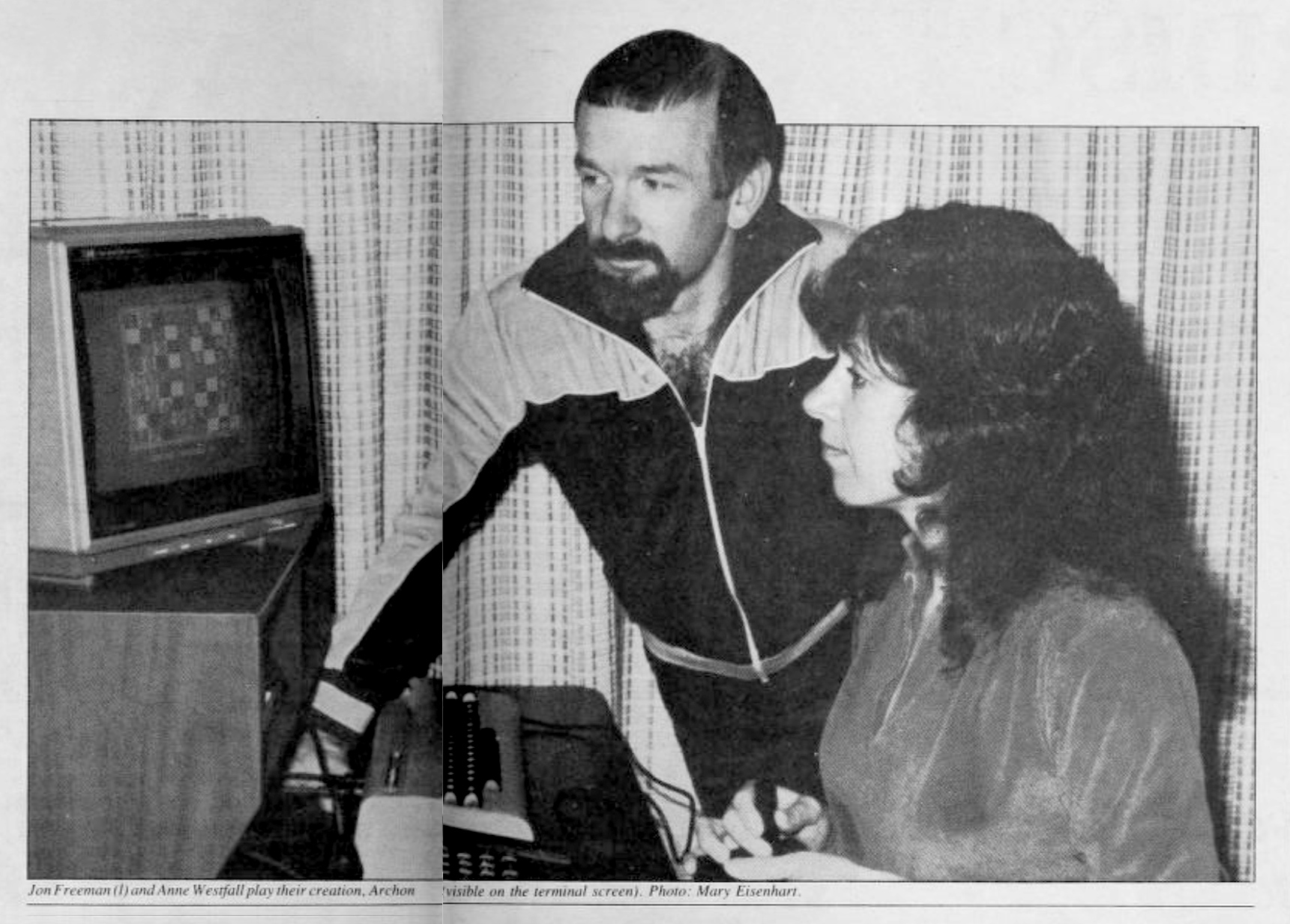
Jon Freeman and Anne Westfall in 1984, showing off their creation, Archon: The Light and the Dark, on the Commodore 64.
Image from MicroTimes Volume 1, Number 1 – May 1984.
Sources: Wikipedia, CRPG Addicts, Hardcore Gaming 101, Halcyon Days, The Dot Eaters, The Digital Antiquarian…