In the early 1980s, an underlying anxiety began to ripple through the rapidly expanding video game market. While arcade halls glowed with teenagers pouring millions in quarters into flickering cabinets, a backlash was brewing in American homes. Parents, educators, and social critics viewed early games as little more than a digital epidemic, a collection of brainless, pixelated violence that threatened to turn an entire generation into zombies. Many analysts confidently predicted that the video game boom was a passing fad, a temporary craze destined to burn out just like the hula hoop or the pet rock insanity of the previous decade.
Yet, right in the center of the cultural tug-of-war, a counter-movement emerged. A progressive wave of developers looked at home computers not as overpriced toys, but as the ultimate educational tools. The concept of edutainment exploded across the industry as software houses realized that computing power could be harnessed for interactive learning rather than just blowing up invading aliens. Between anxious parents and technologically optimistic educators, the foundation was laid for a new species of software designed to justify the expensive, chunky beige contraption sitting on the family desk.
One of the most established corporate giants to dive headfirst into the digital frontier was the Hayden Book Company, based out of Rochelle Park, New Jersey. A titan in technical literature and academic publishing, Hayden was led by the forward-thinking James S. Mulholland Jr., who recognized that the computing revolution would inevitably disrupt traditional print media. Initially, the company attempted to bridge the gap by publishing printed books filled with raw BASIC source code, listings which hobbyists would painstakingly type into their machines line by line, praying they didn’t miss a single character. However, as the market matured, management realized the future belonged not to these marathon exercises, but to pre-recorded magnetic tapes and floppy disks.
By 1978, Hayden was fully committed, establishing Hayden Software as a dedicated subsidiary. The brand quickly earned historical legitimacy by publishing the groundbreaking Sargon chess series, which set early benchmarks for “consumer artificial intelligence”. As the 1980s progressed, Hayden sought to aggressively expand its footprint. Following the acquisition of California-based Programma International in 1980, the company pivoted sharply toward the lucrative educational software market. Recognizing that the quickest shortcut to a parent’s wallet was the shiny promise of improving their child’s school grades, Hayden set out to establish a firm grip on the market, hunting for educational experts who could transform bone-dry curricula into captivating interactive experiences.
In an era where game development was almost entirely the exclusive domain of a male-dominated enclave of self-proclaimed teenage hackers, middle-aged Natalie Jesdale stood as an absolute anomaly. Not only was she a woman who could easily pass as the mother to most of her young, scruffy peers, but she also lacked any formal or even non-formal computer science background. Instead, she was a highly trained academic holding a Master of Science in Education and possessing years of hands-on experience as a mathematics teacher at the Groton School in Groton, Massachusetts.
Jesdale’s presence at Groton was quite historic in its own right. The elite New England preparatory school had been a strictly all-boys institution for nearly a century until it transitioned to coeducation between 1975 and 1980. Hired right in the thick of the monumental shift, Jesdale became one of Groton’s very first female mathematics faculty members, a role that undoubtedly required navigating the unique brand of chaos that occurs when teenage boys suddenly realize girls exist on campus.
Her venture into educational software design came as a practical response to a massive technological invasion occurring right inside the school’s historic brick walls. In the early 1980s, many, especially elite preparatory schools, were heavily investing in their very first computer labs, buying up fleets of Apple II computers. As a leading voice in the math department, Jesdale was tasked with the rather daunting assignment of figuring out how to actually integrate these incredibly expensive, bleeping boxes into the daily curriculum before the board of trustees demanded to know why they had spent a small fortune on high-tech door stoppers and paperweights.
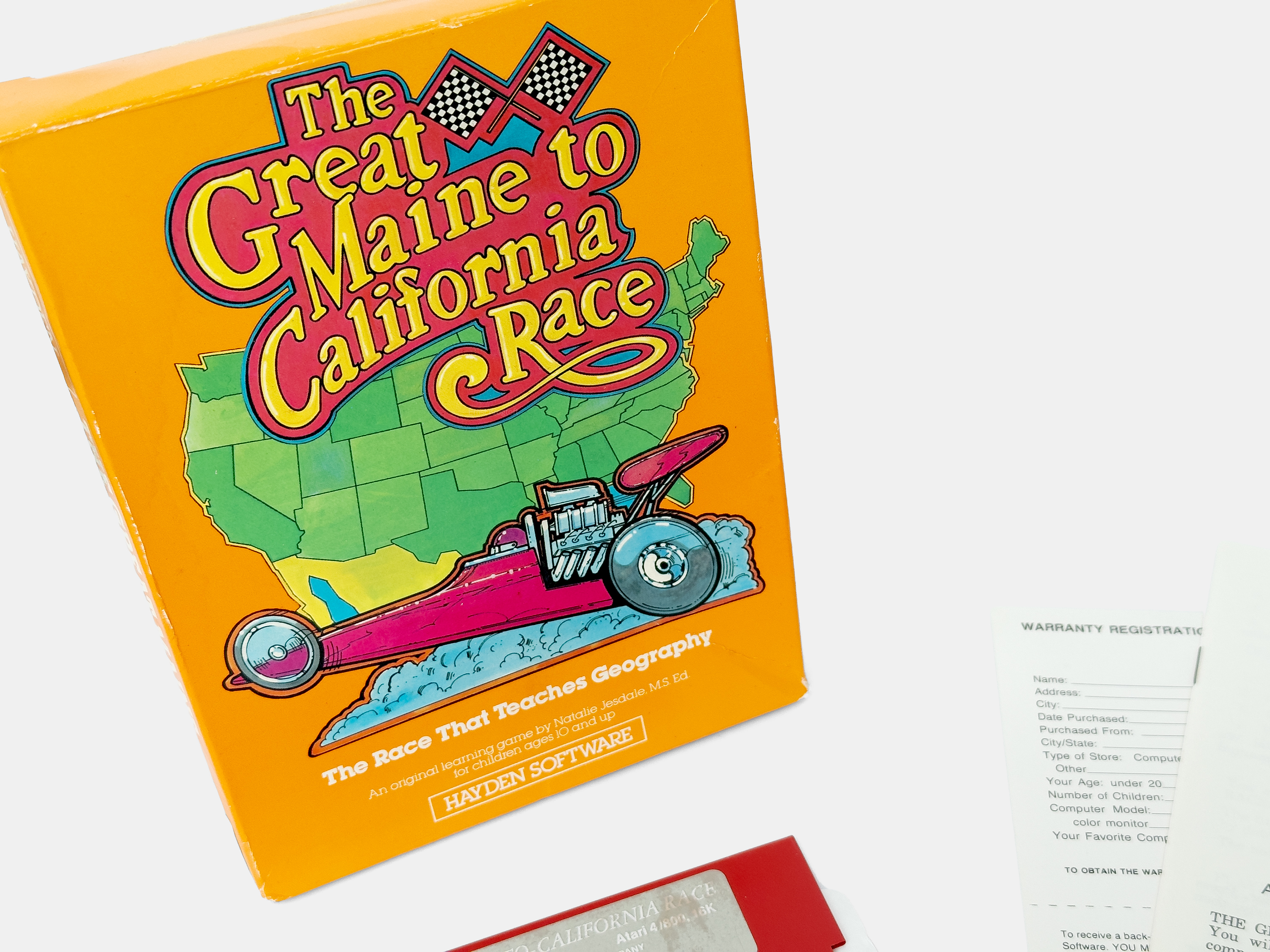
From her time in the classroom, Jesdale understood the exhausting challenge of capturing a teenager’s attention using traditional blackboards and tired, mandatory textbooks that had likely survived since the previous World War. She viewed the computer as a powerful classroom ally rather than a distraction. While male programmers of the era typically designed software centered around rapid laser-fire, destruction, or high-score bragging rights, Jesdale approached development with a structured pedagogical lens. Her goal was to build something for children that wrapped factual information in a compelling, yet competitive format. Finding a severe lack of anything remotely educational on store shelves, she sat down and coded The Great Maine to California Race herself. She ran it as a localized experiment, turning her own students into a captive audience of playtesters to see if an interactive cross-country race could successfully teach regional geography and state boundaries.
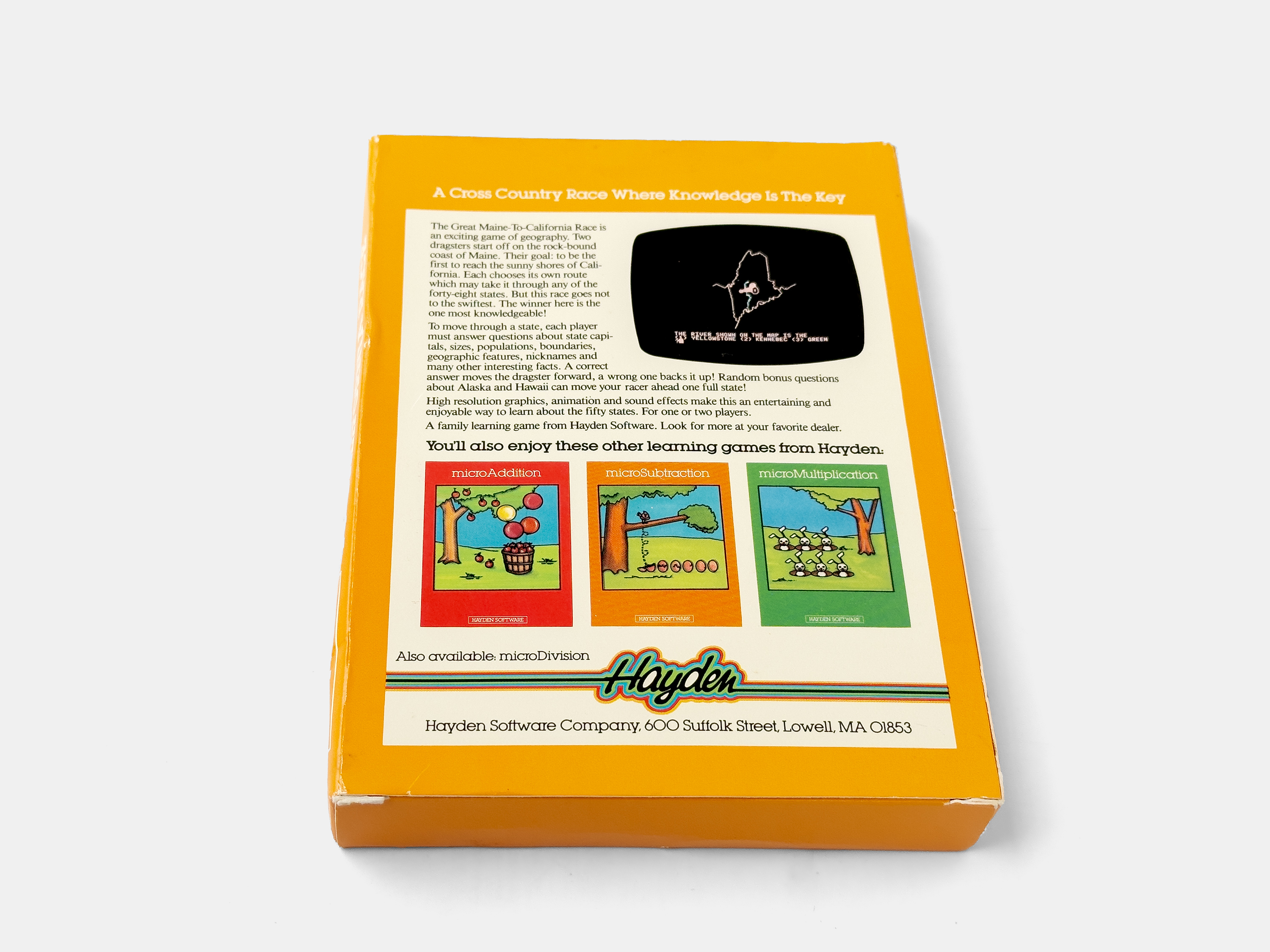
The design was as brilliant as it was mechanically straightforward. Capitalizing on the popularity of cross-country road races, Jesdale threw players into a virtual coast-to-coast sprint stretching from the rocky shores of Maine all the way to the mist of the Pacific Ocean along the California coastline. However, unlike contemporary arcade racing titles, where success depended on a fast joystick hand, the fuel here was pure knowledge.
During the early 1980s, the consumer software industry operated much like the traditional book publishing world that Hayden Book Company knew so intimately. To source new material, publishers like Hayden actively ran advertisements in major magazines like COMPUTE! and Byte with prominent headlines reading “Authors Wanted,” inviting educators and hobbyists to submit their proprietary software for royalty-based publishing contracts.
Because her husband, T. Todd Jesdale, an incredibly prominent Cornell rowing alumnus and legendary prep school crew coach, was deeply connected to elite academic and athletic circles, Natalie understood the mechanics and value of professional publication. Rather than keeping the program locked away as a private teaching aid in Groton’s computer lab, she packaged her completed Apple II master disk and submitted it directly to Hayden Software’s headquarters in New Jersey.
For Hayden, Jesdale’s submission was ideal. As an established print publisher trying to legitimize its “Educational” division, the company desperately needed academic credibility to win over skeptical school boards and parents. Having a game authored by a master ‘s-holding female educator from one of America’s most prestigious boarding schools gave Hayden the ultimate marketing badge. They swiftly accepted her submission, secured the publishing rights, and polished the user interface. Recognizing its broader commercial potential, Hayden immediately commissioned outside programmers to handle cross-platform conversions, porting Jesdale’s original Apple II code over to the Commodore 64 and the Atari 8-bit systems.
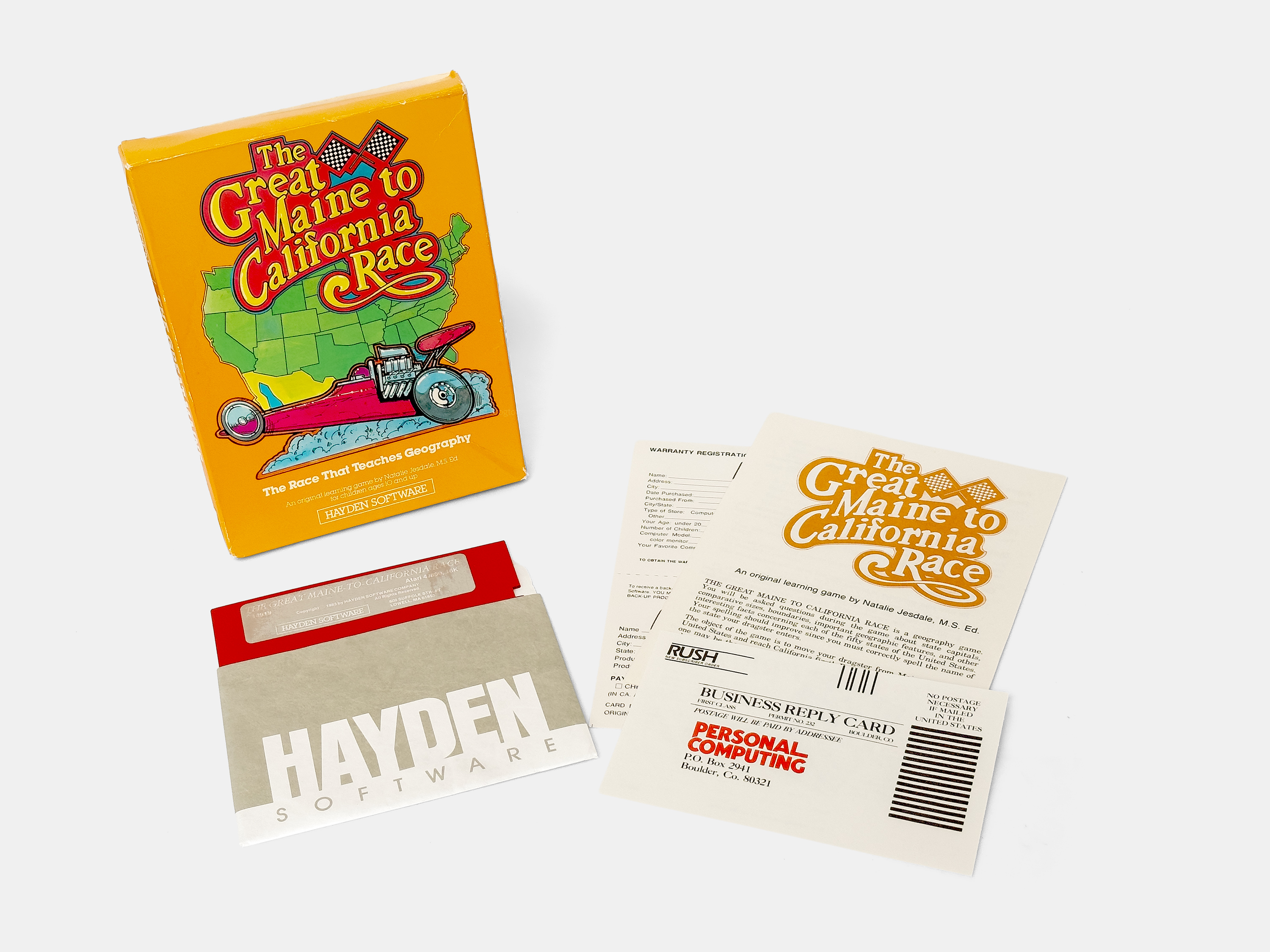
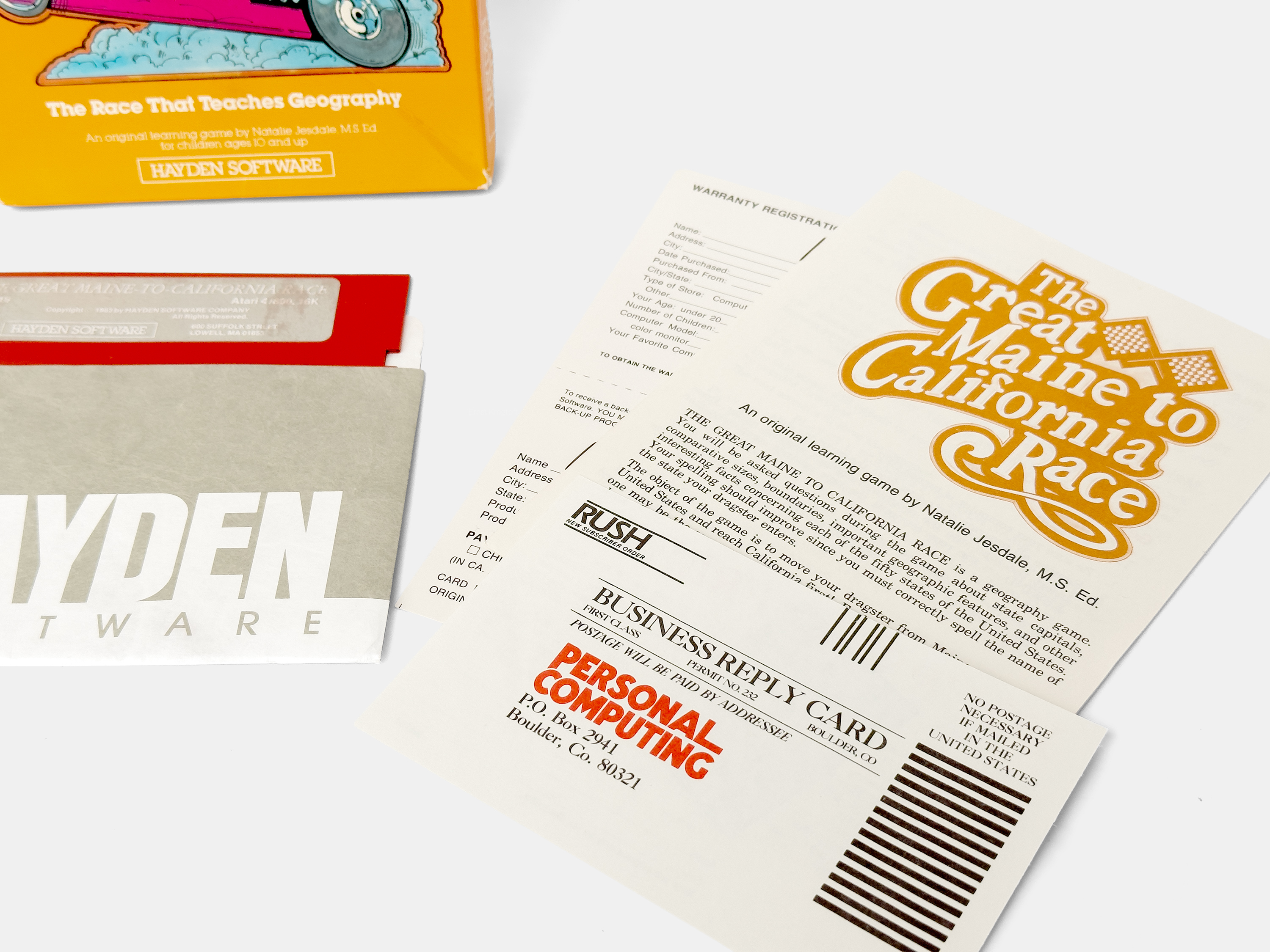
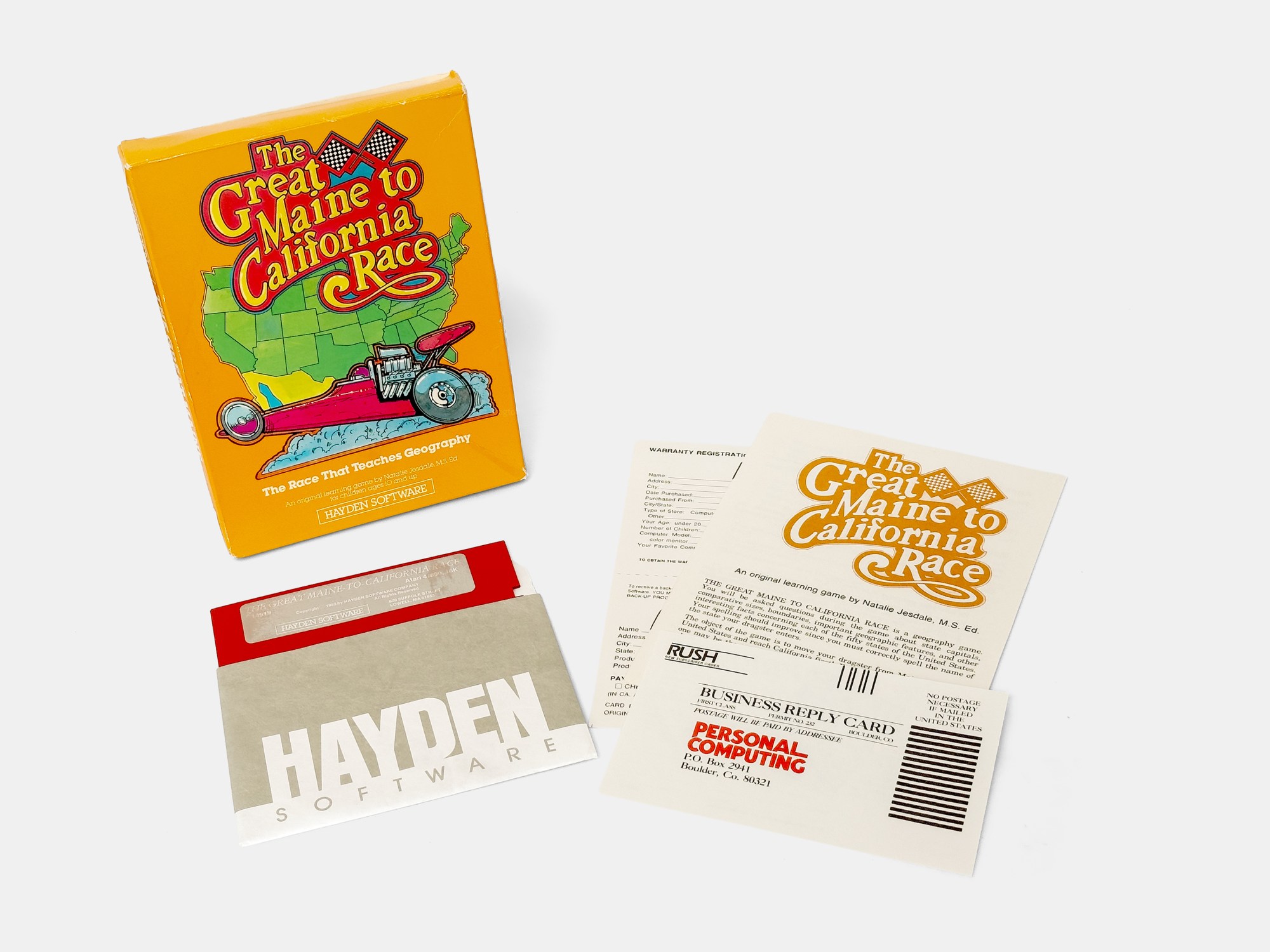
The Great Maine to California Race was released for the Apple II, Commodore 64, and the Atari 8-bit family in 1983. It was praised for successfully blending competition with learning.
The game allowed two players to go head-to-head, or a single player to face off against the computer opponent, RoByte. Forget fast reflexes, advancing your dragster required answering questions on U.S. geography, state capitals, sizes, boundaries, products, and other interesting facts.
While the 8-bit graphics and sound effects were rudimentary even by 1983 standards, the game was still highly regarded as a fun, trivia-based alternative to classic simulations of the era like The Oregon Trail.
Upon its release in late 1983, The Great Maine to California Race was met with praise from educational circles. Early computer magazines targeted at families singled out Jesdale’s work for its balance of entertainment and educational value and found a steady home in households and school computer labs.
Commercial success, however, remained a relative metric in 1983. Because it was positioned as a specialized educational piece rather than a mass-market entertainment title, it never achieved the runaway sales volume of the mindless action games it sought to counter. Furthermore, its arrival on store shelves collided with the turbulent, catastrophic onset of the 1983 video game crash. The industry-wide meltdown saw store shelves suddenly buried under a mountain of bargain-bin software, triggering desperate price wars that ruthlessly squeezed independent publishers across the country. The Great Maine to California Race would ultimately stand as Jesdale’s first and only commercial software release, as she chose to return her full focus to her beloved students at Groton until her retirement in 1993.
Sources: Wikipedia, Scribd, Compute Magazine Issue 044, Gamespot, Computer Gaming World, RowingNews, Personal Computing Feb. 1984…