
In the latter part of the ’70s, Donal Albert Ursem joined the microcomputer revolution as one of the early enthusiasts. His growing passion for computers and technology would come to define a lifelong career in the industry. Having graduated from Mayfield High School in Ohio in 1960, Ursem dedicated two years to serving in the U.S. Army Engineers from 1967 to 1969, with a deployment to Vietnam in 1968.
As the ’60s transitioned into the ’70s, the landscape of computers evolved from inaccessible mainframes, sprawling behemoths, occupying entire rooms or even floors, into more compact and approachable devices. Ursem’s enthusiasm found its expression in one of the numerous early microcomputers that emerged in the mid-to-late ’70s.
In 1977, Ursem developed his first game, Tank Trap, a straightforward action game where players had to construct walls in an attempt to trap a tank. The game was released on cassette by SPD Software for the Ohio Scientific Challenger II series, a line of early microcomputers targeting both the home and hobbyist markets. While the Ohio Scientific computers weren’t as widely known as other contemporary home computer systems of the time, they contributed to the diversity of computing platforms available to enthusiasts in the latter part of the 1970s, and early programmers like Ursem found a platform for his programming pursuits with the system.
By the late ’70s, the home computer industry was changing fast with new systems emerging at a rapid pace. In April 1978 Exidy introduced its Z80-Based Sorcerer, a system that achieved a moderate level of popularity, particularly among hobbyists. The computer boasted a substantial selection of available software, encompassing both games and productivity applications. Ursem successfully ported his Tank Trap to the new Sorcerer and got it published in 1978 by Bob Pierce and Bob Christiansen‘s Quality Software.

Don Ursem’s first game, Tank Trap was initially released for the Ohio Scientific Challenger II series of microcomputers in 1977.
The game was ported to the Exidy Sorcerer and in 1980 it was released for the Atari 8-bit by Quality Software.
Following the successful porting of his Tank Trap game for the Exidy Sorcerer, Ursem began working on a more intricate game, a single-player tactical simulation and strategy space game, seemingly inspired by earlier Star Trek-like games. Working on the project, intermittently, for a year, in 1980, Starbase Hyperion was completed and released by Quality Software.
While the Sorcerer gained a moderate level of popularity and had a fair amount of software available, it didn’t achieve the same level of widespread success as some of its competitors. Exidy had its primary attention on the rapidly growing video arcade game market, resulting in limited emphasis and support for the system. Home computer systems such as the Apple II, TRS-80, and the newly introduced Atari 400/800 emerged as dominant forces of the era. In contrast, the Sorcerer while being capable and expandable, quickly faded into obscurity.
The Sorcerer’s lack of popularity, especially in the US, led Ursem to port his Starbase Hyperion to the Atari 8-bit line of home computers. The Sorcerer BASIC code was rewritten along with the implementation of the needed machine language subroutines. The Atari version, unlike the earlier Sorcerer version, was in full color and with sound effects. Starbase Hyperion was published for the Atari by Quality Software in 1981.
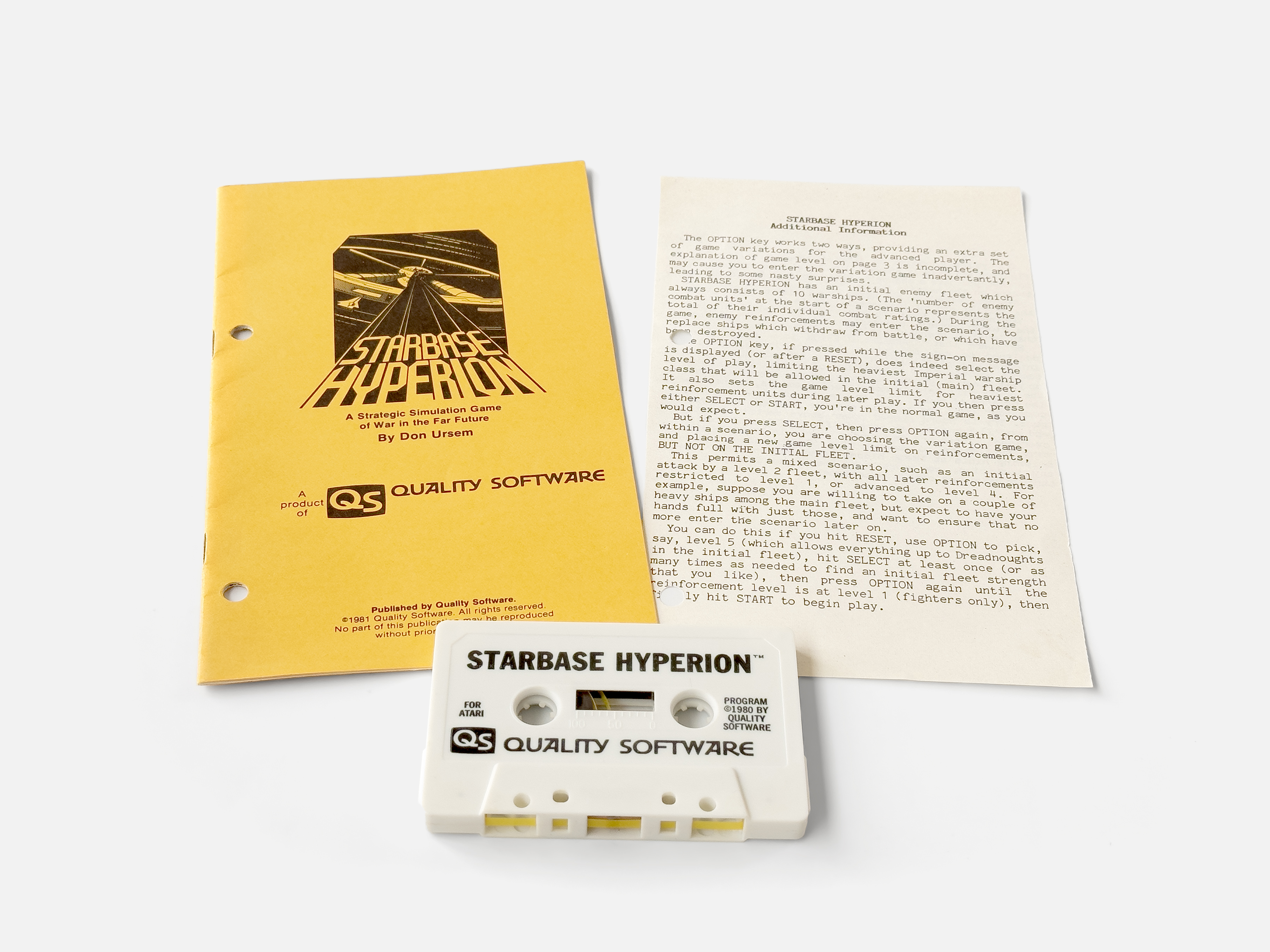
Don Ursem’s second game, Starbase Hyperion, was released on cassette and floppy for the Atari 8-bit by Quality Software in 1981.
By the 37th century, human expansion had reached far across the galaxy. Security of the frontiers of these worlds was the responsibility of Colonial Star Command. During the latter years of the 37th century, first contact was made with probes of the non-human Empire. To prevent Empire penetration of inner worlds, a number of Colonial Starbases were established to create buffer zones, designed to hold enemy fleets for several days, until large Colonial reinforcements could arrive. This tactic worked well for some time, until 716 CD, when a large fleet of Empire vessels were spotted in Sector Hyperion. The armada has already captured 18 frontier worlds, and Starbase Hyperion is the remaining defensive position preventing invasion of inner worlds. As captain of the Starbase, you must hold out superior numbers until Colonial reinforcements arrive, to drive back the invading forces.
Excerpt summary from the Starbase Hyperion manual
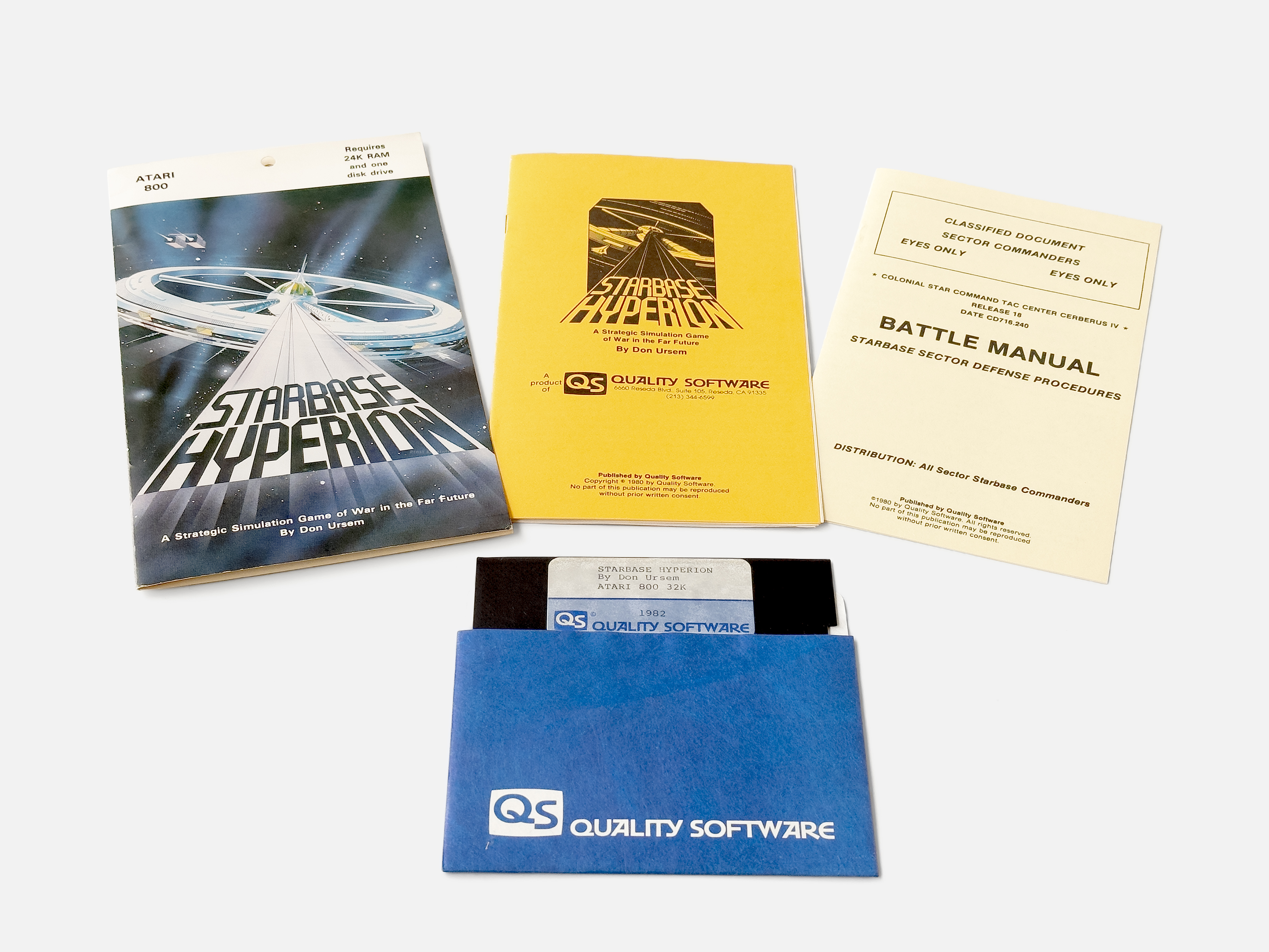
The Starbase Hyperion floppy release required an Atari 800 and a minimum of 24K of memory.
The Atari 400, the Atari 800’s smaller brother, had a maximum capacity of a rather limited 16K, shared between system memory and video memory, and wasn’t user-expandable through standard means (could be expanded by replacing the 16K memory board inside the computer with a 32 or 48K board)
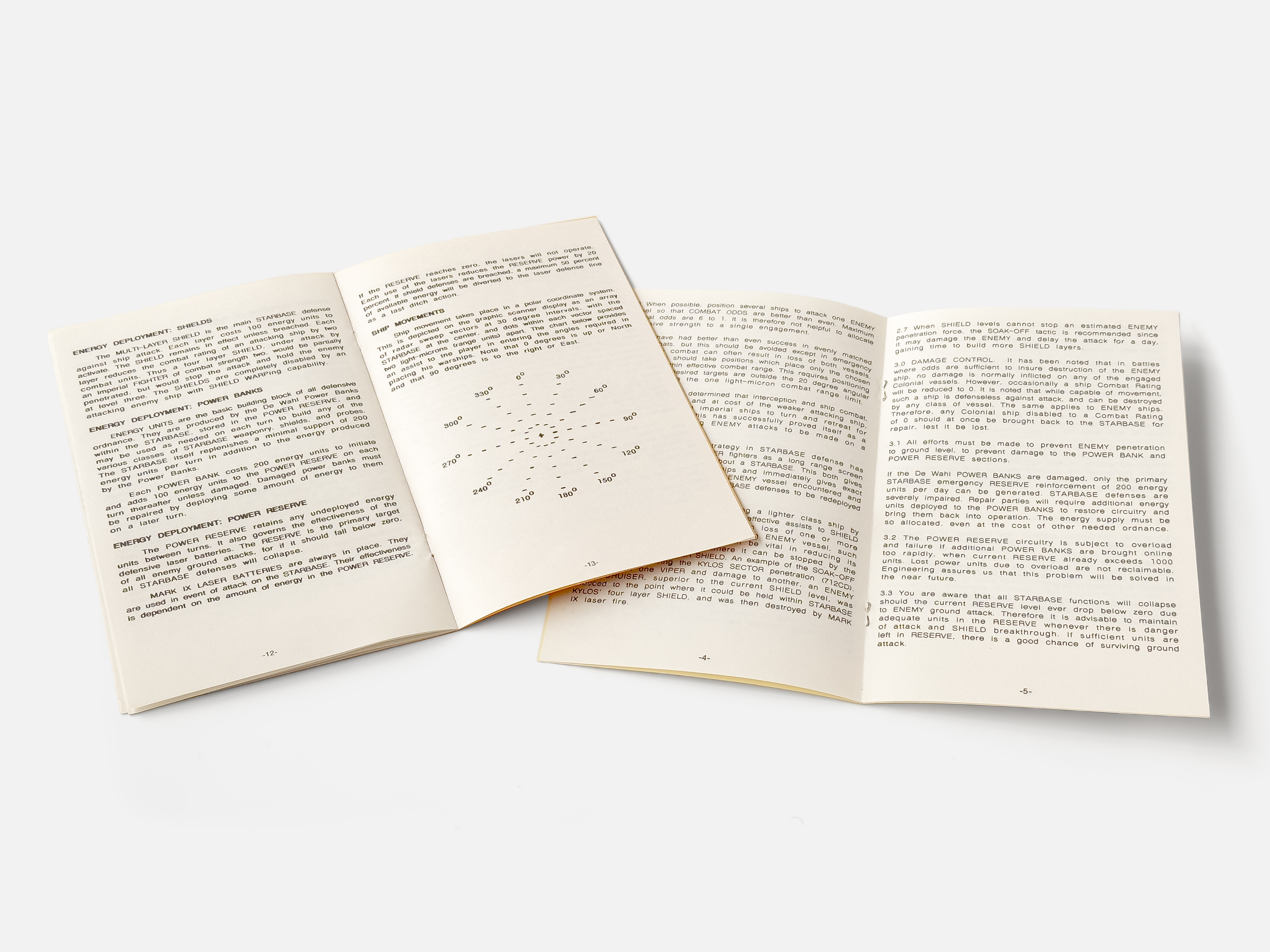
Starbase Hyperion included an impressive amount of documentation.
The manual thoroughly describes the scenario and game mechanics and the included Battle manual includes information on ship types, defense tactics, and strategies.
Playing as the colonial side, you must successfully defend Starbase Hyperion for a total of 15 days (turns) or destroy all incoming enemy forces to win. The starbase is located in the center of a 360-degree field. During each turn, you manage the limited resources that control your power generators, shields, and ability to build and power ships and probes. A fleet, derived from five different classes, can be created and commanded, the amount of energy used determines the ship’s combat strength.
There are a total of 6 difficulty levels, affecting the strength of alien vessels from small fighter squadrons to dreadnaughts.
Starbase Hyperion was reviewed in a few contemporary magazines as an excellent, simple yet challenging simulation game with full graphics and real-time combat displays.
Not much info is available on Ursem and it seems Tank Trap and Starbase Hyperion were his only two contributions to the gaming industry. By 1980 he worked as district manager in the Business Marketing Department of New York Telephone Co. In 1982 he joined as an editor, reviewer, and librarian for the Jersey Atari Computer Group and would continue his career, working at Novell and Remedy Corporation. He became a mainframe database manager and vice president of network operations at San Francisco-based application service provider, VocalPoint, Inc.
In his retirement years, before passing away at age 70 in 2014, he wrote How-to books for the Amazon Kindle and taught technology courses in the Highlands at Dove Mountain community.
Sources: Atariage, Wikipedia, Halcyon Days, The Wargaming Scribe, Computerworld, vistosofh.com…


 Retro365
thank you so much for this review – Don Ursem was my Dad, and I’m sure he would be thrilled to see that you enjoyed his game! He was a lifelong gamer although he did leave coding behind and made his career in data infrastructure. He passed his gaming passion on to me and my daughter, and now that she’s 15 I’m going to try and find a way to play this with her (I only have the floppy version and no Atari LOL)! My mom found your review via Google search, and it really brought us joy to see that his creation endured 😀
Dear Kristen
First of all, I’m honored that you have taken the time to write to me. Thank you so much.
Thanks for sharing a bit of your story. I was very excited to read it. Your dad did a great job back in those early days of computing.
My own dad was one of the pioneers here in Denmark, working as a system engineer and programmer on early IBM mainframes and minicomputers before he turned to personal computers in the late ’70s and early ’80s. So, I have always found the developers, technology, and times extremely interesting… Hence, my blog here is as much a tribute to those as it is to the games themselves.
Finding and getting authentic hardware working definitely requires some time and effort. On modern hardware, you can use an emulator and find the games/software in many places on the internet. I recommend using the Altirra Atari 8-bit emulator if you’re on Windows. It emulates the Atari 400/800, 1200XL, 600/800XL, 130XE, XEGS, and 5200 systems.
I can put together a small package that includes the emulator, the game, and what else is required to make it run.
All the best
Ernst
My dad was a huge fan of this game. He would play it all the time. He also passed his passion for gaming on to me. It was the reason I became a coder myself and love to hear about the “real” programmers from back in the day when they had to do everything themselves. These games weren’t easy to pull off back then.