
In 1978, Robert Clardy created Dungeon Campaign, one of the earliest examples of a graphic role-playing game for the personal computer. Over the following years, Clardy continued to expand his fantasy universe through a series of follow-up titles that would come to define his company, Synergistic Software, as one of the pioneers of the early computer game industry. By around 1980, Synergistic had also begun focusing on publishing games by other developers, among them Bolo, an impressive, fast-paced, multidirectional tank shooter.
By 1982, the Apple II home computer was five years old. Since its introduction, far more capable machines had entered the market, and Commodore was on the verge of launching what would become the most successful home computer of the 1980s, the Commodore 64. While the Apple II had received several incremental updates over the years, it remained, at its core, the same 1 MHz system that Steve Jobs and Steve Wozniak had introduced in 1977. Nasir Gebelli had demonstrated that games on this relatively modest hardware could rival contemporary coin-operated arcade machines. His fast-paced, visually striking action titles from 1980 and 1981 established him as one of the medium’s early prodigies. A year or two later, however, in a market that had grown significantly larger and far more competitive, achieving that same level of recognition had become increasingly difficult.
Nevertheless, programmer Jim Lane managed to create a game that impressed both consumers and reviewers alike, even if it ultimately failed to achieve commercial success or secure Lane a lasting place in gaming history.
Lane’s tank-based maze battle game was inspired by a demonstration he had seen on another microcomputer, as well as by American science fiction author Keith Laumer’s 1976 novel Bolo: Annals of the Dinochrome Brigade, part of a series centered on intelligent, self-aware tanks. Working in his spare time with a friend, Lane set out to create what they envisioned as the ultimate tank battle game. When his collaborator dropped out after moving out of state, Lane pressed on alone, forming Elvyn Software and continuing development in the hope of completing the game in time for the crucial Christmas season. Robert Clardy’s Synergistic Software ultimately acquired the title and published it for the Apple II in 1982.

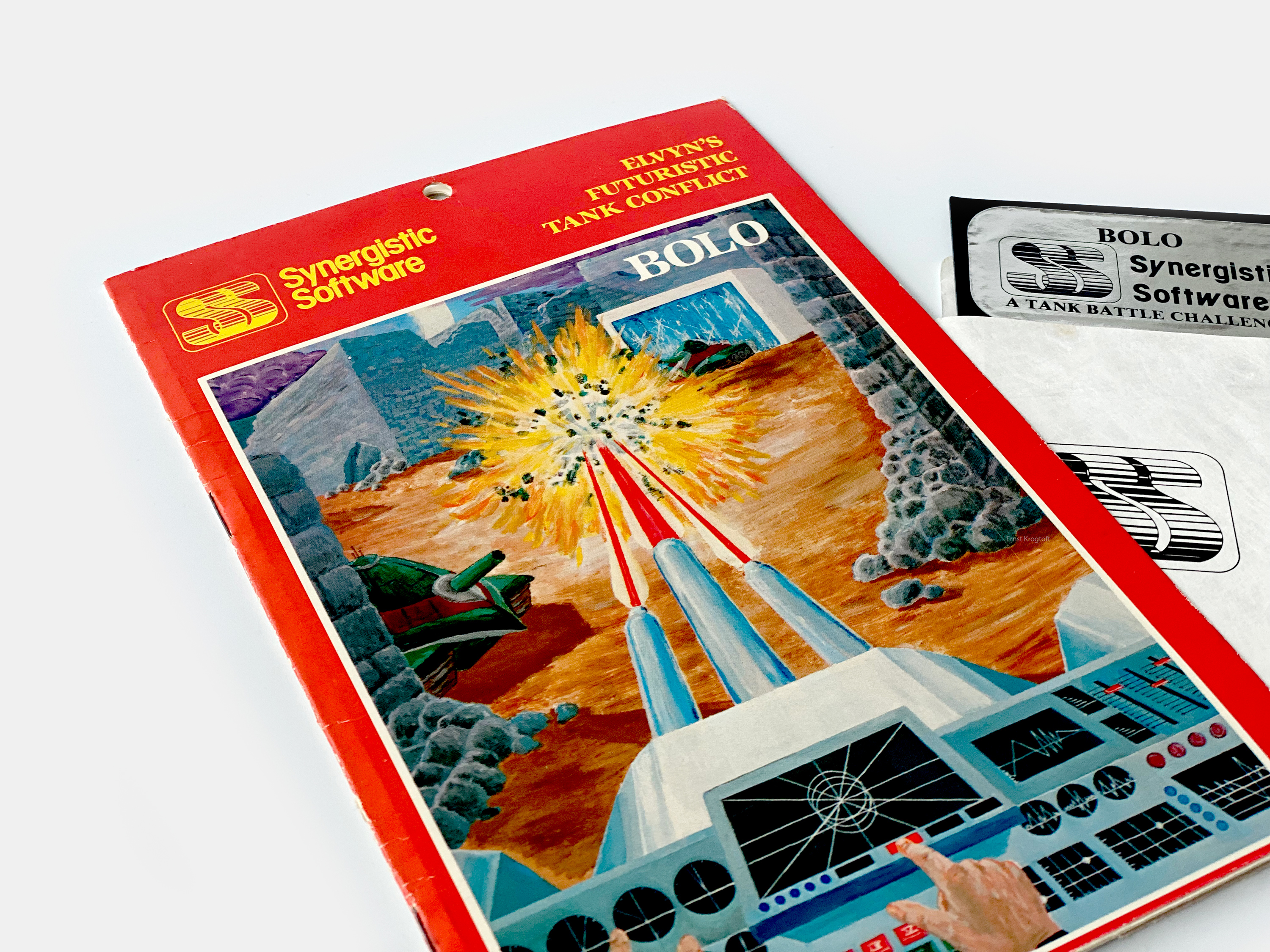
Jim Lane’s fast-paced tank action maze game, Bolo, was released by Synergistic Software in 1982 for the Apple II.
While highly regarded at the time, it became a commercial failure and was hugely pirated. This, being one of only a few original copies I know of
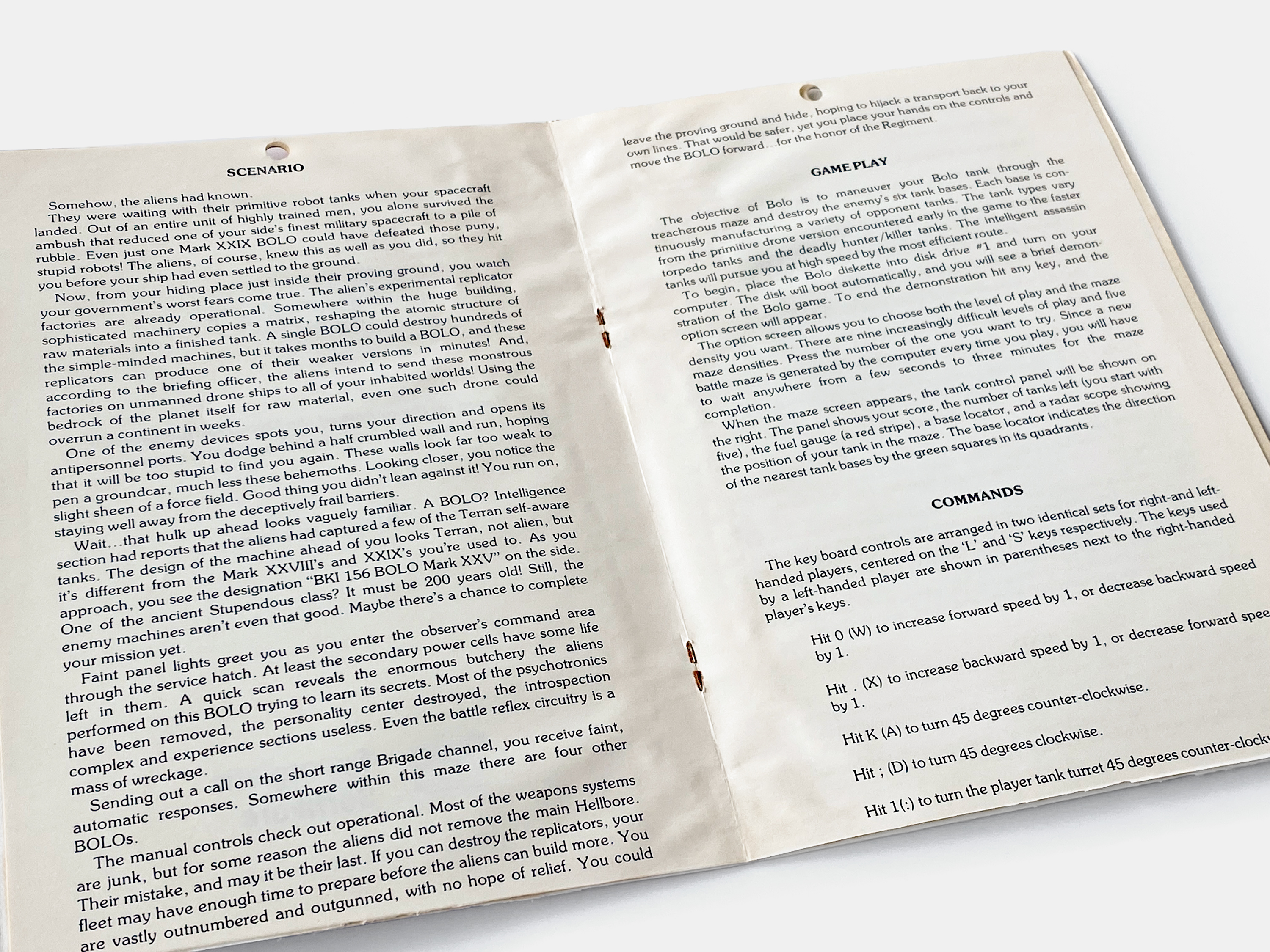
Bolo became one of the first commercial games to tie into a novel, and while Lane tried to get sci-fi writer Keith Laumer to write the scenario description, he declined, and Lane and his then-wife wrote it
Bolo featured fast-paced gameplay set within a vast, randomly generated maze, complemented by smooth scrolling, pixel-accurate collision detection, and strong audiovisual presentation. Technically and artistically, it stood among the most impressive titles ever released for the Apple II. The game’s impact was reflected in its reception, climbing to the top of Softalk magazine’s “Game of the Year” rankings for 1982, where it tied for first place with Brøderbund’s Choplifter.
In March 1983, Softline magazine reviewed Bolo favorably, praising its animation, graphics, and overall playability. The review went so far as to describe it as superior in every respect to Tron, the multidirectional shooter inspired by the film and broader cultural phenomenon of the same name.
Despite this critical acclaim, Bolo arrived at an inopportune moment. The early 1980s home computer market was undergoing rapid expansion, with more powerful systems and a wave of next-generation software quickly reshaping consumer expectations. Along with this shift was the rampant piracy that plagued the Apple II ecosystem, reducing the commercial lifespan of many titles to only a few months before unauthorized copies became widespread. As a result, despite its technical achievements and critical success, arguably serving as a showcase for both Lane’s abilities and the Apple II’s untapped potential, Bolo ultimately failed to achieve lasting commercial success.
In the March 1983 issue of Softline Magazine, the reviewer noted that the game required almost superhuman, multi-finger coordination and
speed-of-light decision making, clearly none of which I possess.
The turret can be tuned separately from the tank, but my lack of skills resulted in disaster when trying to control the tank and turret direction at the same time. The layout of the controls allowed for two players to control the tank simultaneously, one driving the tank and one controlling the turret
Lane continued to develop a handful of additional games for the Apple II before returning to more conventional work, earning a living by writing compilers and contributing to embedded systems development.
In 2010, Time columnist Lev Grossman ranked Bolo third on his list of the “10 Greatest Games for the Apple II,” praising its remarkably fast-paced action, smooth scrolling, elegant visuals, and the surprisingly sophisticated artificial intelligence of its enemies. Four decades on, Bolo continues to retain a dedicated following, fondly remembered by many as one of the most striking and formative Apple II games of their childhood.
Sources: Wikipedia, MobyGames, Softline Magazine March 1983, Techipedia, Softalk Magazine


 Retro365
One thought on “Bolo, a forgotten masterpiece of technical prowess”