
In 1990, Sierra On-Line was looking for suitable people to join a writer’s group the company was putting together aimed at enhancing the writing and dialogue in its games and associated written material. The industry was growing and becoming more competitive, requiring Sierra to attract new talent despite its remote location in the Sierra Nevada foothills, far from major cities. While the company was well-regarded within the industry, recruiting individuals who were not necessarily computer literate, such as writers and managers, posed a challenge.
Going through applications and resumes, the manager for the newly established group discovered a resume accompanied by a sample of a short story, which had been submitted almost a year earlier by system programmer and aspiring writer Jane Jensen.
Like Sierra On-Line co-founder Roberta Williams, Jensen had experienced William Crowther and Don Woods’ Colossal Cave Adventure on mainframe computers during the early days of computing. The interactive work of fiction not only captivated her but also sparked an interest in the logic and programming behind it. After earning a Bachelor of Arts in Computer Science from Anderson University in Indiana, Jensen joined Hewlett-Packard as a system programmer in 1983. While working in engineering, Jensen continued to pursue her love for writing by writing fiction and attempting to publish a novel and various short stories. However, it became evident that her creative drive and writing aspirations couldn’t be fulfilled in an engineering role at HP.
In 1989, Jensen acquired her first personal computer, providing her with an opportunity to witness the evolution of interactive fiction over a decade. From the rudimentary text-only games of the late ’70s to On-Line Systems‘ text-parser-driven graphic adventures of the early ’80s to the now fully animated titles like the King’s Quest series. Adventure games captivated Jensen’s imagination, and after a year of fascination and enjoyment, she made the decision to pursue a job at Sierra, recognizing the appeal of merging her technological background and experience with her passion for writing.
In 1990, Jensen was brought in for an interview. Whatever reservations she may have had of leaving the Bay area and her well-paid, secure position at HP for an entry-level creative role as a computer game writer, nestled in the woods near Yosemite National Park, was completely dispelled.
Jensen joined Jim Walls and his team, collaborating on the development of the third installment of the acclaimed Police Quest series. Her contributions included story elements and puzzle ideas. Subsequently, she teamed up with Gano Haine and co-designed the 1991 children’s adventure EcoQuest: The Search for Cetus, marking her first project as a fully-fledged game designer.
In 1992 Jensen joined veteran designer Roberta Williams as co-designer, co-writer, and co-director on the highly anticipated sixth installment in the King’s Quest series. During the project, Jensen got an unprecedented insight into Roberta’s over 10 years of experience not only working as a game designer but also as a director, managing and leading a team down the same path all while incorporating her visions into the final product.
King’s Quest VI: Heir Today, Gone Tomorrow, when released in 1992, became an overnight commercial and critical success and is widely regarded as the pinnacle title of the series. Jensen’s successful involvement with writing, directing, and designing didn’t go unnoticed and she was immediately given the opportunity to pitch ideas for her own game.
Partly influenced by the 1987 American neo-noir psychological horror film Angel Heart, Jensen eventually settled on creating a murder mystery thriller set in New Orleans, featuring supernatural elements and a significantly darker tone compared to Sierra’s usual adventure games. Co-founder Ken Williams had initially envisioned a more lighthearted setting and story, but he placed complete trust in his designers, granting approval for the game’s development.
Jensen began work on the plot narratives, and once the overarching story was established, it was broken down into game design components such as locations, puzzles, items, and dialogue trees. Jensen took charge of the game’s production with support from Roberta, while Jensen’s husband and producer, Robert Holmes, joined as the game’s composer.
During the game’s development, Sierra’s internal tools, the Sierra Creative Interpreter, underwent a transition to SCI32, allowing for high-resolution 640×480 graphics, as well as better movie support. The shift resulted in approximately six months of troubleshooting and resolving issues. Despite the challenges, the game successfully reached the hands of late Christmas shoppers upon its release on December 17, 1993.
Gabriel Knight: Sins of the Fathers was released to an immediately enthusiastic audience. With the strength of Jensen’s exceptional writing, coupled with the game’s mature and dark themes, filled a distinctive niche within Sierra’s already impressive adventure game catalog.
The game revolves around the protagonist, Gabriel Knight, an author and bookstore owner in New Orleans who becomes entangled in an investigation of a series of mysterious murders. As the story unfolds, Gabriel discovers that he is part of a lineage known as the Schattenjägers, or Shadow Hunters. Through a spiritual trial, Gabriel assumes the role of the new Schattenjäger, tasked with thwarting those who employ supernatural means to endanger others.
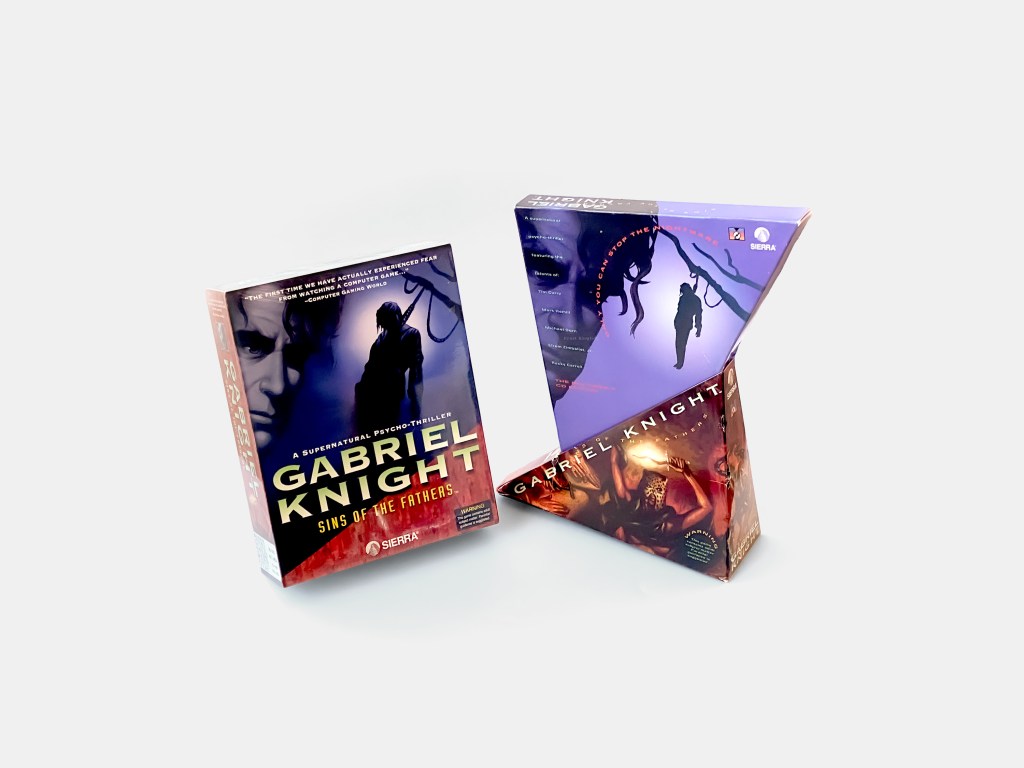

An 11-disc floppy version and a CD-ROM version of Jane Jensen’s first Gabriel Knight title, Sins of the Father, were released simultaneously right before Christmas in 1993.
The floppy version came without voice acting and had an animated sequence switched for still images. The multimedia version came with superb voice acting, done by well-known actors like Tim Curry, Leah Remini, Virginia Capers, Mark Hamill, and Michael Dorn
Following the release of Gabriel Knight: Sins of the Fathers, Jensen was approached to develop a sequel. Despite the game receiving accolades such as Consumer Electronics Show’s Best of Show in 1993 and Adventure Game of the Year recognition from multiple gaming authorities, it fell short of meeting its projected sales target and did not achieve the mainstream commercial success, hoped for. Nonetheless, it was widely praised for its mature and darker themes, as well as its exceptionally well-crafted story.
Motivated by the positive reception, Jensen felt empowered to further explore and intensify the dark elements in the sequel, surpassing the level of darkness presented in the first game.
Technology was advancing rapidly, and as adventure games held a prominent position as AAA titles of the era, developers continuously sought to incorporate new techniques to distinguish themselves in the competitive genre. While the original game featured classic 2D painted backgrounds and 3rd-person animated characters, the team decided to take a different approach for the sequel by embracing Full-Motion Video (FMV) technology. The decision aimed to enhance the visual experience and further captivate players by incorporating live-action video elements into the game.
Hollywood and computer game development were at the time, with high expectations, predicted to merge, but the integration of live-action film production into game development posed several significant challenges due to the lack of experience in the area. The team had to continuously adapt to unproven methods, ultimately resulting in going over budget and having to cut one entire chapter from the final game.
In 1995 Jensen’s sequel, The Beast Within: A Gabriel Knight Mystery, was finally completed and released. It went on to perform exceptionally well, winning the Game of the Year in Computer Gaming World and even receiving positive reviews from mainstream media like Rolling Stone and Entertainment Weekly.

Jane Jensen’s sequel, The Beast Within was released in 1995 to much critical acclaim.
The game came on six CDs, a testament to how much data the chosen full-motion video approach required
In a similar vein, Roberta Williams’ Phantasmagoria, also targeted at a mature audience, employed the same full-motion video technology as Jensen’s The Beast Within. Both games were released within months of each other and encountered numerous production challenges. However, Phantasmagoria achieved remarkable financial success, selling 300,000 copies and grossing $12 million in its opening weekend alone. It went on to become one of the best-selling games of 1995. In comparison, it took Jensen’s two Gabriel Knight games a span of five years to reach the same number of sold copies.
Following the release of the second Gabriel Knight title, Jensen began the novelization of the original Gabriel Knight game. Much of the dialogue and general storyline from the game were directly incorporated into the book, shaping its overall structure. The novel proved to be commercially successful upon its release in 1997, allowing Jensen to begin work on a novelization of the sequel.
To create a more refined and well-structured book, Jensen extensively reworked the story from the game, resulting in an improved adaptation when completed in 1998, offering fans a more compelling and cohesive reading experience.


While Jane Jensen had been an aspiring writer for much of her adult life, it wasn’t until the success of her first two Gabriel Knight games that she had a chance to have her writings published.
Jensen’s Gabriel Knight: Sins of the Father and The Beast Within novels were published in 1997 and 1998 respectively
While Jensen was ready to embark on the third and what would become the last title in her Gabriel Knight series. The market for adventure games was in rapid decline, the huge amount of work and financial cost of doing high-end adventure games was becoming more and more unattractive, and Sierra was feeling the heat.
While the full-motion video approach initially generated excitement, it soon became apparent that it was an exceedingly expensive endeavor. The production costs associated with hiring actors, building sets, and acquiring specialized equipment posed significant financial and logistical challenges. Many developers enthusiastically adopted the FMV trend, but without substantial budgets and the necessary expertise, the resulting games often fell short, resembling B-movie-like experiences. This ultimately diminished the overall perception and reception of full-motion video games.


In 1996, the first two Gabriel Knight titles were re-released in the Gabriel Knight Mysteries: Limited Edition.
A sneak preview of Jane Jensen’s next chapter in the Gabriel Knight series: Blood of the Sacred, Blood of the Damned was included
By the mid-to-latter part of the ’90s, 3D real-time graphics was becoming the hottest thing around, and while the approach was deemed fit for a number of genres, it didn’t necessarily make sense with adventure games, regardless, the struggling genre went 3D without too many questions asked. Also, Sierra felt the Gabriel Knight series would benefit from a move to 3D graphics, to keep up with the time but more or less failed to acknowledge the format required a completely reworked pipeline and a new and skilled 3D labor force, all of which required both time and money, both of which being in short demand.
During the mid-to-late ’90s, 3D real-time graphics emerged as the newest trend. While the approach was deemed suitable for various genres, its compatibility with adventure games was questionable. Nevertheless, the struggling adventure game genre followed suit and embraced 3D graphics without much scrutiny. Sierra believed that transitioning the Gabriel Knight series to 3D would align it with contemporary standards. However, they failed to fully recognize that adopting the format necessitated a complete overhaul of the production pipeline and the acquisition of a skilled 3D workforce, both of which demanded significant time and financial resources, both of which were scarce commodities.
Due to delays and various challenges, Jensen was unable to commence work on the third Gabriel Knight title until late 1996. A 3D engine had to be developed and a team assembled who could fully utilize it, and create 3D scenes, characters, and animations, an undertaking requiring thousands of hours of work. It took an additional three years of production before the game was ready for release.
During this period, Sierra On-Line faced its own difficulties, with Ken Williams stepping down as CEO and the company being acquired by direct marketing service CUC International. As a result, clear direction became elusive, and the development of adventure games was neglected.

Gabriel Knight 3: Blood of the Sacred, Blood of the Damned was to become the last title in the Gabriel Knight series when released in November of 1999.
Gabriel Knight 3: Blood of the Sacred, Blood of the Damned, when released in late 1999, received mixed reviews. Jensen’s story, plots, and puzzles would all be praised, but the execution in emotionless 3D wasn’t a complete success story and was deemed unnecessary by many seasoned adventure game players. The high cost and long production time coupled with the declining market for adventure games, in general, resulted in no further titles in the series being commissioned.
Jensen’s three Gabriel Knight titles each chronicle distinct periods within the ’90s, reflecting the evolution of the adventure game genre. From the flourishing golden age of adventures in the early ’90s to the constant struggle of adapting and keeping pace with advancing technology amid a declining market in the latter part of the decade, the games embody the challenges faced by developers during that era.
Despite the technological obstacles, Jensen showcased her exceptional talent as a writer, surpassing many others in the industry. She had the privilege of working with esteemed designers at Sierra On-Line during its prime, including the likes of Roberta Williams, Jim Walls, Corey, and Lori Ann Cole, among others.
Jensen would continue to work in games and in 2012 established the game studio Pinkerton Road together with her husband Robert Holmes. A Kickstarter campaign was launched to raise funds for the studio’s first year of development and in 2014 the studio released its first games, Moebius: Empire Rising and Gabriel Knight: Sins of the Fathers 20th Anniversary Edition which included improved graphics, a remastered soundtrack, new puzzles, and gameplay elements.


 Retro365