
When Ken and Roberta Williams had completed the development of their first game, Mystery House, in the summer of 1980, Roberta took out a full-page ad in Micro 6502 magazine. To offer more than just Mystery House, two other titles, Skeetshoot and Trapshoot, both developed by a third party, were also featured. While Skeetshoot and Trapshoot quickly faded away, the company’s portfolio rapidly expanded with a multitude of new titles added over the next couple of years, one of the titles being Pegasus II by Olaf Lubeck.
By 1981, video arcade games had become the hottest thing around. Game manufacturers were all striving to please a rapidly growing customer base, constantly demanding new and more elaborate games well deserving of their hard-earned cash. The heightened demand prompted manufacturers to pursue innovative designs and concepts, all in pursuit of becoming the next major commercial success story. As a result, the year emerged as one of the most innovative and prosperous years in the industry, spawning numerous hit titles, which in return greatly inspired the early home computer developers. Ultimately resulting in a saturated home market full of rip-offs and clones.
One of the year’s big hit titles was Konami’s side-scrolling space shooter Scramble, released in the U.S. by Stern. Scramble rapidly gained popularity, becoming Konami’s second-best-selling game and the highest-grossing video arcade game in June of 1981. Despite its success, Scramble didn’t receive any official ports to the major video game consoles or home computers at the time but clones were starting to appear, one of which was Olaf Lubeck’s Pegasus II released for the Apple II by On-Line Systems later that year.
In 1981, Ken Williams, co-founder of On-Line Systems placed advertisements in magazines, aiming to recruit new talent to further expand the company’s range of games. The ad simply read, with bold letters, “AUTHORS WANTED” and below listing the perks of working with On-Line Systems. Including “I (Ken) will personally be available at any time for technical discussions, helping to debug, brainstorming, etc.“.
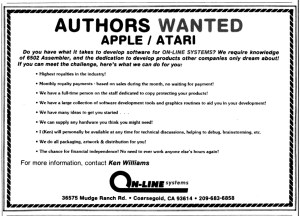
On-Line Systems “Authors Wanted” ad from InfoWorld in 1981
Among those who came across the advertisement was Pam Lubeck, wife of professional scientific programmer Oluf Lubeck. Lubeck had written a couple of video arcade clones on his Apple II computer prior to responding to Ken Williams’ advertisement and submitted his creations for consideration. Williams promptly responded, showing a keen interest in one of the titles. The two agreed on a publishing deal and Lubeck’s Pac-Man clone, Gobbler was published for the Apple II in 1981.
Gobbler ended up doing quite good, selling just shy of a thousand copies a month. But by becoming successful and also being superior to most other Pac-Man clones, the title soon got the attention of conglomerate Atari.
In the late ’70s, Atari had acquired the rights to produce home versions of Namco’s Pac-Man. Atari which yet had to release its official port for its Atari 2600 home video console (the game would be developed throughout 1981 but didn’t see release until the spring of 1982) soon claimed copyright infringement. Gobbler, by request from Atari, ended up being pulled after just 5 months on the market.
With Gobbler off the market, Lubeck turned his attention to a new project and would over the next few months create, the horizontal side-scrolling space shooter, Pegasus II, greatly inspired by Konami’s Scramble.
The objective was to destroy enemy installations by strategically dropping bombs and using the laser cannon to shoot down enemy rockets launched from the ground, as well as various flying enemies that were introduced as the game progressed.
Upon its release in 1981, Pegasus II became one of the first, if not the first Scramble variant available on personal computers.
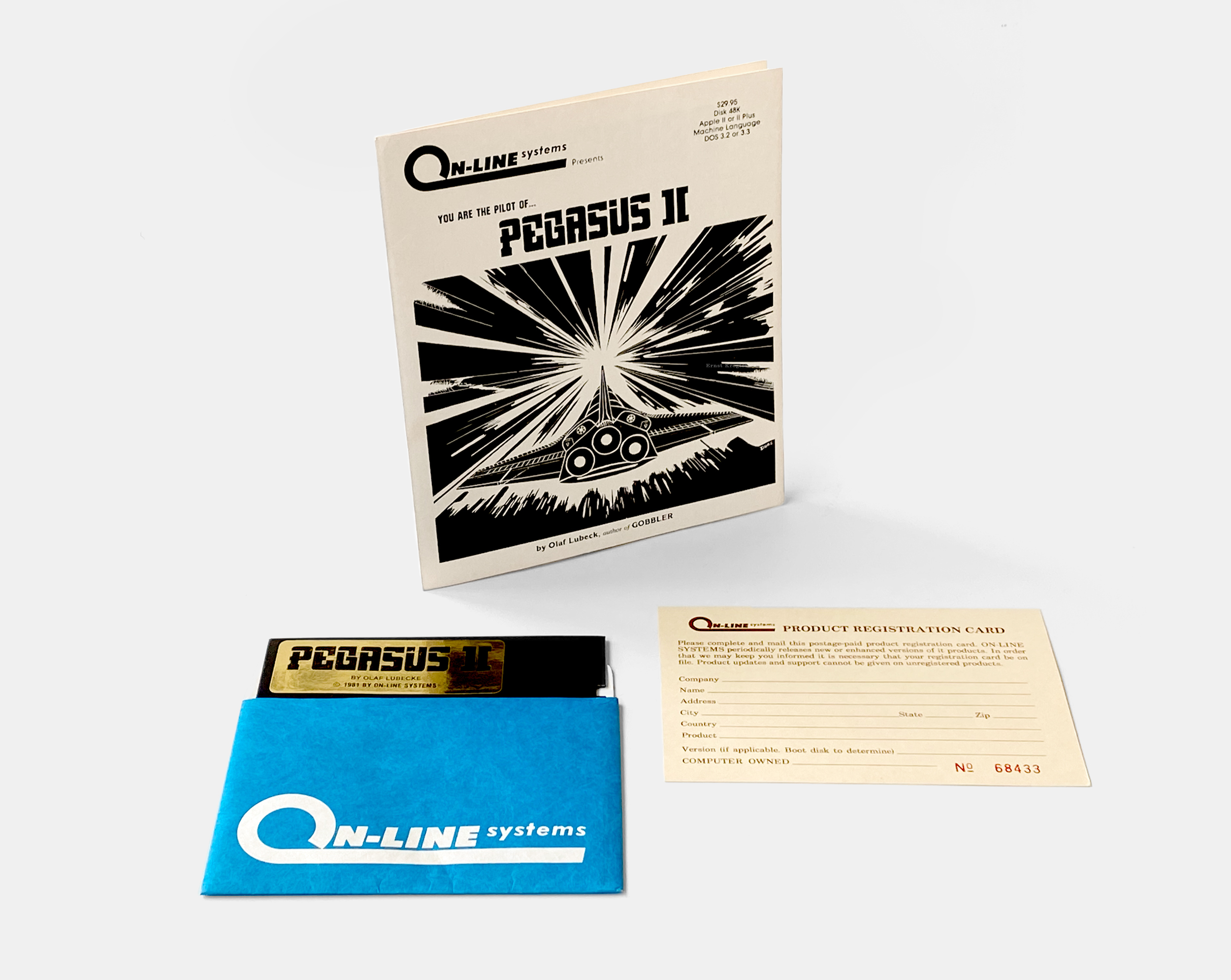
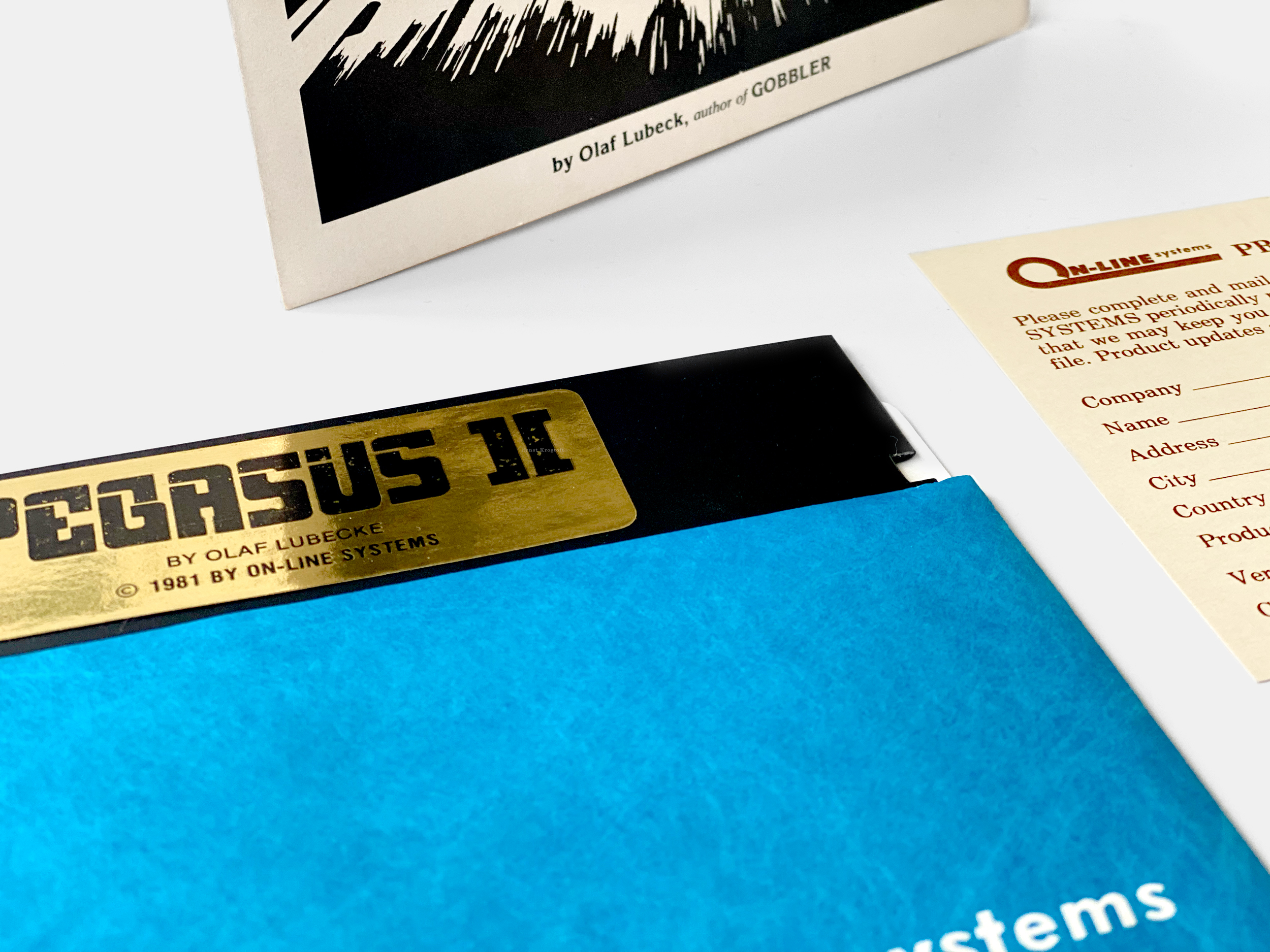
Olaf Lubeck’s second published title, Pegasus II, released for the Apple II by Ken and Roberta Williams’ On-Line Systems in 1981
In printed advertisements for Pegasus II, there was a reference to Sirius Software’s wunderkind, Nasir Gebelli, who at the time created some of the fastest and most impressive action games on the Apple II. In Lubeck’s game, enemies were called Gebellians and described as an alien lifeform best known for depositing eggs in space, referring to Gebelli’s monster hit Space Eggs.
Pegasus II was one of the very first computer games to feature a built-in level editor, a feature Lode Runner a few years later would popularize. The level editor would grab the attention of a young John Romero, who would go on to become one of the industry’s most prolific game developers of the ’90s.
While Pegasus II may not have featured the same level of graphical complexity and vibrant colors as Scramble, the resemblance is still evident in its visuals, and in its mechanics.
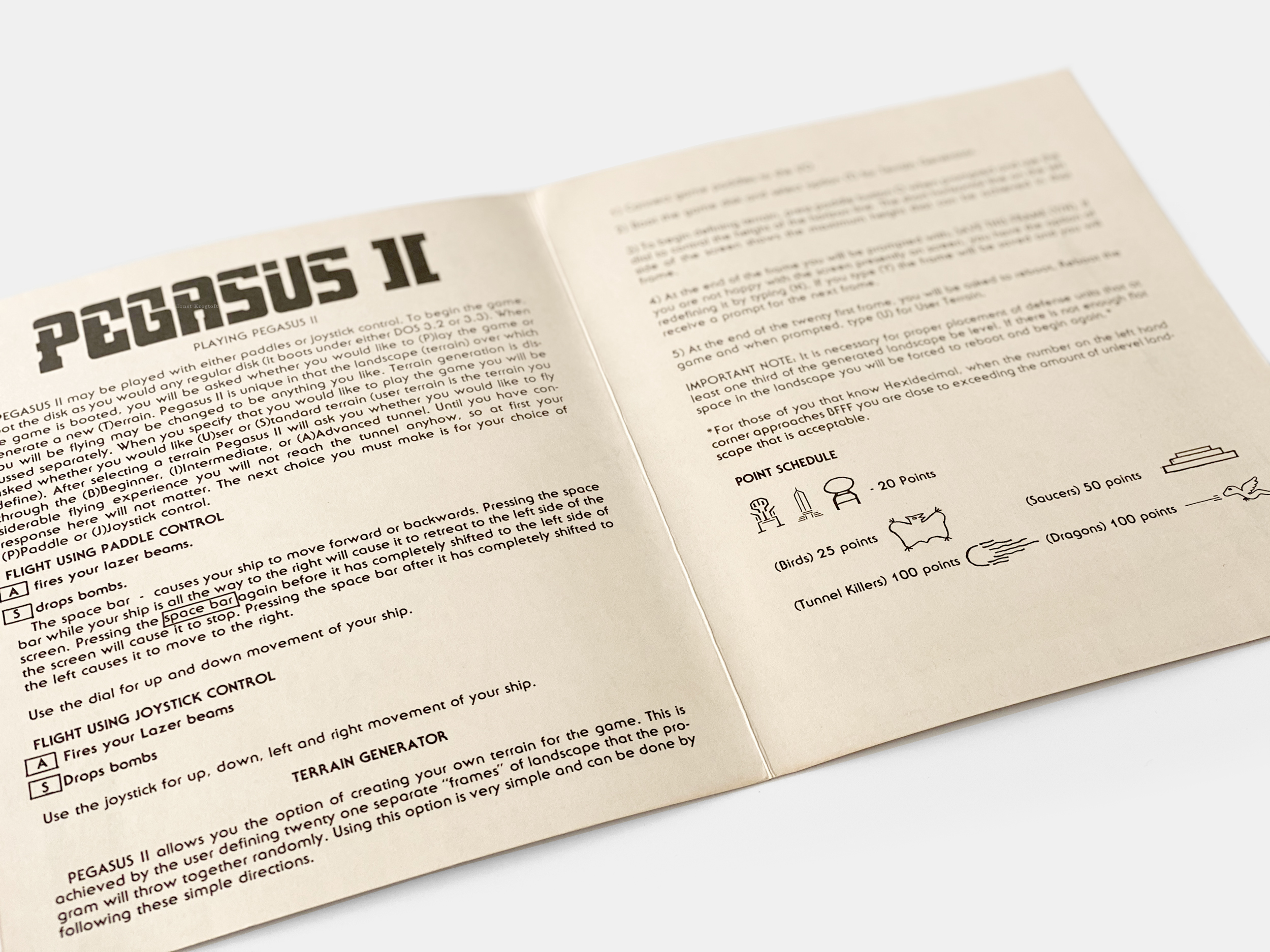
The included Terrain Editor allowed for the design and creation of new levels with the player creating 21 individual frames, each representing a different section of the terrain. These frames would then be combined randomly by the program and generate the final level
Lubeck would, while still working as a researcher in the Computer Research and Applications Division of Los Alamos National Laboratory, continue to partner up with On-Line Systems and write Cannonball Blitz in 1982.
Konami’s Scramble became so well received that a new arcade version, replacing the spaceship with a helicopter and increased difficulty was made. The new version was released later in 1981 under the title Super Cobra after The Bell AH-1 SuperCobra helicopter.
Sources: Shmuptacular, Lifewire, Wikipedia, InfoWorld…

 Retro365