
By the latter part of the 1980s, Sierra On-Line had firmly established itself as the definitive name in the graphical adventure game genre. A quick look at the company’s adventure game portfolio in 1987 showed familiar and highly successful titles like King’s Quest, Space Quest, and Police Quest. All games created using the same formula, all 3rd person perspective text-parser-driven games, and all developed in-house using Sierra’s Adventure Game Interpreter, AGI.
Over the next two years, two notable additions would come to stand significantly out from the lineup, not only by being vastly different in tone and setting but also by not being developed in-house by Sierra.
In late 1987 Sierra had reached out to Evryware, Inc. a small but successful game developer from Washington state, with an offer to let them use the AGI development framework and create an adventure game of their liking. While Evryware had no experience in the adventure game genre, the company had an interesting movie-like approach to its game design, complemented by technological know-how. The company had been around since 1980, established by engineers Dave Murry and Joe Gargiulo, initially to develop arcade-style games for the CP/M operating system and the Heathkit/Zenith Z-89 personal computer.
The first three years saw a dozen arcade games developed for the Z-89 platform before the company switched focus to the much more popular x86 architecture used in the IBM PC and PCjr. The first game for the IBM PC platform was Championship Boxing, an impressive boxing game with strategic elements, initially to be published by Microsoft’s new Home Software Division, but analysts decided the otherwise rapidly expanding home consumer market still wasn’t big enough for Microsoft to invest in and withdrew from the deal. Luckily, Evryware’s contact person at Microsoft was an acquaintance of Sierra co-founder Ken Williams and told him about the game. Williams impressed eventually contracted with Evryware and published the game as Sierra Championship Boxing in 1983.
5 years later, with the impressive The Ancient Art of War series, published by Brøderbund, under the belt and with an offer from Sierra to create something unique, Evryware, which now included Dave’s brother, Barry, and sister, Dee Dee started working on a new adventure game set in a dystopian 2004 post-apocalyptic New York where aliens known as the Orbs, had invaded and consequently enslaved the world. The setting was truly darker and more chilling than anything previously associated with Sierra. The Murrys, having full creative autonomy over the project, aimed to distance themselves as much as possible from Sierra’s conventional adventure games.
In the bleak setting of a decaying Manhattan, the player, a New York City detective, is contracted by the newly founded alien dictatorship to take on the role of “Manhunter,” an enforcer of alien rule, to track down and destroy a ring of human militants and saboteurs out to end the alien siege.
Manhunter: New York featured a unique and innovative gameplay style, incorporating elements of both point-and-click and text-based adventures. Players would navigate through various locations in Manhattan, interacting with characters and objects to gather clues and solve puzzles to try and discover that the Orbs’ purpose might not be what they claim it to be.
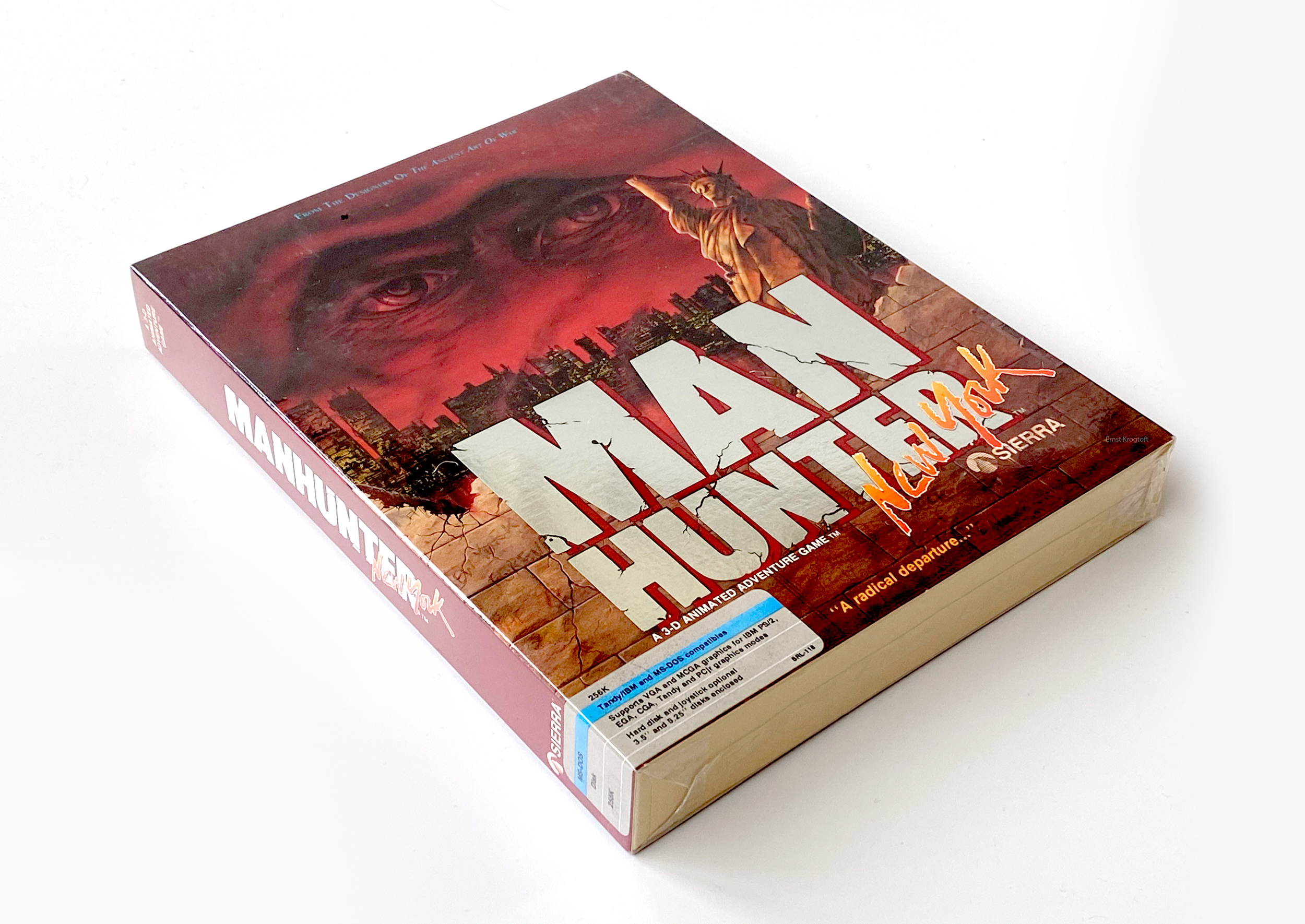
Manhunter: New York, developed by the Murry siblings of Evryware for the IBM PC and published by Sierra On-Line in 1988.
Later it was released for the Atari ST, Amiga, and the Apple IIGS platform
Manhunter: New York not only would feature an innovative movie-like approach to how the game was presented but would also be Sierra’s first large-scale non-text-parser-driven adventure game, with Evryware reworking the AGI frameworks to function more intuitively. Many of the game’s initiatives like extreme closeups, picture-in-picture, large panoramic views, switching between 3rd and 1st person perspectives, etc. would for the most part become standard in the genre later on.
Ken Williams had somewhat mixed feelings about the game. Neither he nor Sierra had been involved in the process and Evryware had only shown the game at the very last stage of its development. While he personally preferred games with a lighter and more family-friendly tone he recognized the game’s innovation and unique gameplay style.
Manhunter: New York was published for the IBM PC in 1988 and afterward ported to the Atari ST, Amiga, Apple IIGS, and Macintosh.
Manhunter: New York would significantly stand out from Sierra’s line-up of adventure titles in the late ’80s, not only by being vastly different in tone and settings but also by being developed by a third-party developer.
The text parser was dropped and options and choices to navigate and interact with the world were presented by a cursor controlled by keyboard or joystick
Manhunter was a welcomed sight in the Sierra adventure game catalog and Despite Williams’ personal preferences, he acknowledged the relative success and positive reception the game earned following its release and greenlighted the development of a sequel.
In the summer of 1989 the direct sequel, Manhunter 2: San Francisco was completed and published by Sierra. The game continued the story and begins with you, piloting an Orb ship and crash-landing in San Francisco while in pursuit of antagonist Phil Cook. Another Manhunter is killed in the crash and you assume his identity. As the game progresses, you learn of organized resistance, experiments that have created mutant slaves, and the real goal of the Evil Orbs. The game plays like its predecessor and just like it, you almost catch the antagonist in the end but he yet again barely escapes, this time to London, clearly paving the way for a third installment, which unfortunately never materialized.

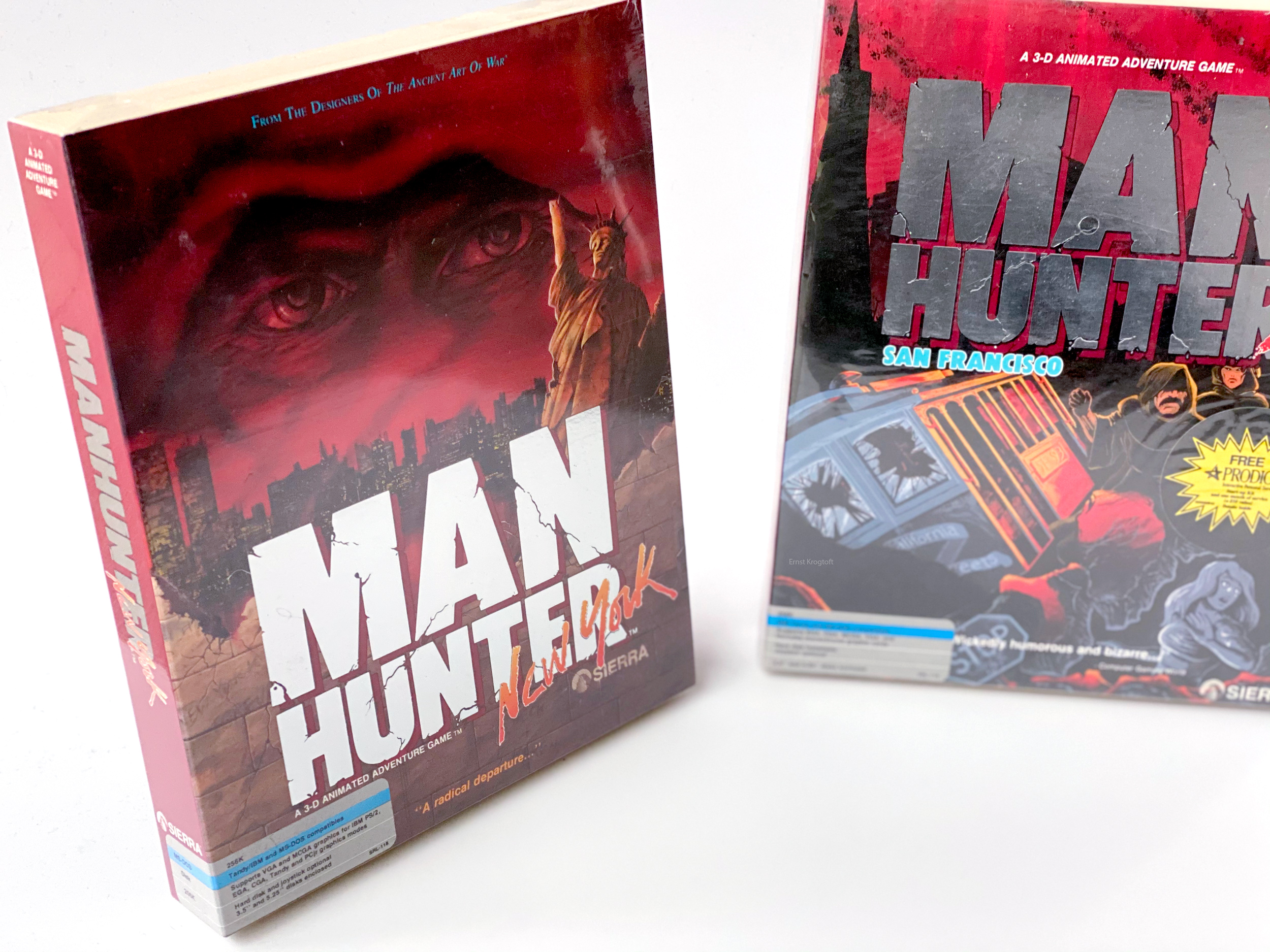
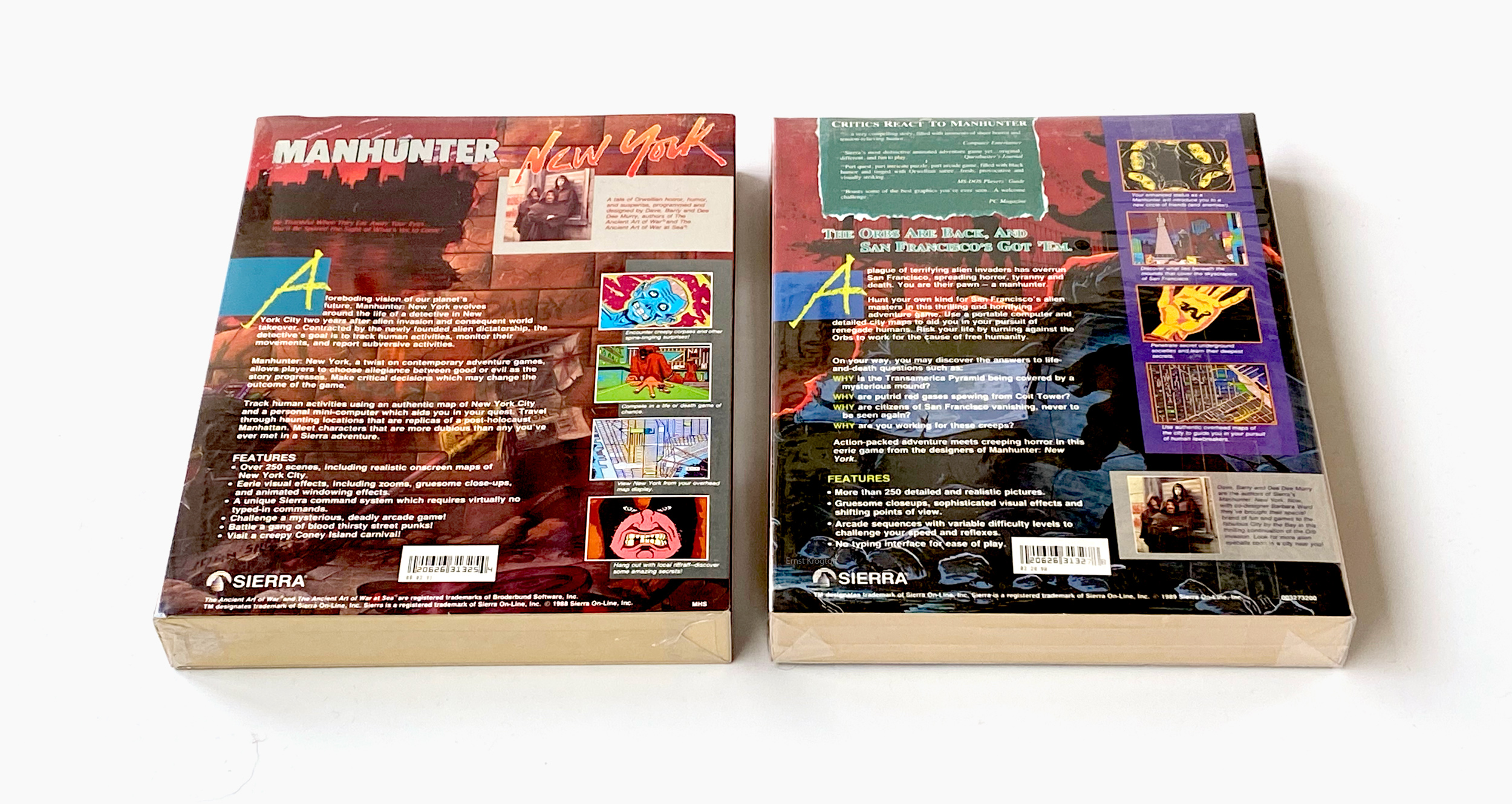
Manhunter 2: San Francisco was, like its predecessor, developed by the Murry siblings of Evryware and published by Sierra On-Line in 1989 for the IBM/PC, Atari ST, Amiga, Macintosh, and Apple IIGS
Manhunter 2: San Francisco looked and played just like the first title but had a bit more focus on inventory and the use of items
While both Manhunter games received a majority of positive reviews and sold over 100.000 copies each, they didn’t achieve blockbuster status like some of Sierra’s other popular titles.
Manhunter 2 would be the last Sierra game to be developed in the now aging AGI framework, initially created to help the development of the original King’s Quest back in 1983-84. Inhouse at Sierra the new Sierra Creative Interpreter, SCI had already been used with the two 1988 titles King’s Quest IV and Leisure Suit Larry 2, rendering the Manhunter titles somewhat technically outdated upon their release.
In 1990, King’s Quest V: Absence Makes the Heart Go Yonder would put the final nail in the AGI coffin, using Sierra’s new SCI1 framework with 256-color VGA support, and a fully mouse-driven interface. SCI would over the next 7 years see continual development alongside the technological advancements before reaching its last version with SCI3 used in Phantasmagoria 2: A Puzzle of Flesh.

Manhunter 2: San Francisco
Centerfold scan from Sierra News Magazine Vol. 2 No. 2 – Autumn 1989
I’ll be uploading the poster to my Sierra Centerfold poster article




 Retro365
One thought on “The Manhunter series, two Sierra adventure game deviants”