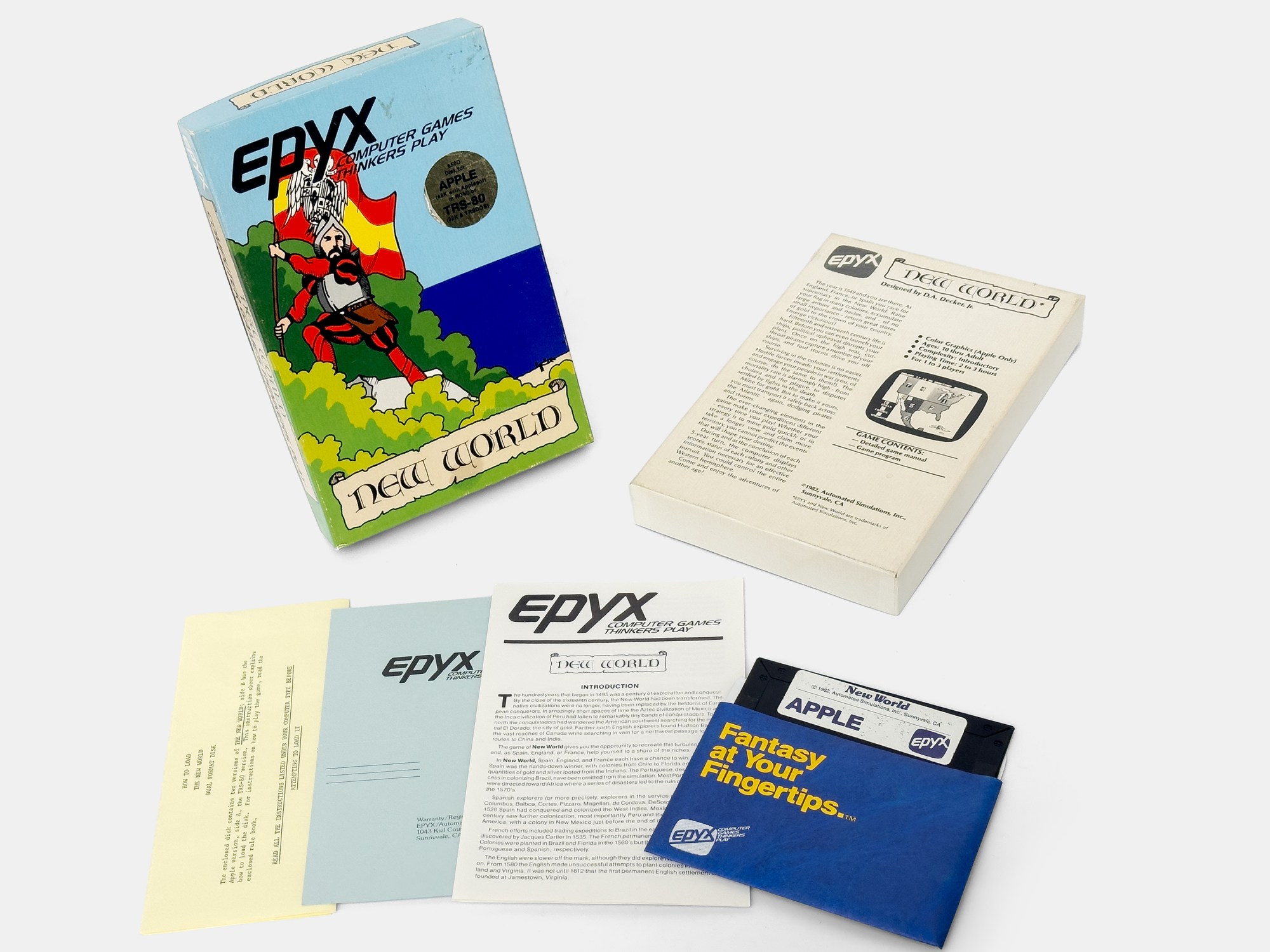
This article is more show than tell, as little to no information is available on either the game or its developer, D. A. Decker Jr. The only substantial information I was able to find comes from The Wargaming Scribe, who published a short write-up on the game in 2022.
By the end of 1982, Epyx was a company in transition. Founded as Automated Simulations in 1978 by Jim Connelly and Jon Freeman, it had spent the first few years building a reputation for home computer strategy and role-playing games, including the early Dunjonquest series. By 1982, the company was beginning to pivot, embracing a broader publishing model under its new Epyx branding. Among the titles that emerged during the transitional period was a little-known turn-based strategy game called New World.
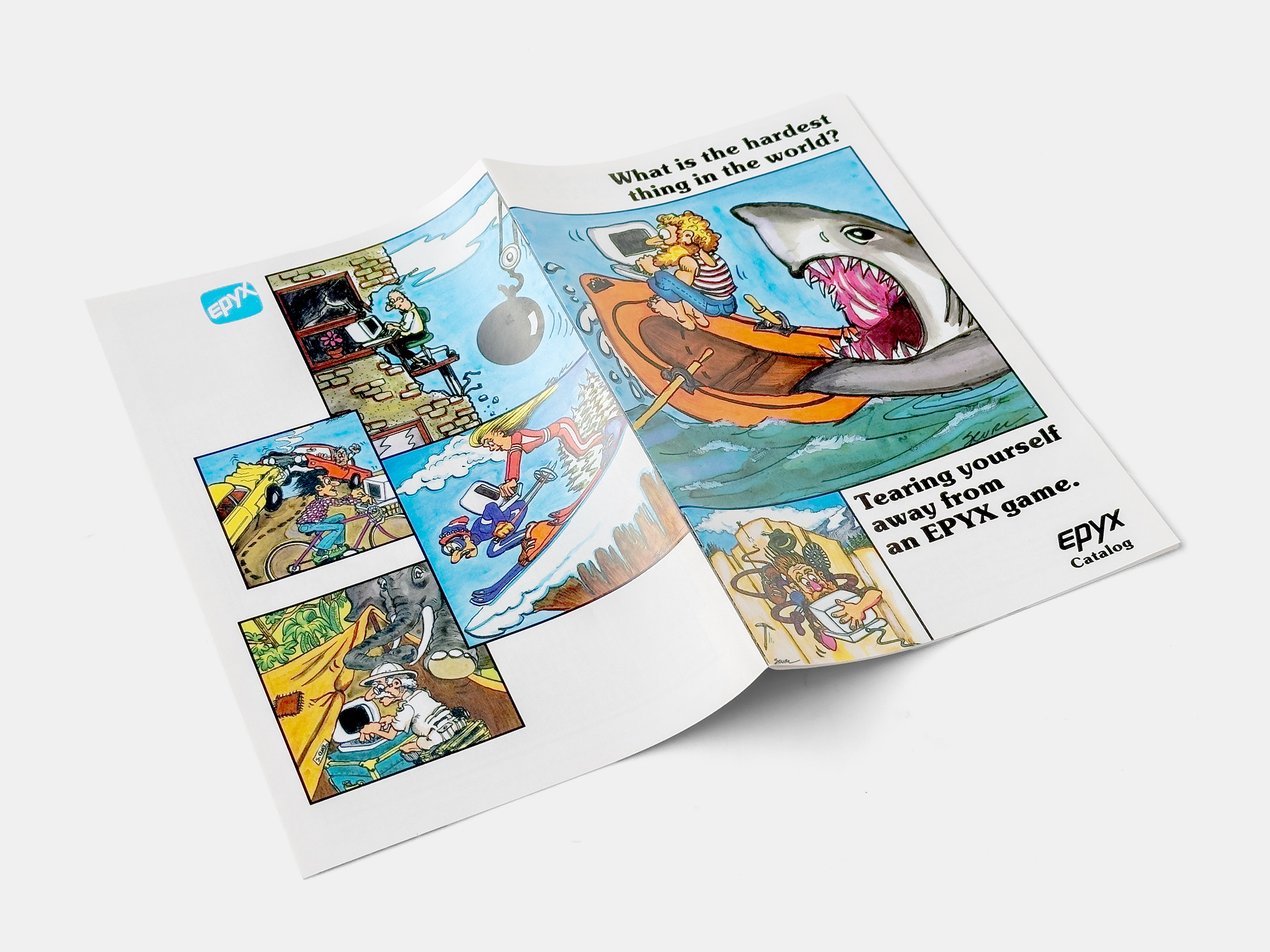
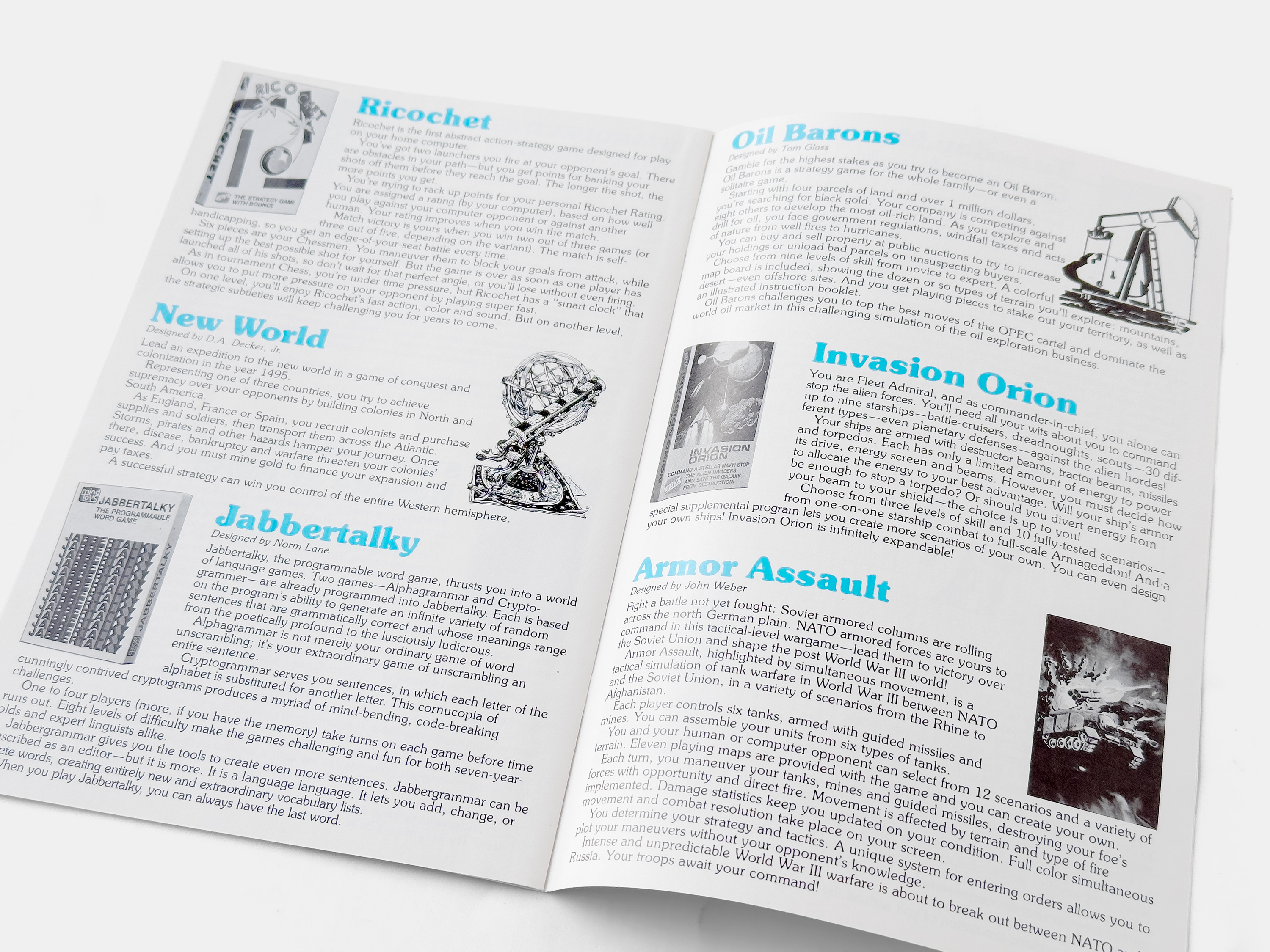
The early 1980s were a time of rapid change for Automated Simulations. The departure of co-founder Jon Freeman in 1981 had left a void in design leadership, and the company was increasingly opening up to externally submitted games. At the same time, it was redefining itself as Epyx, a brand intended to carry its growing catalog into a broader market of home computers. Epyx’s catalog from late 1982 shows a mix of in-house titles and externally developed submissions, including Oil Barons, Armor Assault, Sword of Fargoal, Monster Maze, and D. A. Decker Jr.’s New World, representing everything from arcade action and role-playing to strategy.
Inspired by Simulations Publications, Inc.’s 1976 board game Conquistador, which simulates the exploration of the New World in the sixteenth century, Decker recreated many of its core mechanics in BASIC on his TRS-80 home computer. The game’s production tables, settlement formulas, and expedition mechanics closely copy those found in the board game. For calculating events and outcomes, Decker used a random number function to simulate the roll of a six-sided die.
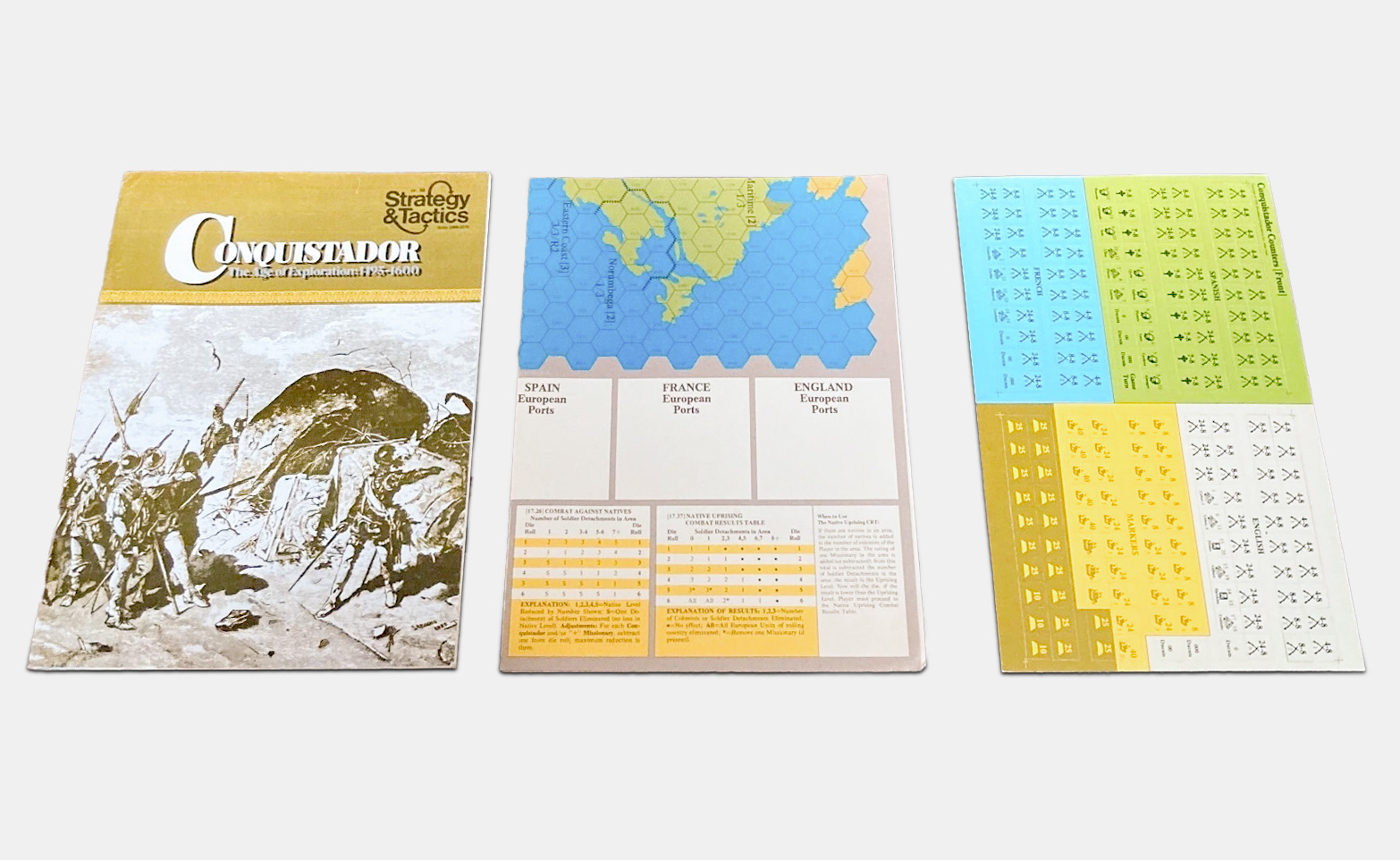
Issue 58 of Strategy & Tactics included Conquistador as a pull-out game simulating the exploration of the New World in the 16th century. Players assume the roles of European powers, sending expeditions to find gold and establish colonies. The game was designed by Richard Berg, with assistance from Greg Costikyan.
After TSR acquired SPI in 1982, the rights to Conquistador were sold to Avalon Hill, which slightly revised the rules, increased the number of counters to address supply limitations, and republished the game in 1983.
In 1990, Avalon Hill released a simplified version for 2–6 players titled New World.
Image from eBay.
Decker likely submitted the finished program to Epyx during the early period when the company was actively seeking external titles to expand its catalog. By 1982, the TRS-80, while still enjoying a sizable installed base, was showing its age compared to other machines. Epyx, eager to position its releases on more capable hardware, appears to have arranged a port to the Apple II, which not only offered graphics but color graphics capabilities, unlike the monochrome text-only TRS-80. One source reports that the Apple II version was converted from the TRS-80 by Steve Bryson, who produced a direct port in Applesoft BASIC while adding routines to show Hi-Res graphical elements.
New World was announced in the EPYX Software 1982 Catalog in December and was released either around that time or in early 1983.
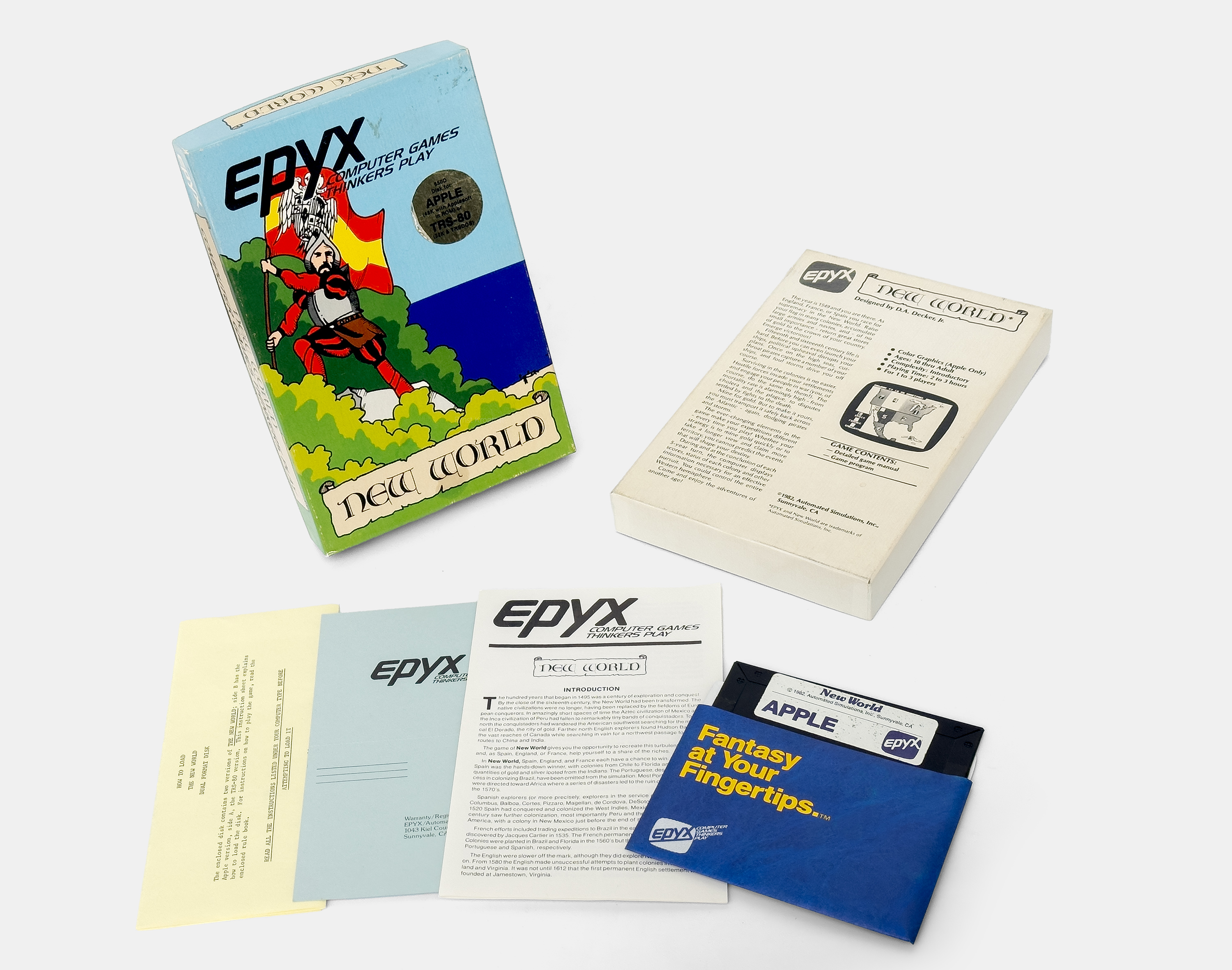
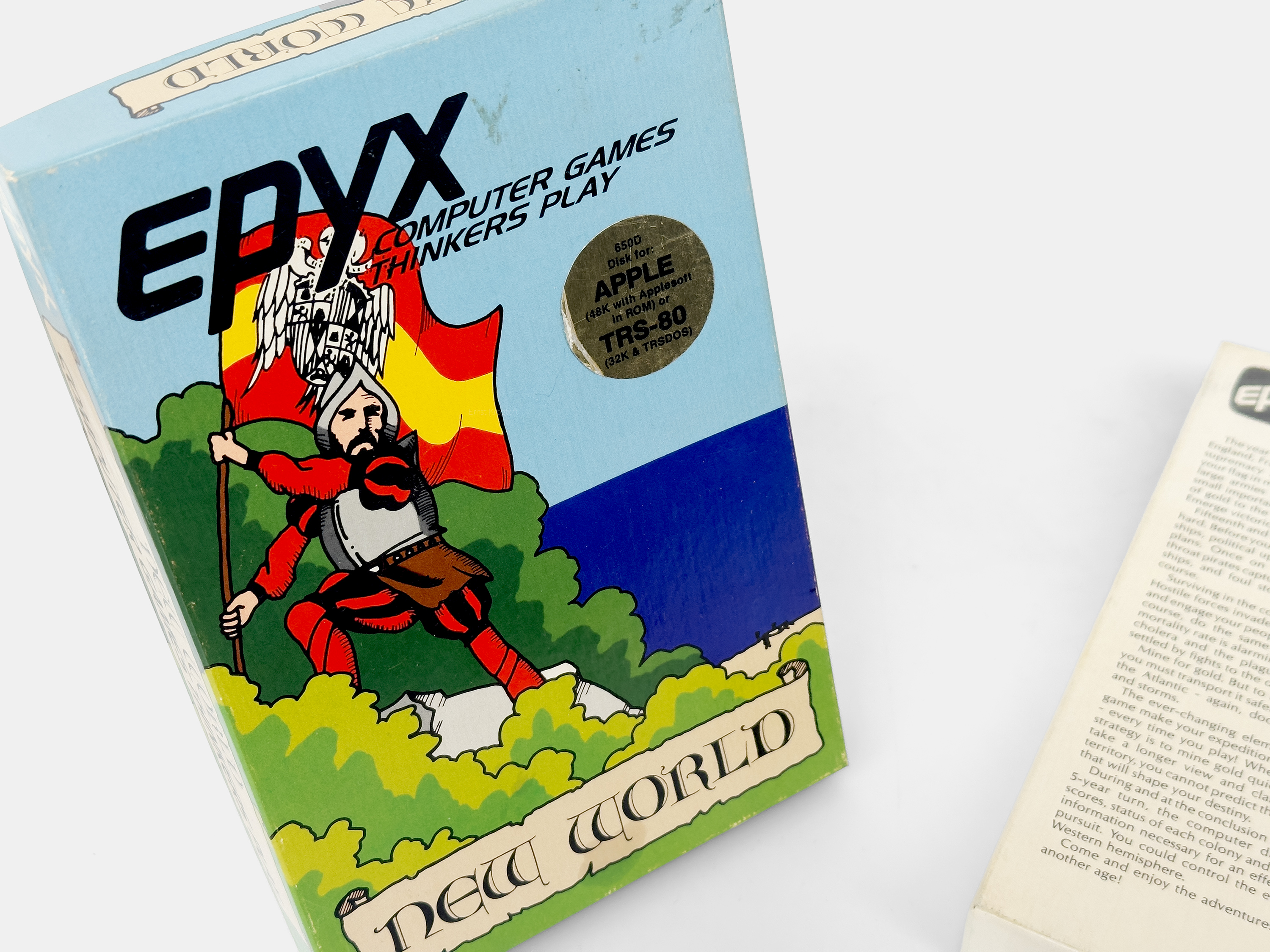
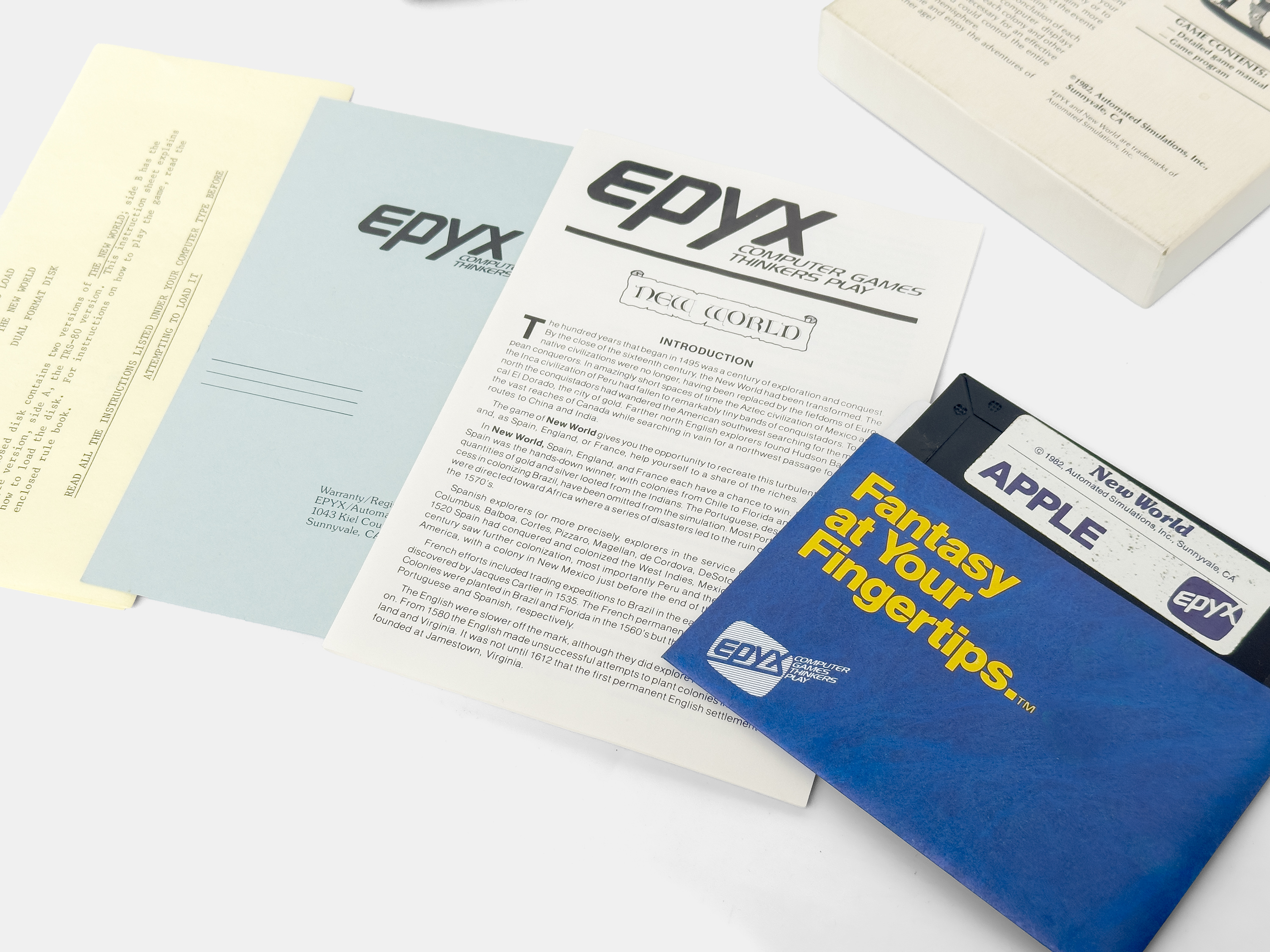
New World was published by Epy in late 1982 (or early 1983).
It was sold on a 5¼-inch floppy disk and included Decker’s original TRS-80 version alongside the Apple II port.
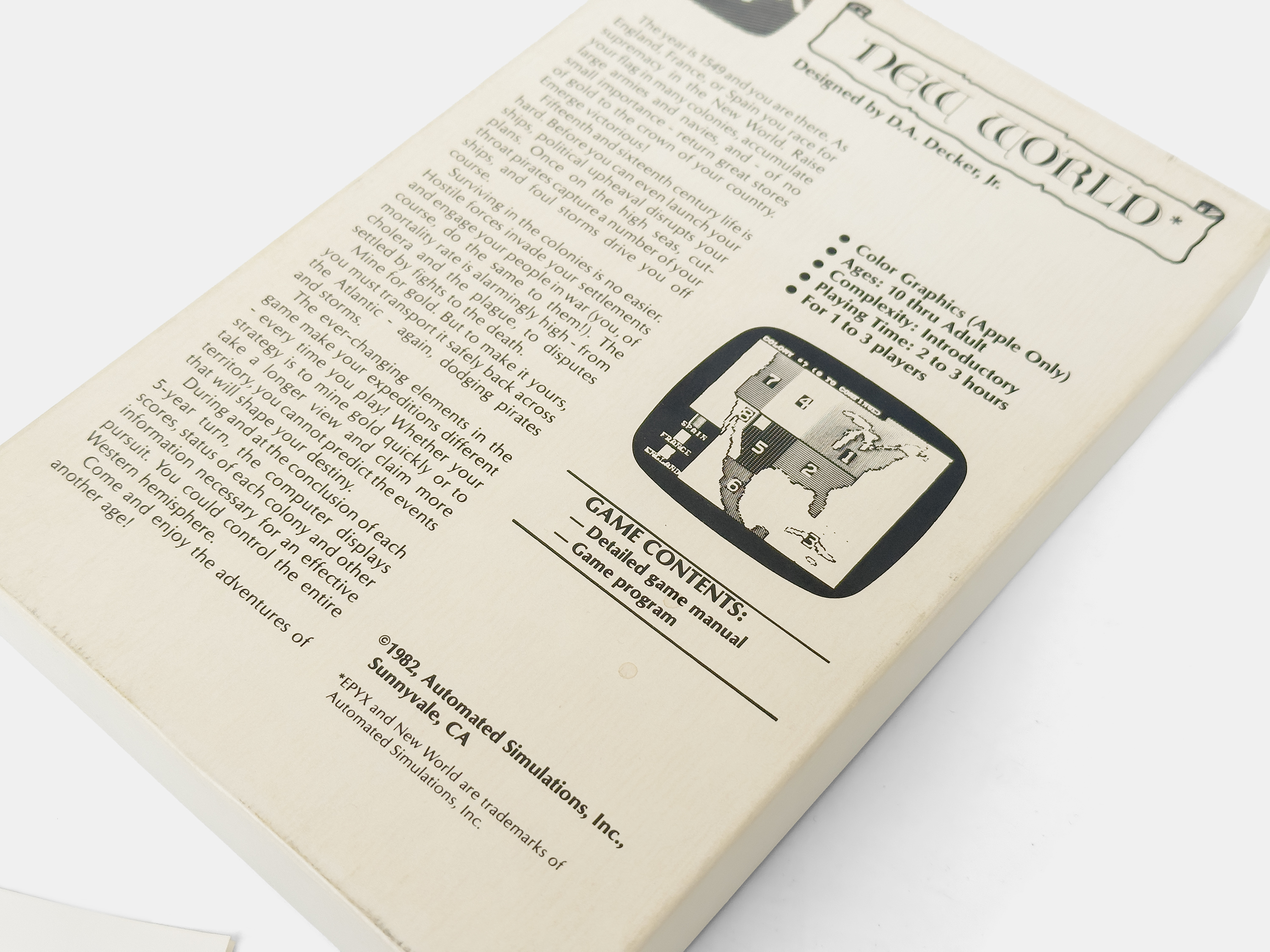
New World is a turn-based strategy simulation of European colonization in the Americas, beginning in 1495. Up to three players take on the roles of England, France, or Spain, leading expeditions across the Atlantic, establishing colonies, mining gold, and competing with rival European powers and Native tribes. Random events like storms at sea, European wars, corruption, and uprisings create unpredictable challenges. Each turn represents five years, with the first turn in 1495 and the game concluding in 1600 after 22 turns.
For a detailed explanation of the game and its mechanics, see The Wargaming Scribe -always an excellent resource.
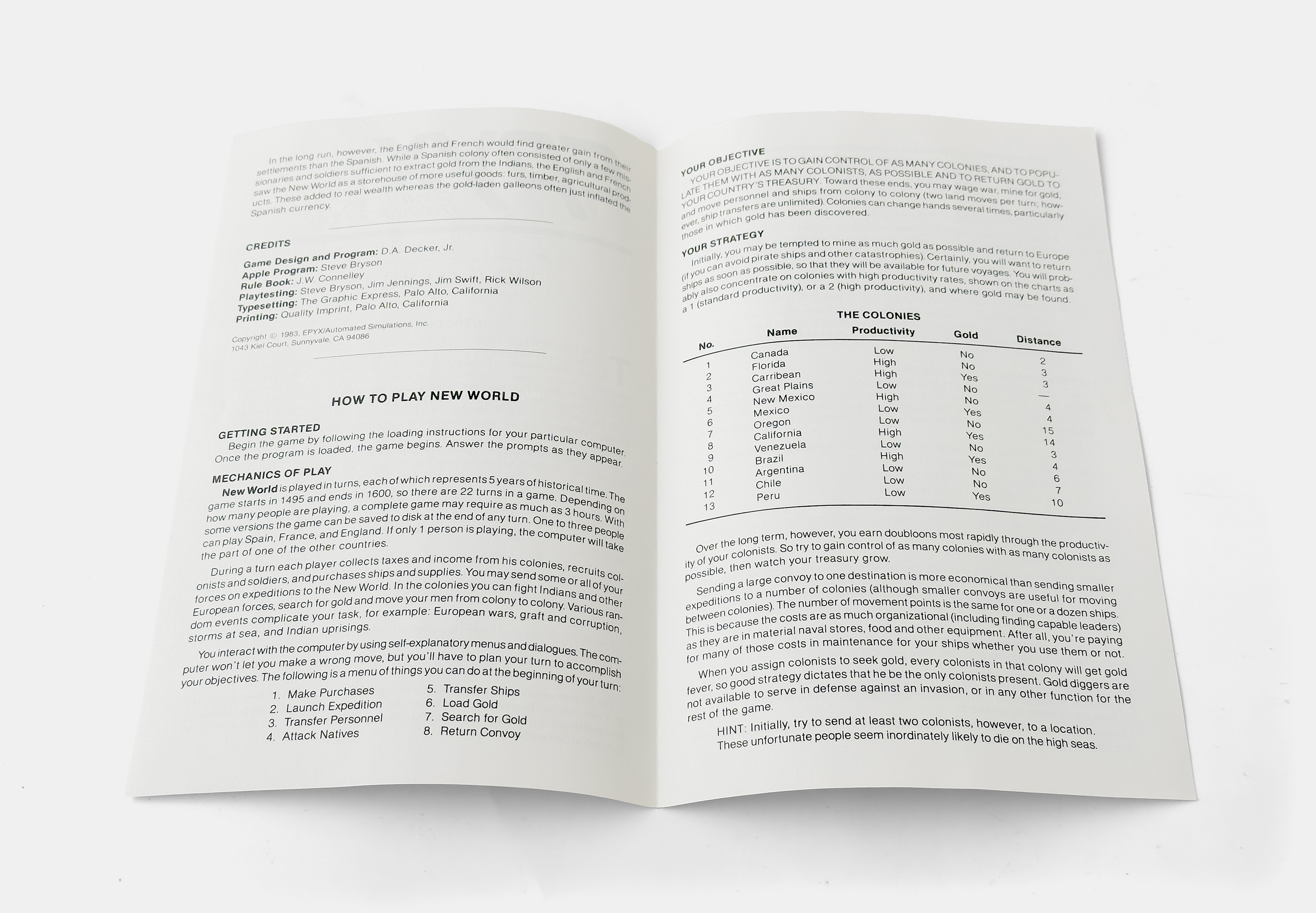
The original New World manual was unclear on certain aspects of gameplay.
In 2022, Mike D “Porkbelly” examined the game’s original BASIC code and recreated a complete manual. The updated manual is available on the Internet Archive.
Beyond a brief mention in Arcade Express in April 1983, contemporary magazines barely acknowledged the game. Computer Gaming World described it only in passing, noting its resemblance to board-game mechanics and warning that pressing RETURN at the wrong moment could crash the program. No full reviews appear to have survived, and the game seems to have passed largely unnoticed by both players and critics.
New World was most likely a hobby project for Decker, perhaps developed as part of the era’s active tabletop and wargaming communities. Translating board games into BASIC programs was a common exercise for early home computer enthusiasts, and Conquistador’s rather simple mechanics provided a natural framework for such an experiment. The game appears to have sold poorly, and Decker himself disappears from the historical record after its release. No other games or software projects are known to bear his name.
Sources: The Wargaming Scribe, EPYX Software 1982 Catalog, Internet Archive, Wikipedia…
 Retro365