By the late 80s, Spectrum Holobyte was in the midst of major changes. Originally founded in 1983, the company had established itself with high-end simulation and strategy games. In 1987, the company merged with another software house, Nexa Corporation, founded by Gilman Louie, a young entrepreneur with a strong interest in simulations and emerging computer technologies. The merger created a new corporate entity called Sphere, Inc., which acted as an umbrella for both Spectrum Holobyte and Nexa, with the two companies continuing to be listed as separate divisions under the Sphere name. Sphere’s ambitions were fueled by serious financial backing from British media magnate Robert Maxwell, who owned 89% of the company.
Spectrum HoloByte went on to publish the first version of Tetris in the United States in 1988, which sold over 100,000 units in its first year. For a time, Tetris and the backing by Maxwell provided stability and resources, and Sphere pursued several ambitious software projects as it positioned itself at the cutting edge of PC game development with titles like Falcon, one of the most detailed and accurate flight simulators on the market, and Vette!, a groundbreaking open-world 3D driving game.
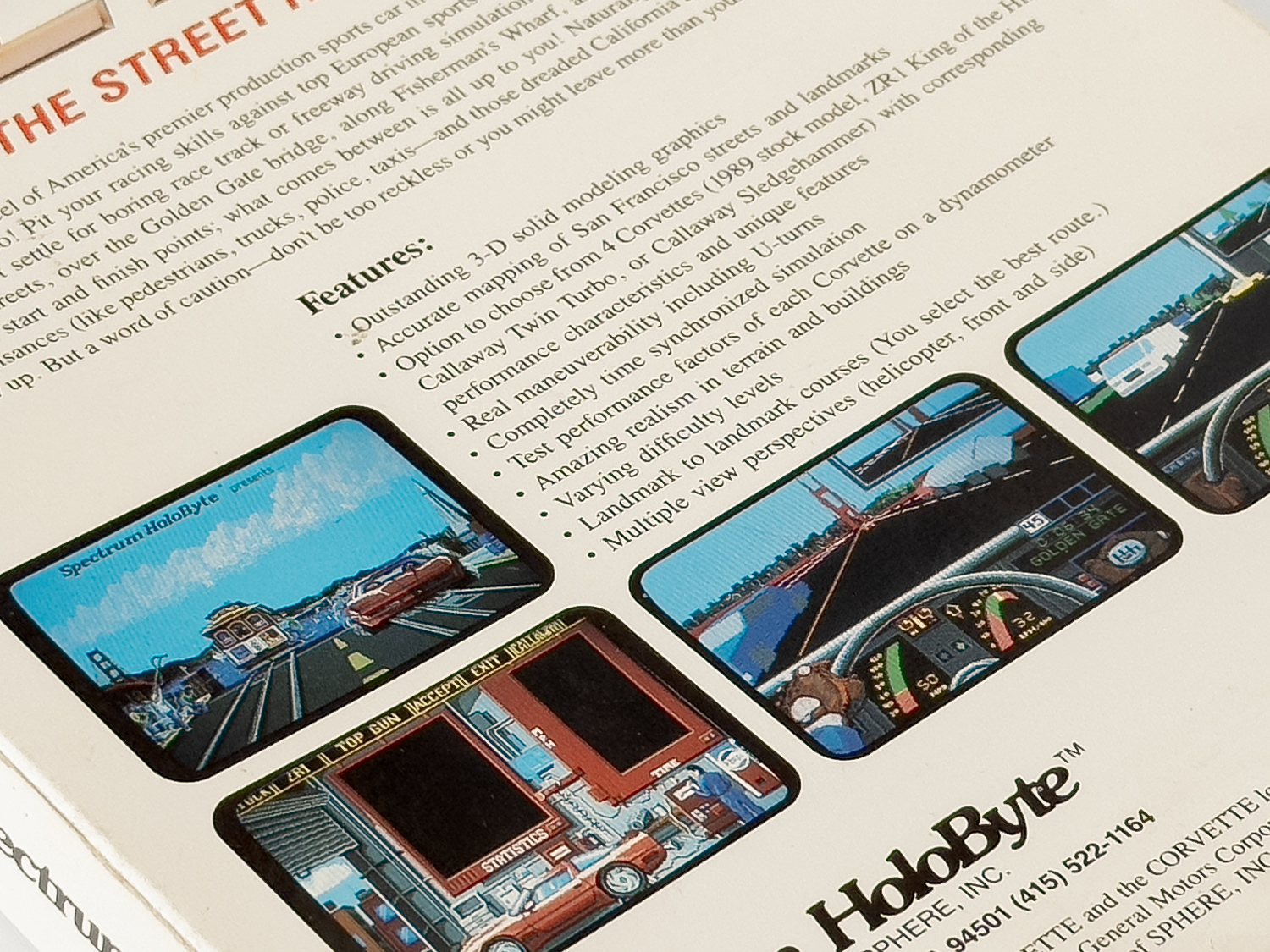
Developing a fully 3D driving game in 1988–89 was an ambitious undertaking, but that didn’t deter the small team at Sphere from setting their sights even higher. With remarkable attention to detail, they modeled San Francisco’s distinctive topography, capturing the steep, winding streets that defined its character. Many of the most recognizable landmarks, such as the Golden Gate Bridge and the Transamerica building, were created as simplified but unmistakable 3D forms.
Sphere used a unique blend of visual techniques. While the driving view was rendered in real-time 3D polygons at 320×200 resolution (without textures, due to hardware limitations), Vette! featured still images, roadside scenes, menus, and crash screens, presented in high-resolution EGA graphics. These static screens offered crisp, colorful images at 640×200 resolution, an unusual choice in an era when most EGA games stuck to the 320×200 standard.
The 640×200 mode was originally intended for business and professional applications and was ideal for displaying sharp fonts, diagrams, graphs, and business charts, especially in software like Lotus 1-2-3, WordPerfect, or early CAD applications. The mode was rarely used in games due to performance constraints, but some games, like Vette! used it for detailed static screens.
Vette! also pushed boundaries with its multiplayer mode using their Head-2-Head technology, allowing two players to compete over a serial (null modem) or network connection (modem), a rare feature in 1989, and a clear sign of the developer’s forward-thinking approach.
When Vette! was released in 1989 for IBM-compatible PCs, it immediately stood out from the pack. While the majority of contemporary driving games were confined to flat tracks and linear courses, Vette! offered something entirely different, an early glimpse of the open-world design philosophy that would later define an entire generation of games.
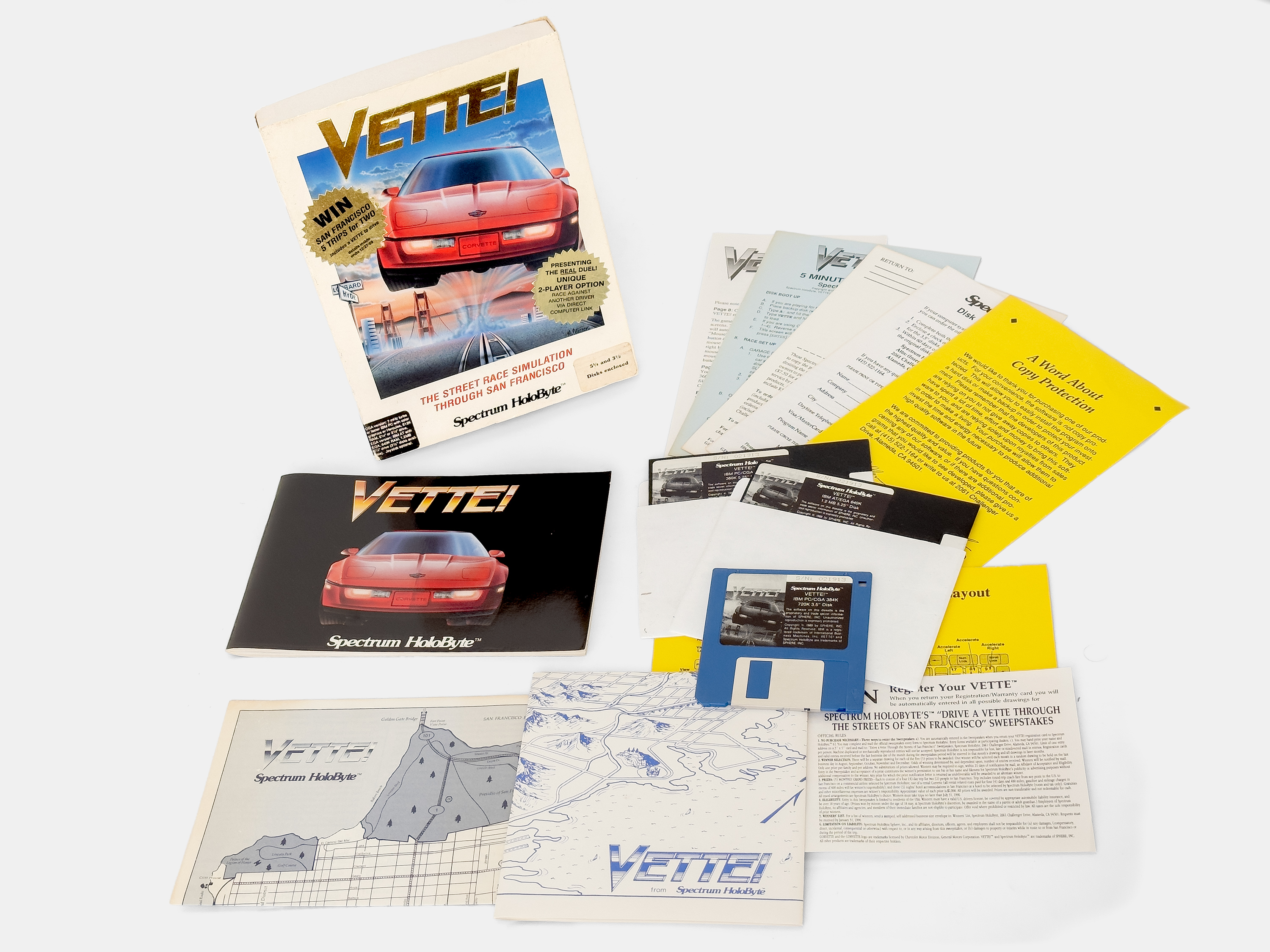
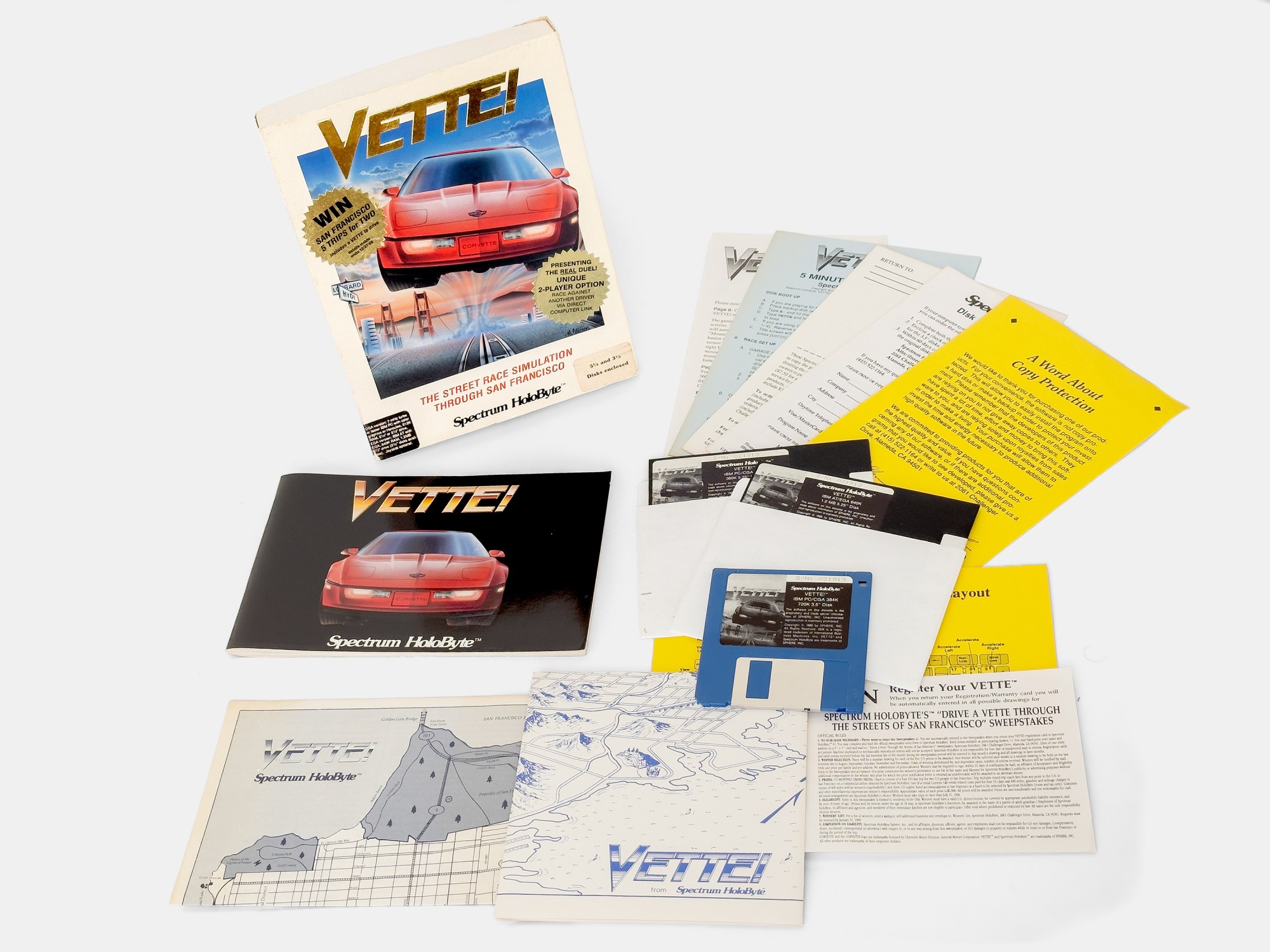
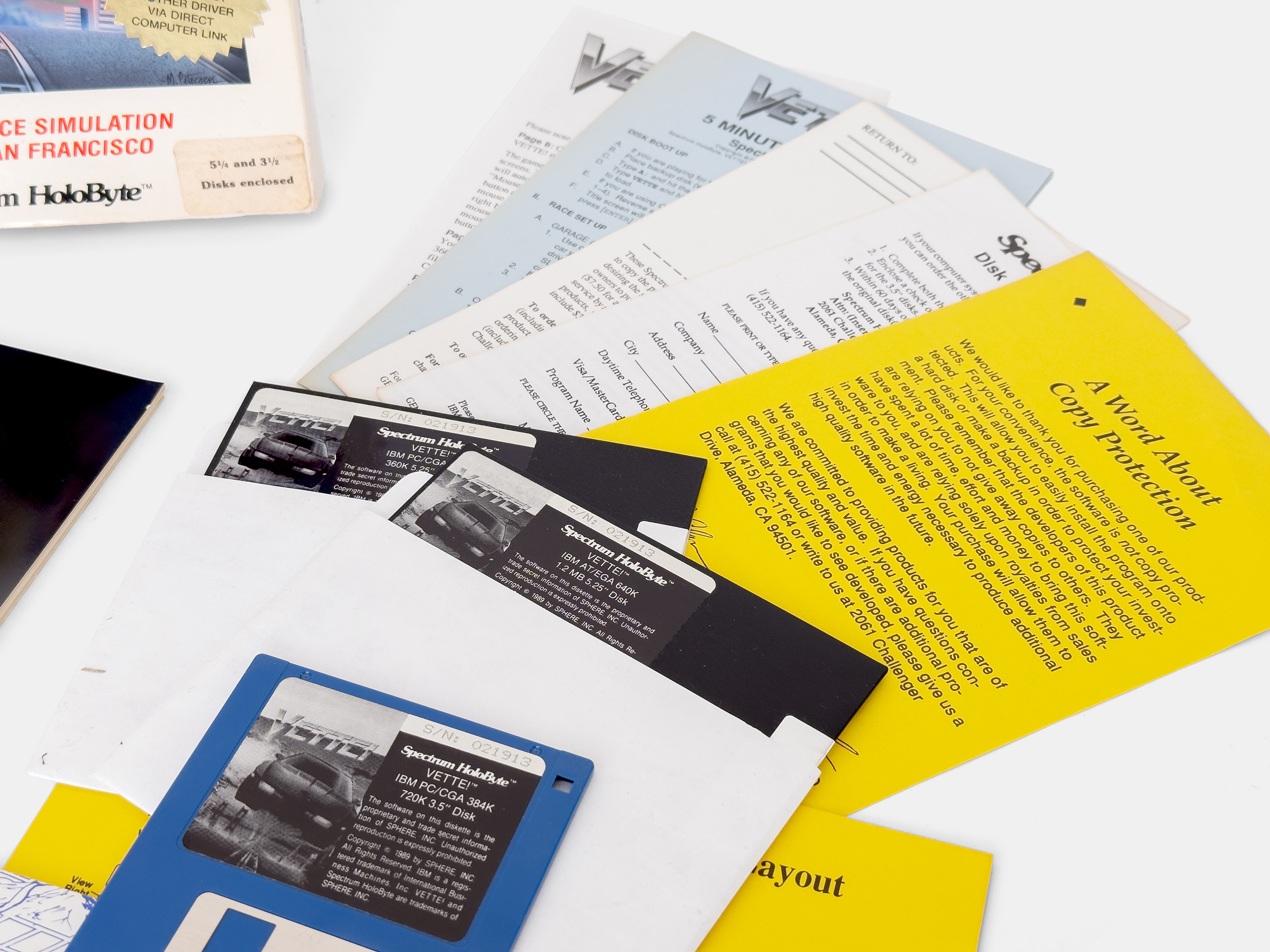
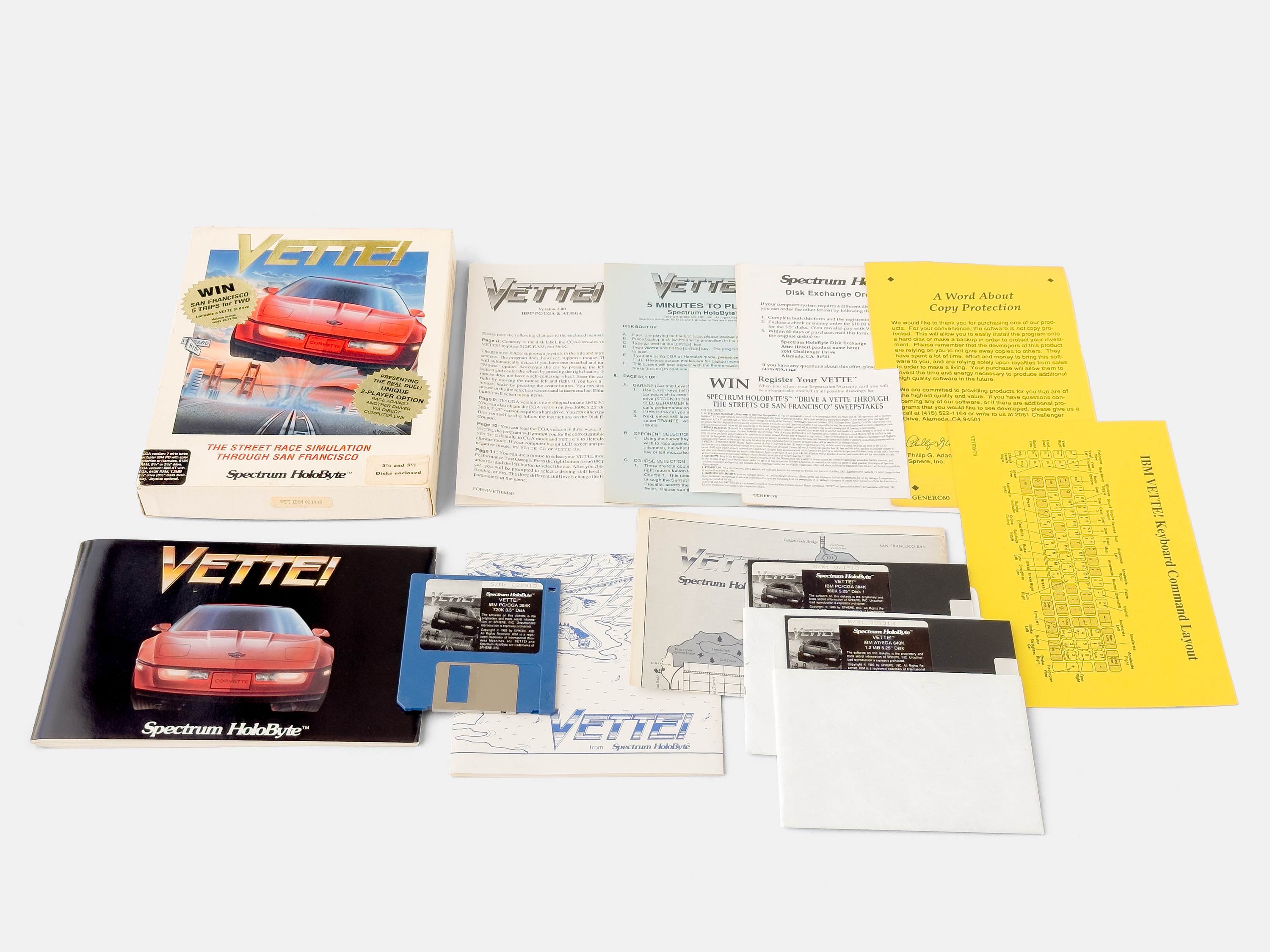
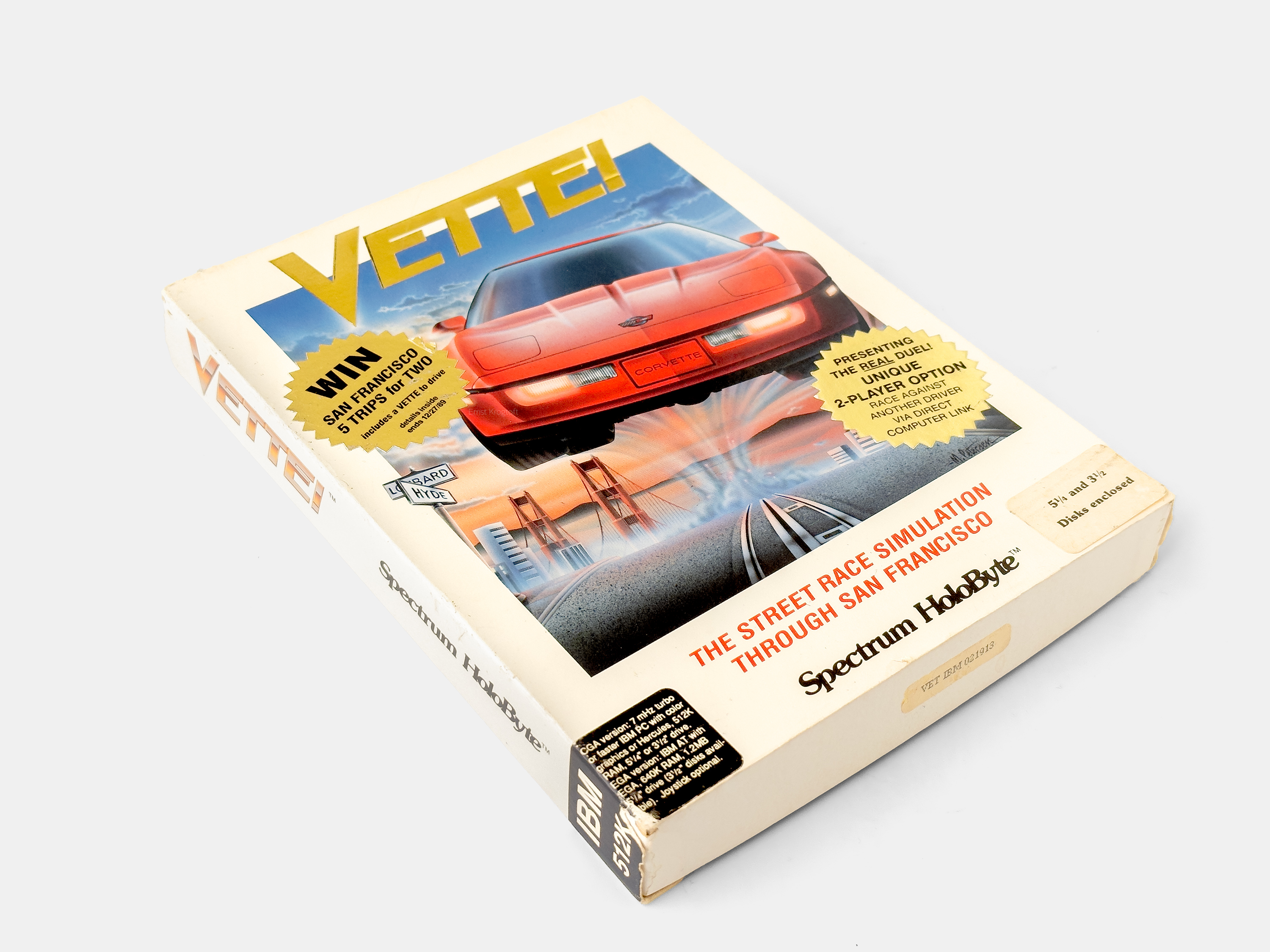
Vette!, published for the IBM PC in 1989 by Spectrum Holobyte, came packaged with content that matched its ambitions. Alongside the game disks came a richly detailed manual, done like an owner’s manual, and two fold-out maps of San Francisco, providing players with a bird’s-eye view of the city’s roads, landmarks, and race routes.
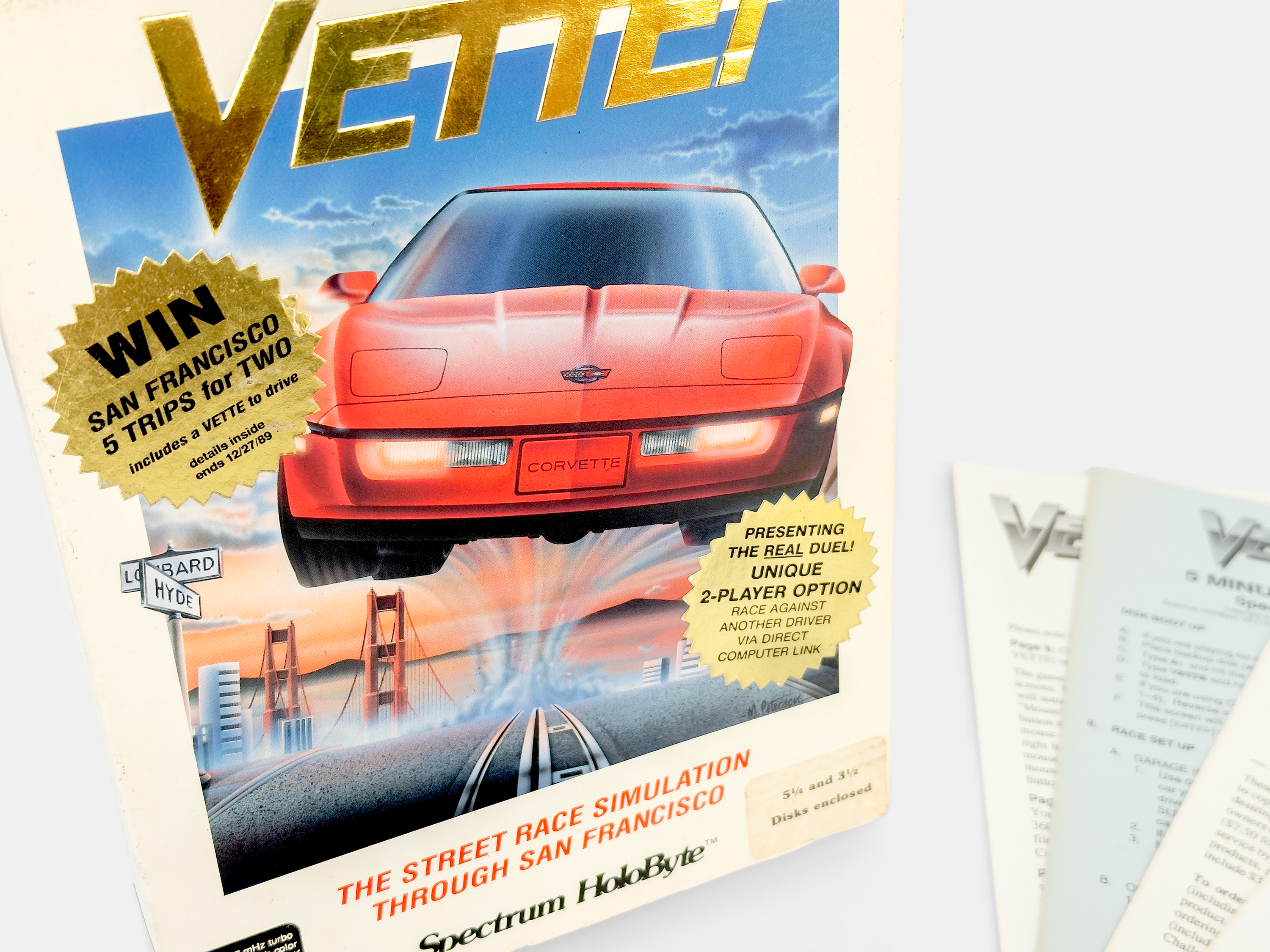
Players could choose from a range of 1989 Corvette models, everything from a base model to the high-performance ZR-1 and two custom-built Callaway twin-turbos, each offering different handling and top speeds. The objective was to outrun a series of European challengers in point-to-point races across the streets of San Francisco.
Vette! was no ordinary driving game. Its open-ended structure allowed players to stray off course, leap off hills, evade police, and carve their own chaotic routes through the city. At a time when most racers were bound to closed circuits, Vette! invited players to explore, bend the rules, and even break them. In doing so, it foreshadowed the sandbox chaos and creative freedom that would define later titles like Driver and Grand Theft Auto.
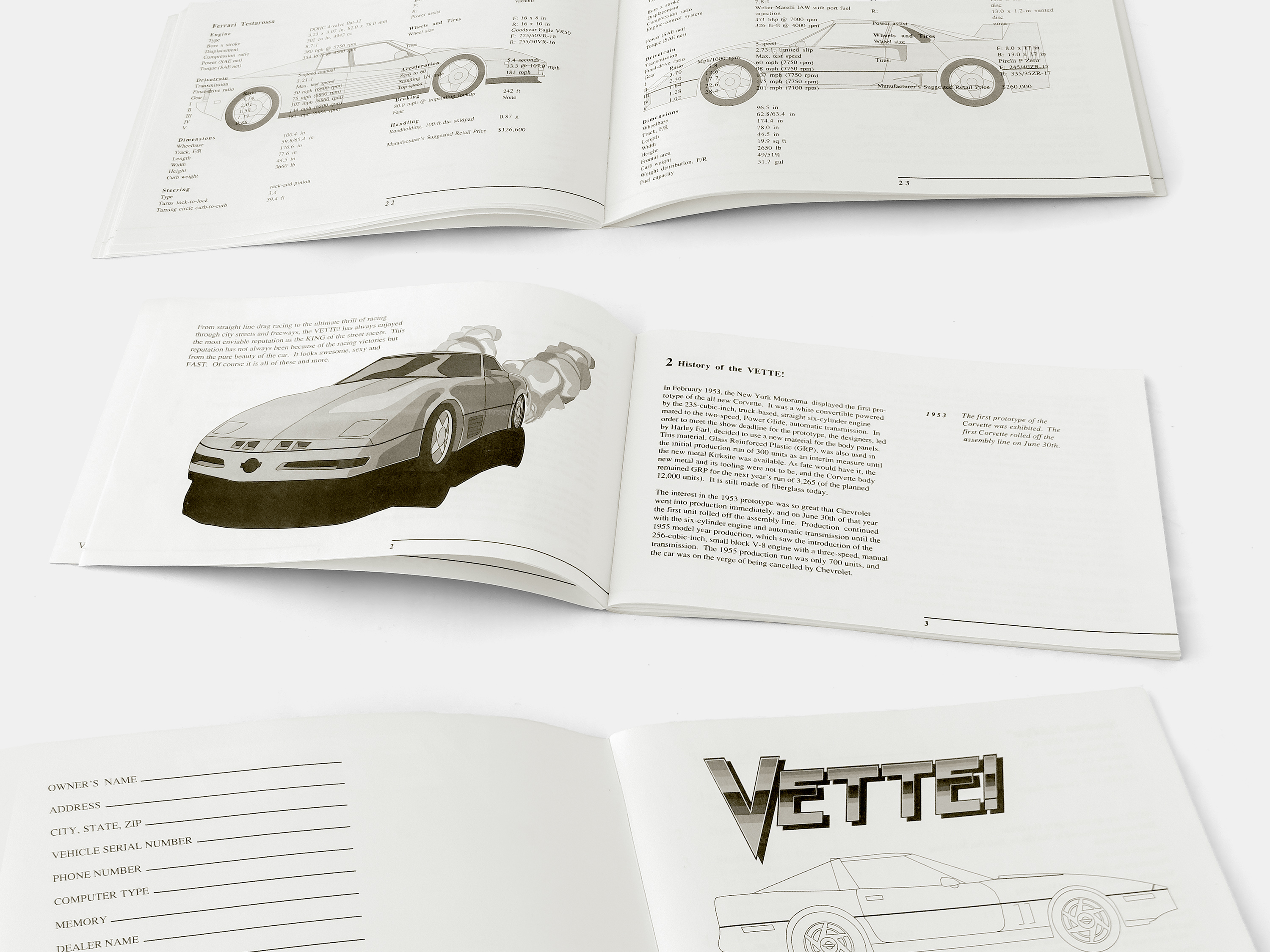
The manual, far more than a simple instruction booklet, included history and detailed information on the Chevrolet Corvette alongside gameplay mechanics.
The manual also acted as copy protection, as the disks were not protected.
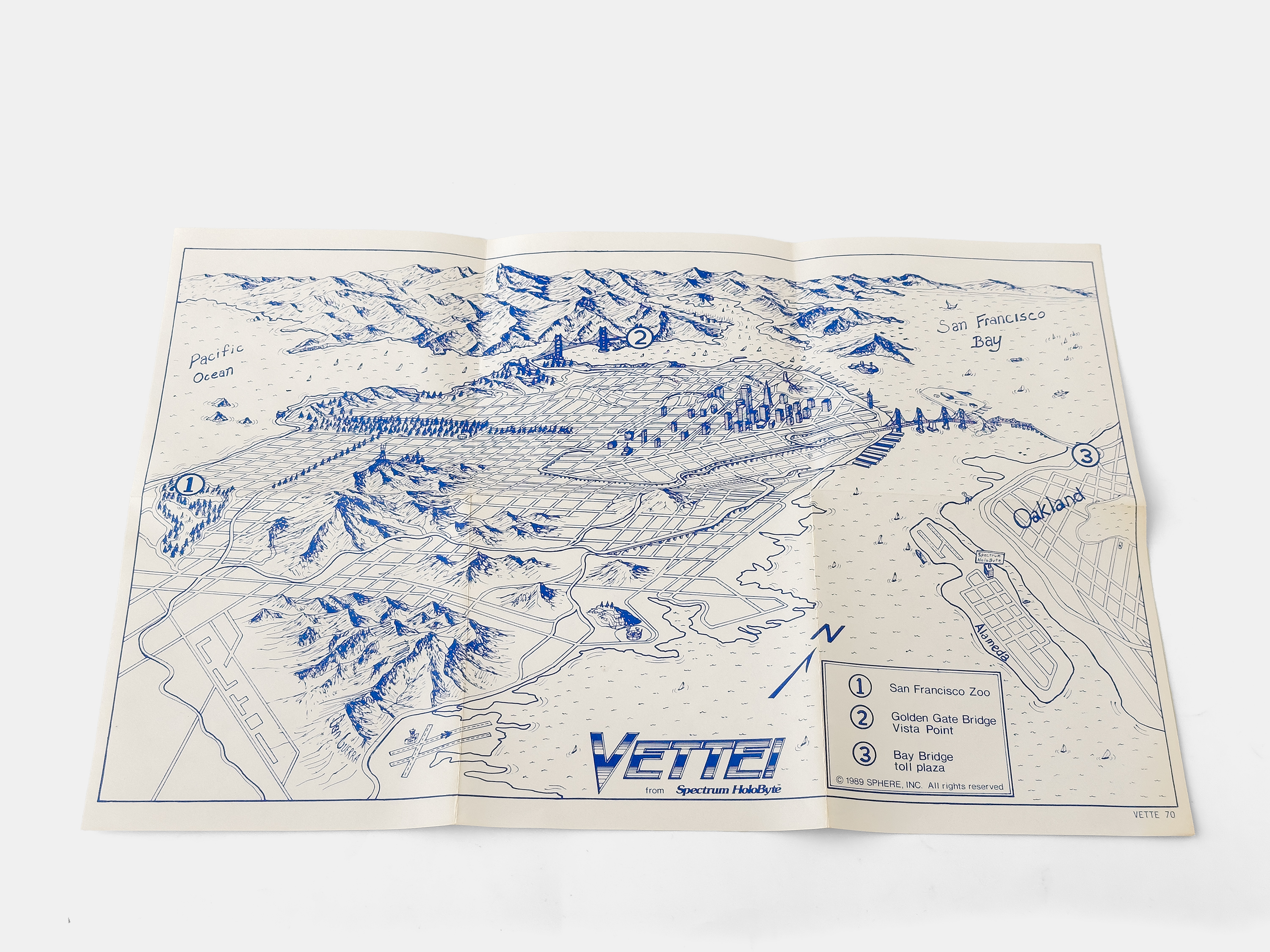
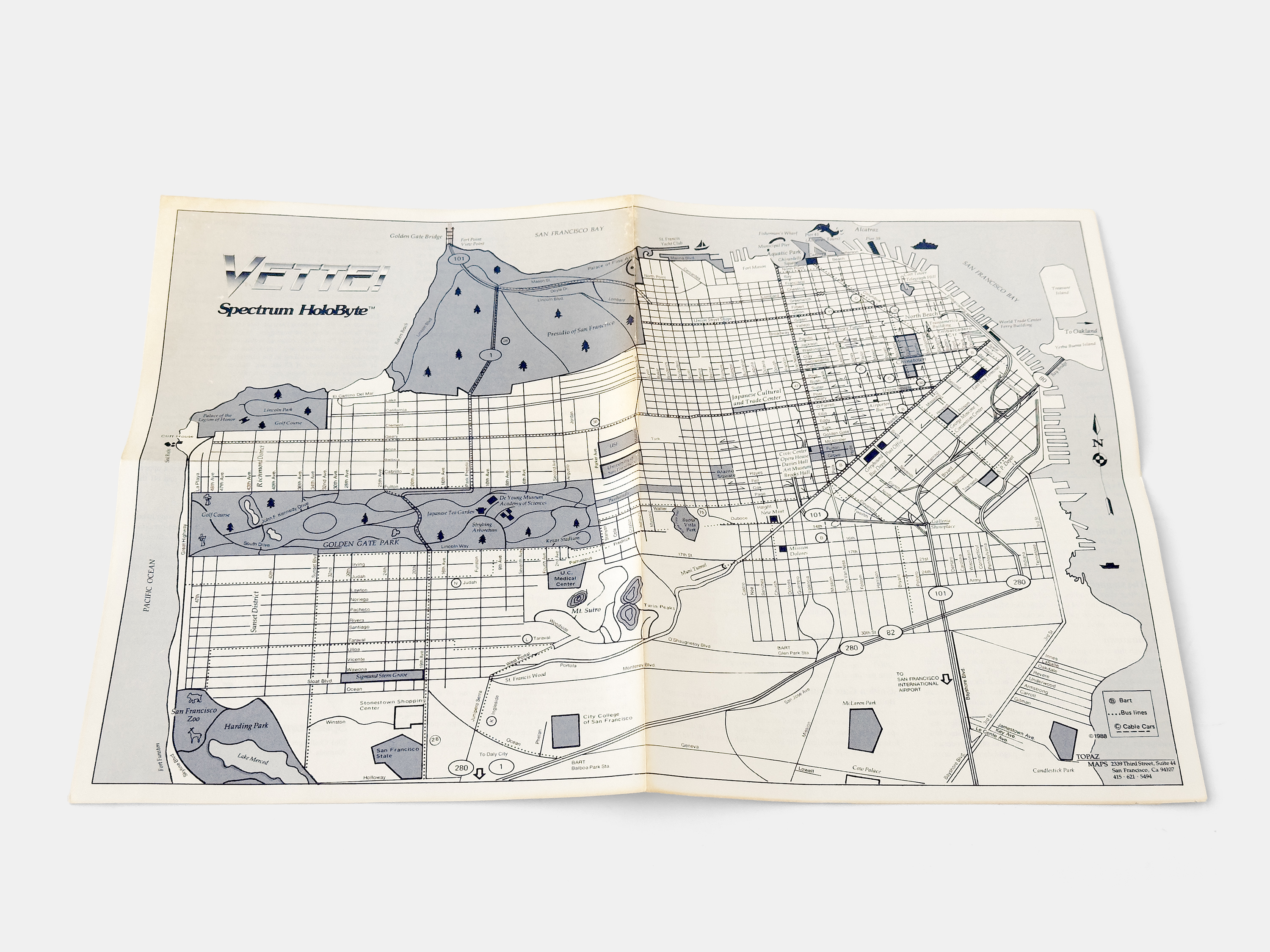
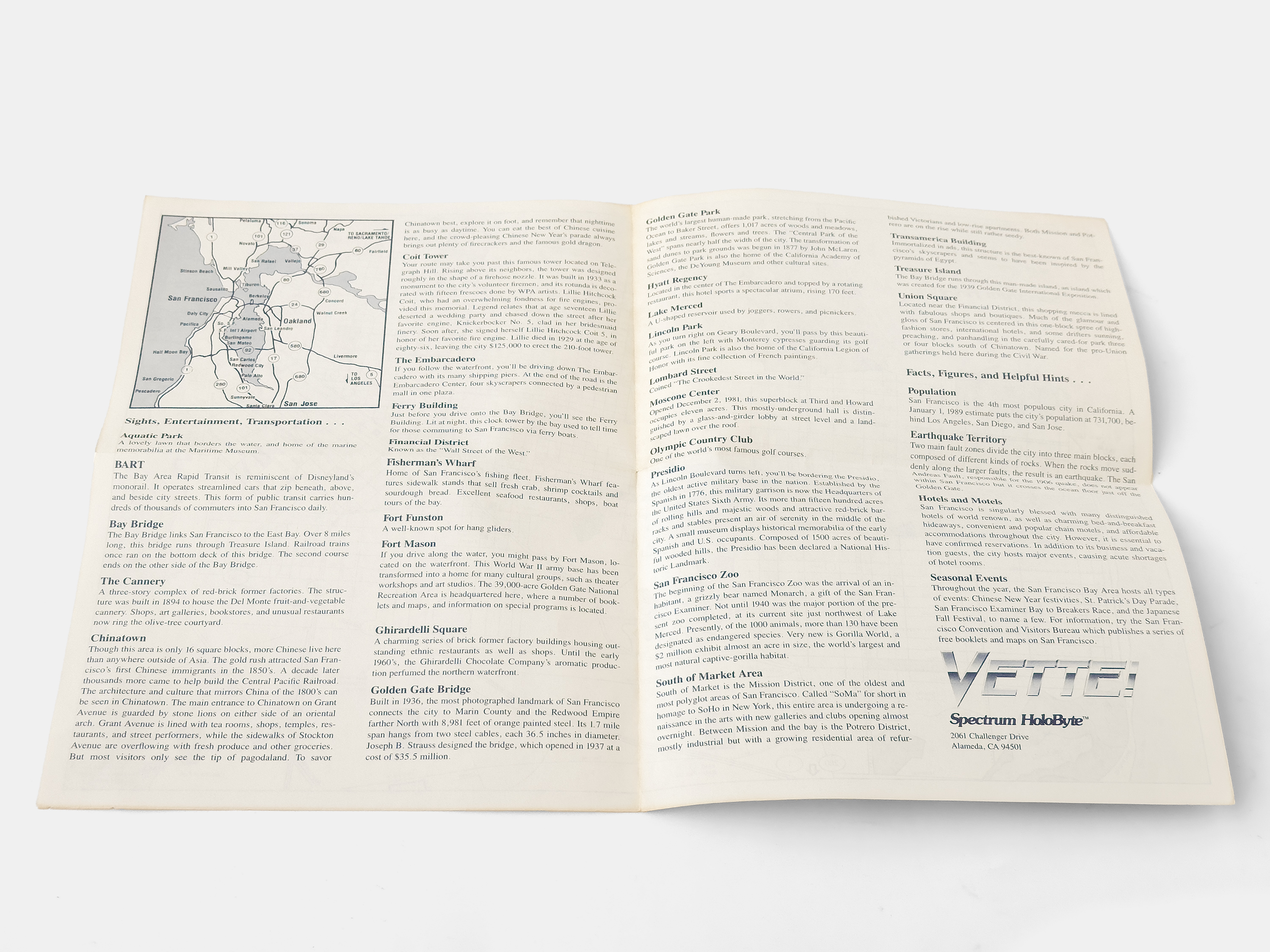
The two included maps show San Francisco, the race courses, and information on the landmarks featured in the game.
Many magazines at the time praised the game’s massive 3D world and attention to San Francisco’s geography. Computer Gaming World called it “a milestone for driving simulations,” highlighting the level of freedom the game offered. Yet, Sphere’s grand ambition came at a cost. While critics and players alike were impressed by the scale and innovation, not all reviews were as glowing. The game’s clunky controls and inconsistent physics often proved frustrating. Steering could feel overly stiff, and acceleration or braking reactions were twitchy and unpredictable. Even a light collision would turn the player’s Corvette into an uncontrollable 3,300 lbs pinball. The game never spawned a sequel, but its influence lingered as a bold, if imperfect, early vision of open-world driving. It pushed the limits of late-1980s PC hardware, hinted at gameplay concepts that would later become industry standards, and helped cement Spectrum Holobyte’s reputation as a pioneer in simulation and innovation.
Vette! would be one of the last major titles to carry the Sphere, Inc. name. In November 1991, investor Robert Maxwell died under mysterious circumstances, reportedly falling from his yacht off the Canary Islands. The resulting financial chaos destabilized Maxwell’s sprawling business empire, Sphere included. In the aftermath, Gilman Louie stepped in to steady the company, eventually dissolving the Sphere name and rebranding the business as Spectrum Holobyte in September 1992.
Spectrum Holobyte acquired MicroProse in 1993 and merged its simulation heavyweights under one roof. Meanwhile, 3D gaming would rapidly evolve with the spread of texture-mapped polygons and faster processors, making Vette! look primitive within just a few years.
sources: Wikipedia, Computer Gaming World, Giant Bomb, Mobygames, The Independent, Forbes…
 Retro365