
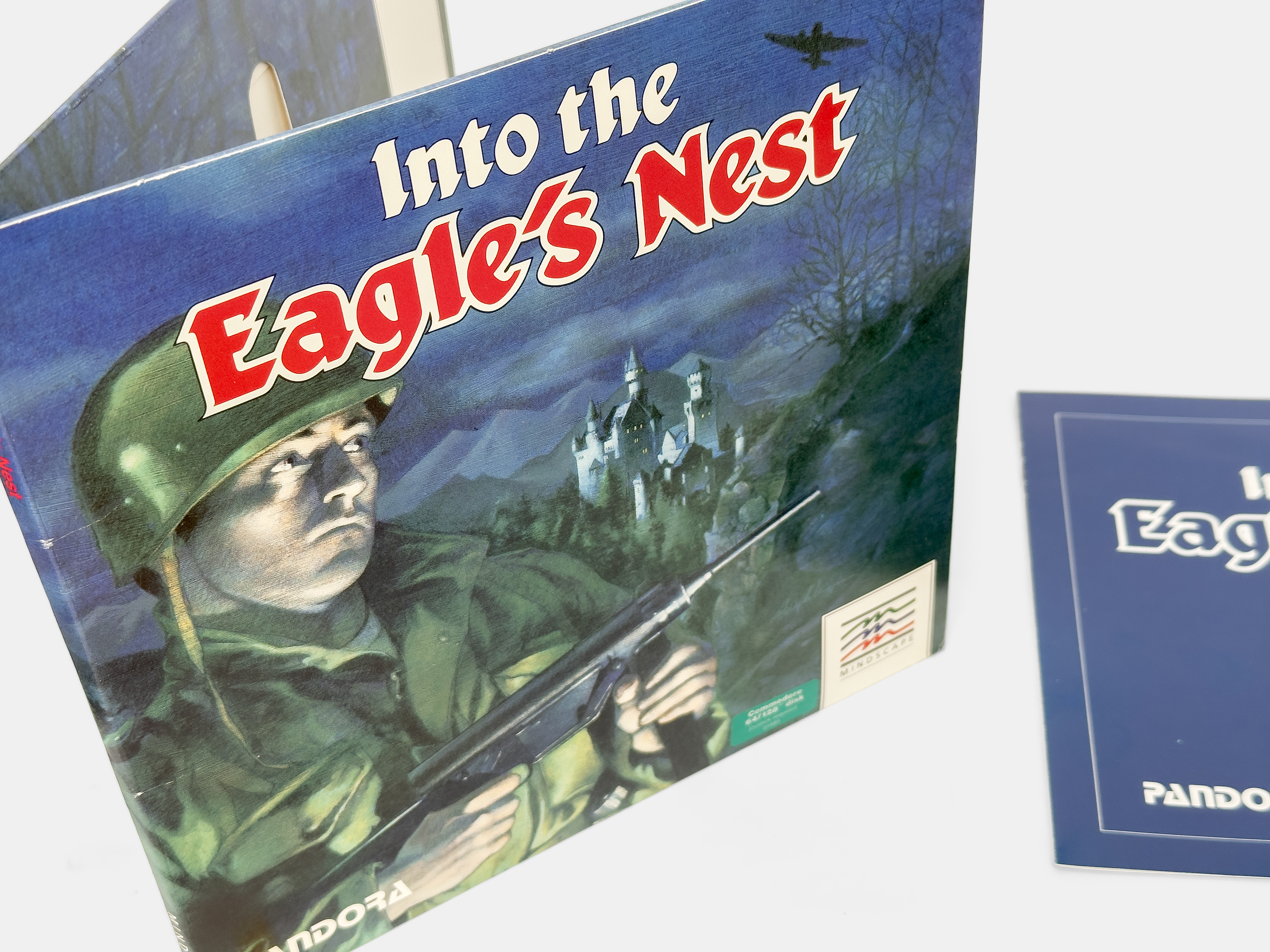
In the mid-1980s, the gaming industry saw a surge in dungeon-crawling arcade games, with Atari’s 1985 arcade title, Gauntlet, leading the charge. The game, widely ported to home computers, set a benchmark for fast-paced action and cooperative gameplay, inspiring numerous developers. Among them was Into the Eagle’s Nest, initially released in 1987 in the United Kingdom and licensed the same year to Mindscape for distribution in the United States. While it drew inspiration from Gauntlet’s mechanics, it distinguished itself with elements reminiscent of Silas Warner’s influential 1981 title Castle Wolfenstein, blending arcade-style shooting with a methodical infiltration of a Nazi stronghold.
The game was published in the UK by Pandora, a premium label launched by British software company Interceptor Micros. Founded by the father-and-son duo Julian and Richard Jones in 1982, Interceptor had earned a reputation in the UK gaming scene for its diverse catalog of titles. Seeking to expand into higher-end, more sophisticated games, the company introduced the Pandora label, with Into the Eagle’s Nest as its first release. Julian Jones served as the producer, with programmer Andrew Challis developing the original Commodore 64 version. Artist Robin Chapman, who created the game’s graphics, would go on to design visuals for many of its ports as well. The game was well-received, making it an attractive prospect for Illinois-based Mindscape, which secured North American publishing rights along with several other British-developed titles, including those from Ocean Software and Gremlin Graphics.
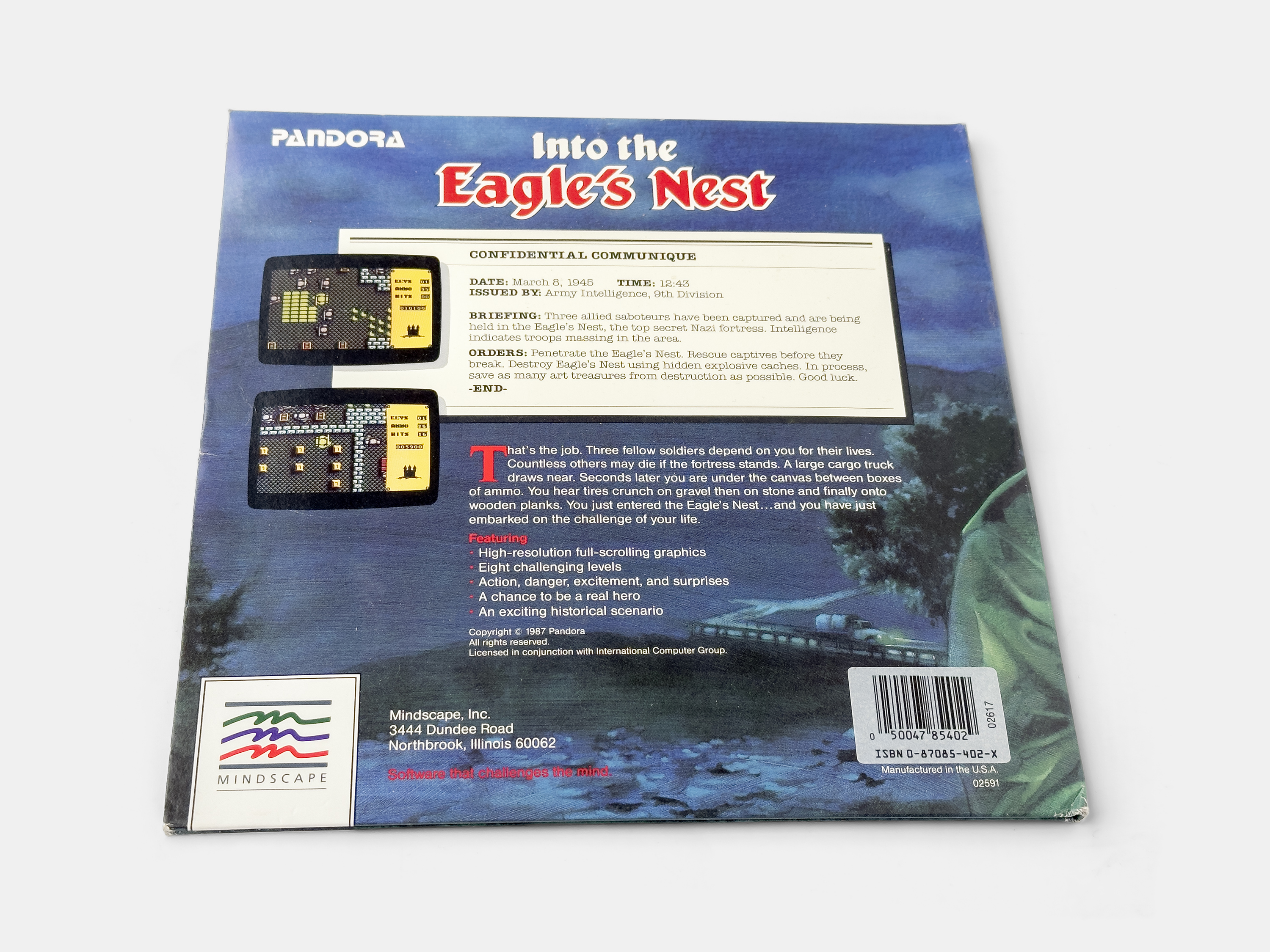
Players assume the role of an Allied soldier tasked with infiltrating a heavily fortified Nazi stronghold known as the Eagle’s Nest. The mission is multifaceted: rescue three captured saboteurs, recover stolen art treasures, and ultimately blow up the fortress. As players navigate the castle’s winding corridors, they must contend with the leaps of enemy soldiers, manage limited ammunition, and search for hidden supplies, all while carefully planning their approach. Unlike Gauntlet, which emphasized speed and cooperative chaos, Into the Eagle’s Nest demanded a more tactical playstyle, somewhat echoing Castle Wolfenstein.

Mindscape secured the publishing rights for the North American market and released Into the Eagle’s Nest for the Commodore 64, Amiga, and IBM PC, in 1987.
Into the Eagle’s Nest blends the fast-paced, multi-directional shooting of Gauntlet with the infiltration and exploration elements of Silas Warner’s 1981 Castle Wolfenstein. Set in a Nazi-occupied fortress, the game places players in the role of a lone Allied soldier tasked with rescuing three captured commandos, destroying the enemy stronghold, and retrieving valuable treasures. With limited resources and overwhelming enemy forces, players must carefully balance combat with strategic movement, making every shot count.
Upon its release, Into the Eagle’s Nest received positive reviews for its challenging gameplay and immersive atmosphere. Tracie Forman Hines of Computer Gaming World praised the game, stating it provided “some of the best fun this jaded critic has had in ages,” while also highlighting its strong replayability. Its relative success, particularly in Europe, was accompanied by controversy in Germany.
Rooted in Germany’s strict post-WWII laws, designed to prevent the glorification or trivialization of Nazi ideology, prohibited the display of symbols that could incite hatred or promote extremism. The regulations extended to video games, often resulting in the modification or outright banning of titles that depicted Nazi imagery or related elements, even when presented in a historical context. Into the Eagle’s Nest fell afoul of these restrictions due to its title, a reference to Hitler’s mountain retreat, as well as its depiction of Nazi soldiers. The game’s manual further fueled controversy by showing drunken and sleeping officers described as “harmless, but kill them anyway.” As a result, the game was officially banned in Germany in the summer of 1988.
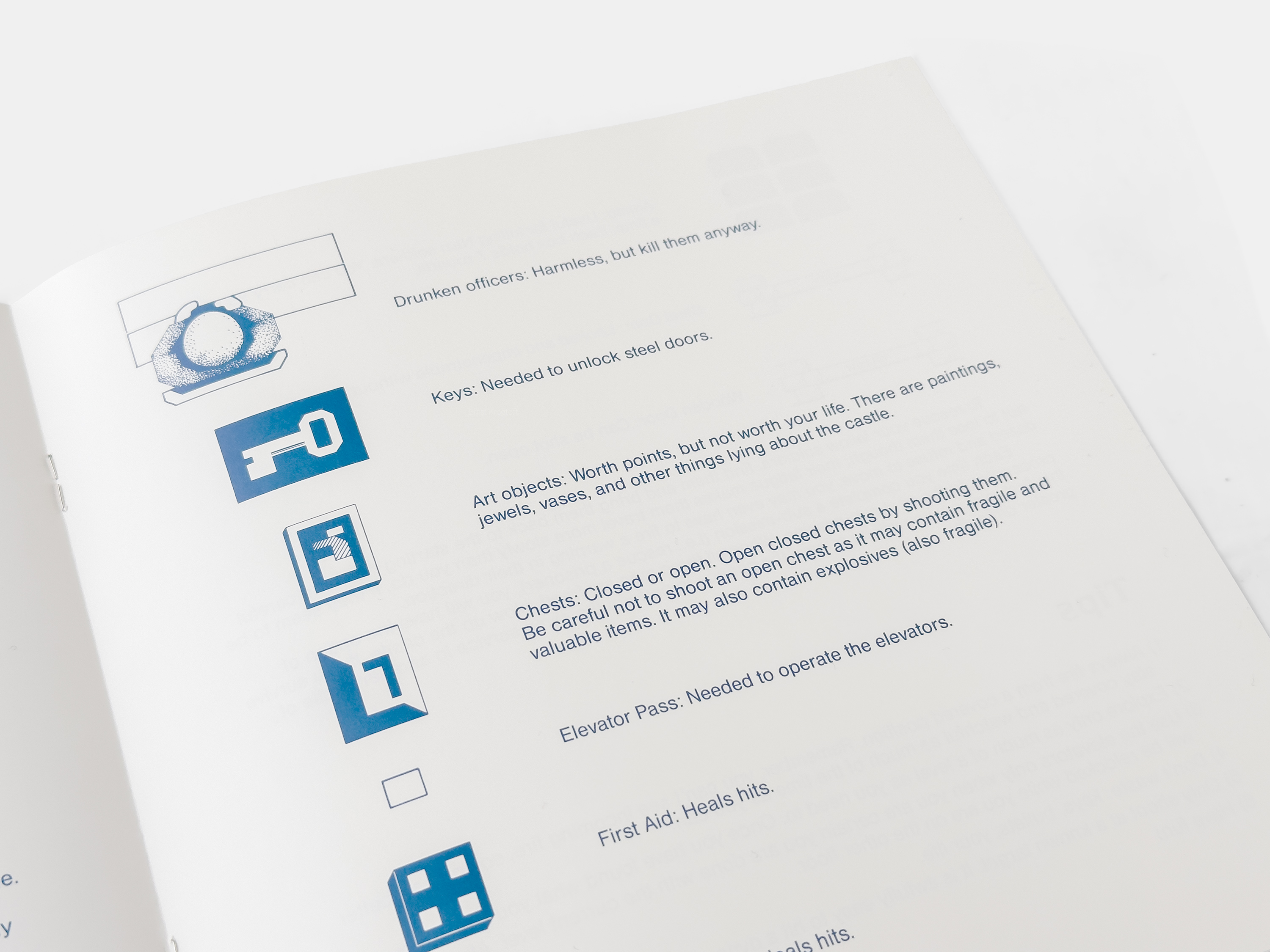
The manual detailed various interactive elements in the game, including an icon of a drunken officer accompanied by the text, “Harmless, but kill them anyway.”
Interceptor Micros and its Pandora label were part of the thriving British software scene of the 1980s, producing a mix of budget and premium-priced titles that captured the era’s spirit. Into the Eagle’s Nest was a success, bolstering Pandora’s reputation and reinforcing Interceptor Micros’ standing in the competitive late-1980s gaming market. However, as the industry evolved and development costs rose, the company struggled to keep pace. By the early 1990s, the market had shifted toward more sophisticated 16-bit titles, and Interceptor ultimately faded into obscurity. The Pandora label was short-lived, with only seven released games. Into the Eagle’s Nest remains the most popular.
Programmer Andrew Challis worked on titles such as Killapede and Dizzy Dice for Interceptor Micros, while also developing loader systems for the company. He created Micro Painter, a graphics tool for their budget label Players Software, before eventually leaving the gaming industry for a long career in telecommunications and later becoming an electrician.
Sources: Wikipedia, The Good Old Days, MobyGames, Lemon64…


 Retro365