During the early winter days of 1982, an unmistakable buzz filled the air as the last Applefest of the year unfolded at the Civic Center, in the heart of San Francisco. This open-to-consumer event served as a significant gathering for all things Apple-related, attracting software companies and hardware suppliers eager to showcase their products and share their visions with the public. The exhibition halls buzzed with activity, collectively embodying the modern-day gold rush ignited by the personal computer revolution.
Ken and Roberta Williams, founders of now well-established On-Line Systems, arrived at their large booth strategically situated directly next to the entrance and the crowded endlessly looping escalators. Ken was arriving in a bad mood straight from a frustrating convention in Chicago, becoming a serious company necessitated business trips and marketing meetings, a far cry from how it all started just a few years earlier.
The On-Line Systems booth was stocked with its large portfolio of games, most playable on displays prominently mounted, ensuring everybody passing wouldn’t miss it. A large photo mural of a Yosemite National Park waterfall dominated the back wall. Ken and a hesitant Roberta had earlier sold 24% of the company to venture capitalist Jacqueline Morby of TA Associates. Becoming a real corporation required a distinct and unclaimed name and On-Line Systems was becoming Sierra-On-Line, with the renowned Yosemite landmark, the iconic Half Dome, as its logo.
Ken Williams had established a prominent reputation in the software business, earning admiration and respect from many within the industry. As he made his way through the show floor, he was warmly greeted with smiles, engaging conversations, and numerous handshakes. Little did he know that one particular handshake exchanged that December of 1982, would leave an indelible mark on gaming history.
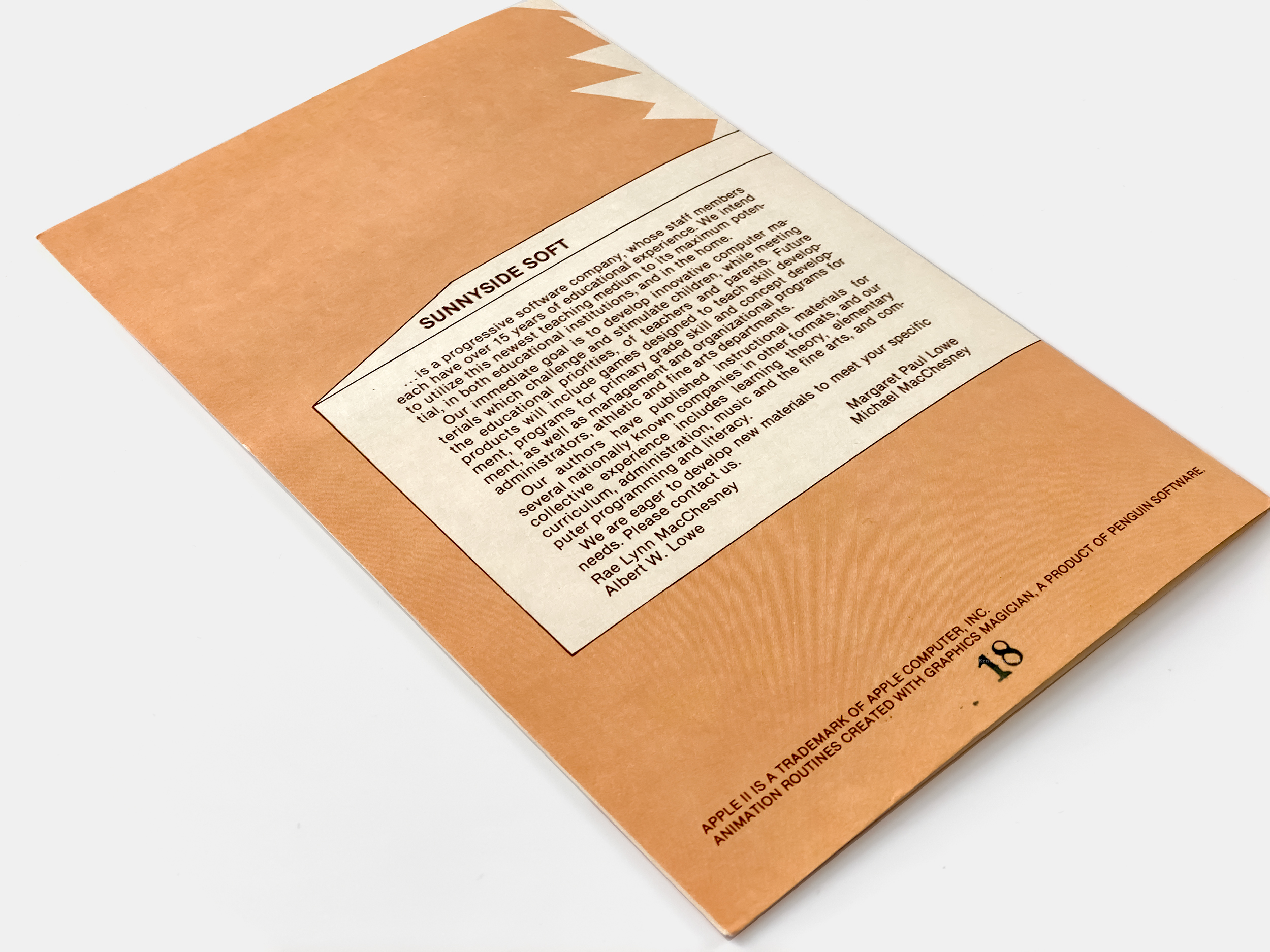
Sunnyside Soft, a newcomer in the software business, had rented a small 10 by 10 feet booth at the convention. Using the opportunity to showcase and market its educational entertainment software, with the hope of selling enough copies to cover the event. The small two-family operation was conceived by Al Lowe and Mike MacChesney, together with wifes Margaret and Rae Lynn. The families lived in the same neighborhood in Fresno, California, and worked in local schools.
With over a decade of experience teaching music in public schools, Al had established a solid career. However, a bout of chickenpox would confine him to his home, where he started experimenting with his DEC timesharing terminal hooked up remotely to the school district’s PDP-11/70 minicomputer. The encounter sparked his interest, leading him to acquire his own computer, an Apple II Plus. Initially, with the intention to develop software that would facilitate his work as a music teacher but he soon started experimenting with games he and his 6-year-old son could enjoy together.
Drawing from their educational background, Al and Mike decided to try and utilize the computer as a platform for education, blending arcade-style enjoyment with simple learning principles. The first two titles were conceived in the summer and autumn of 1982, on the side while still being fully employed in the school system. The first title, an educational adventure game, Dragon’s Keep was programmed by Al in Applesoft Basic with Mike helping with the graphics and with both wives contributing ideas for the game. The game was completed and 200 copies were produced and sold from the Lowe family’s kitchen under the newly established company name, Sunnyside Soft. The constellation was reused in the next title, Bop-a-Bet, a game aimed at teaching kids letter recognition and alphabetization. A third game, Troll’s Tale, was under development as Sunnyside Soft went, with its two completed games, to the San Francisco Applefest.
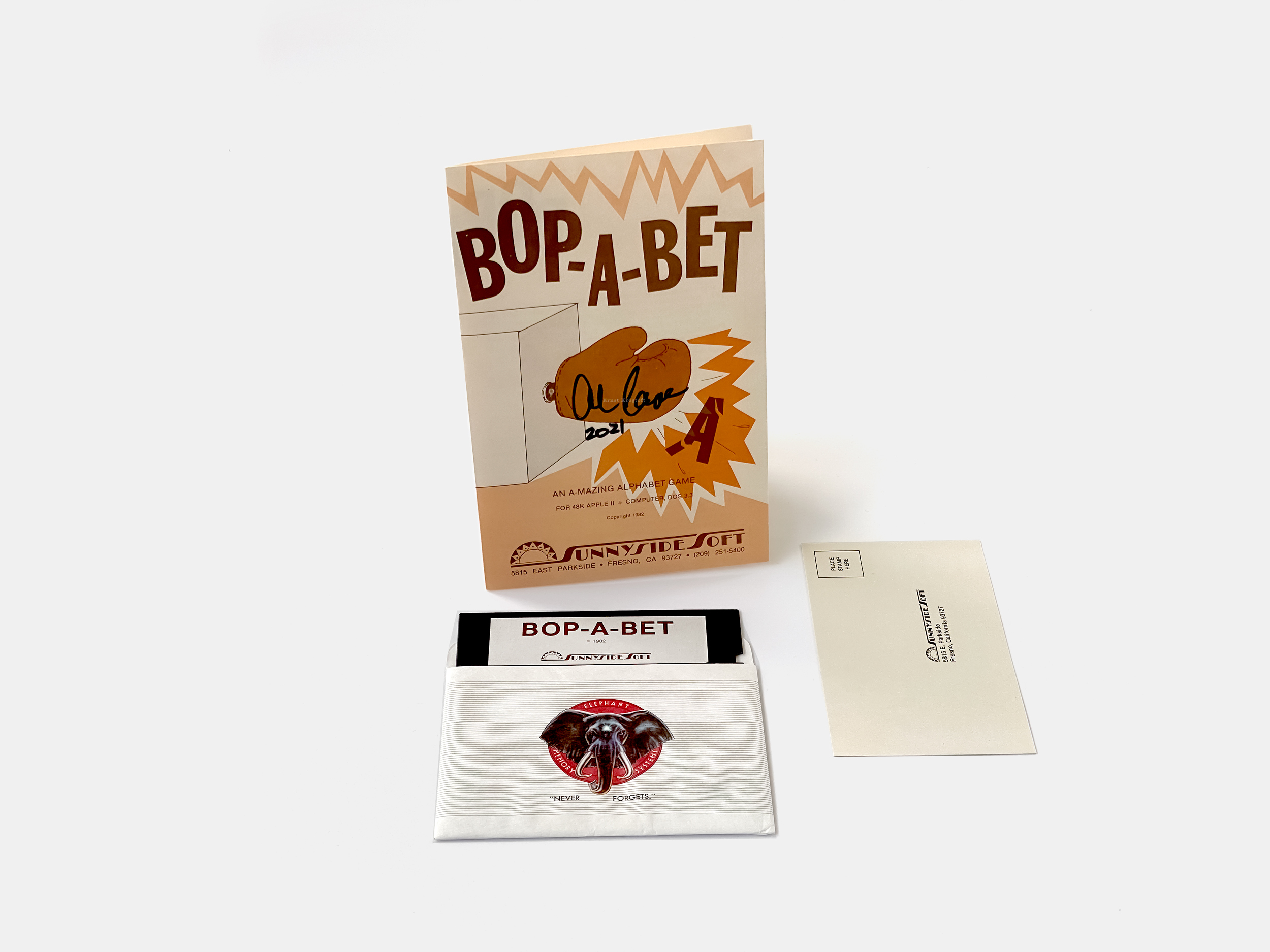
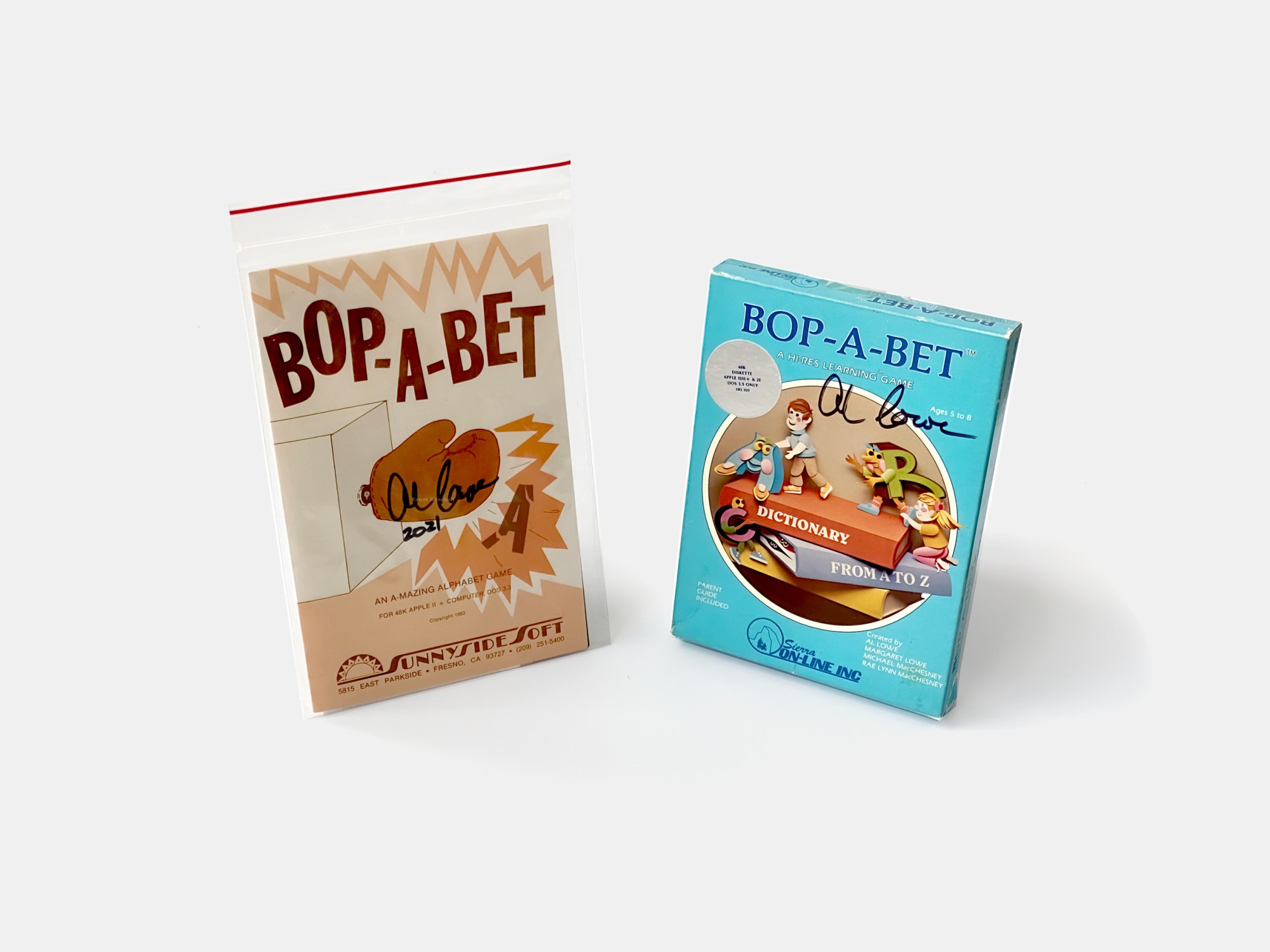
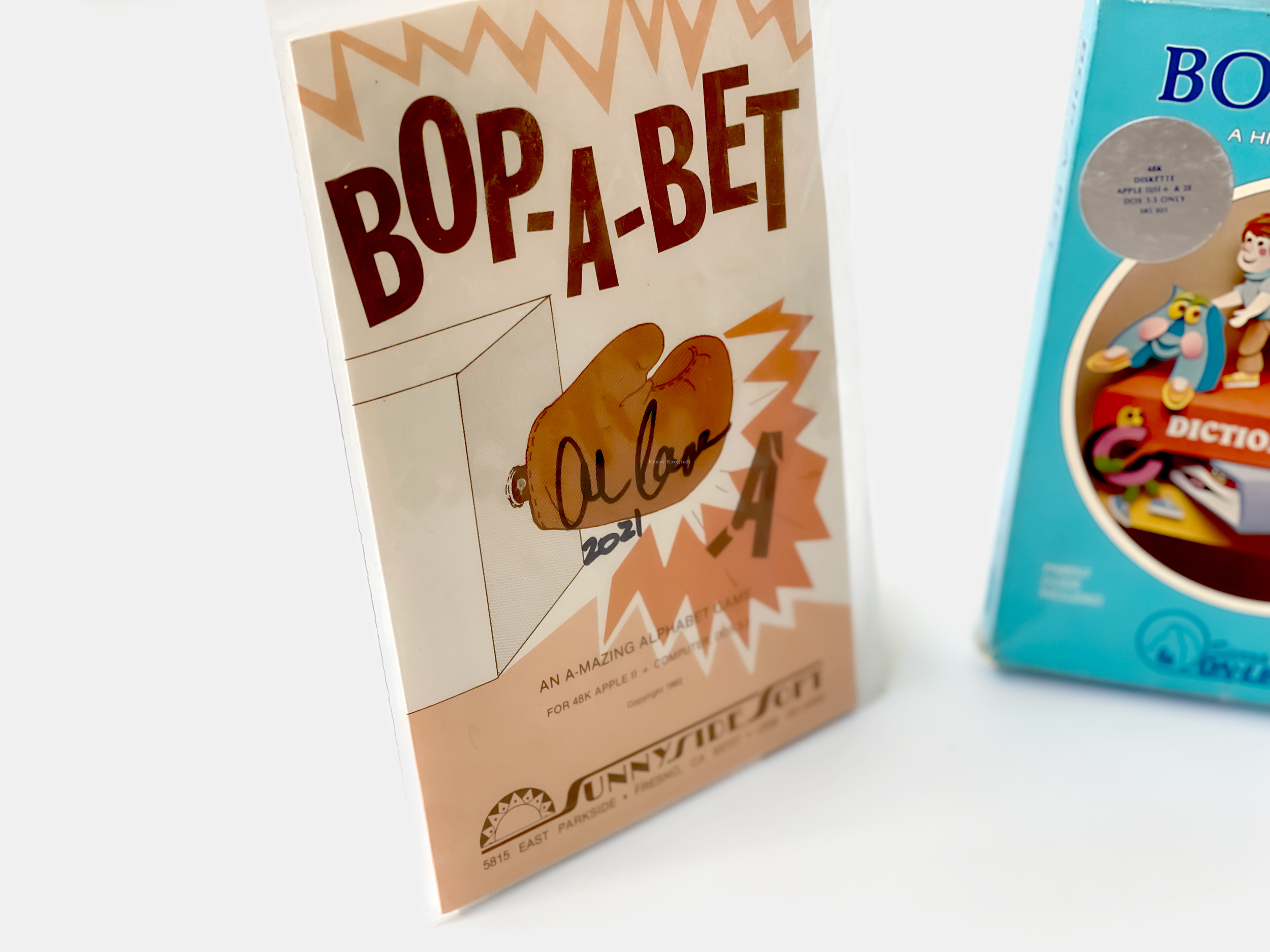
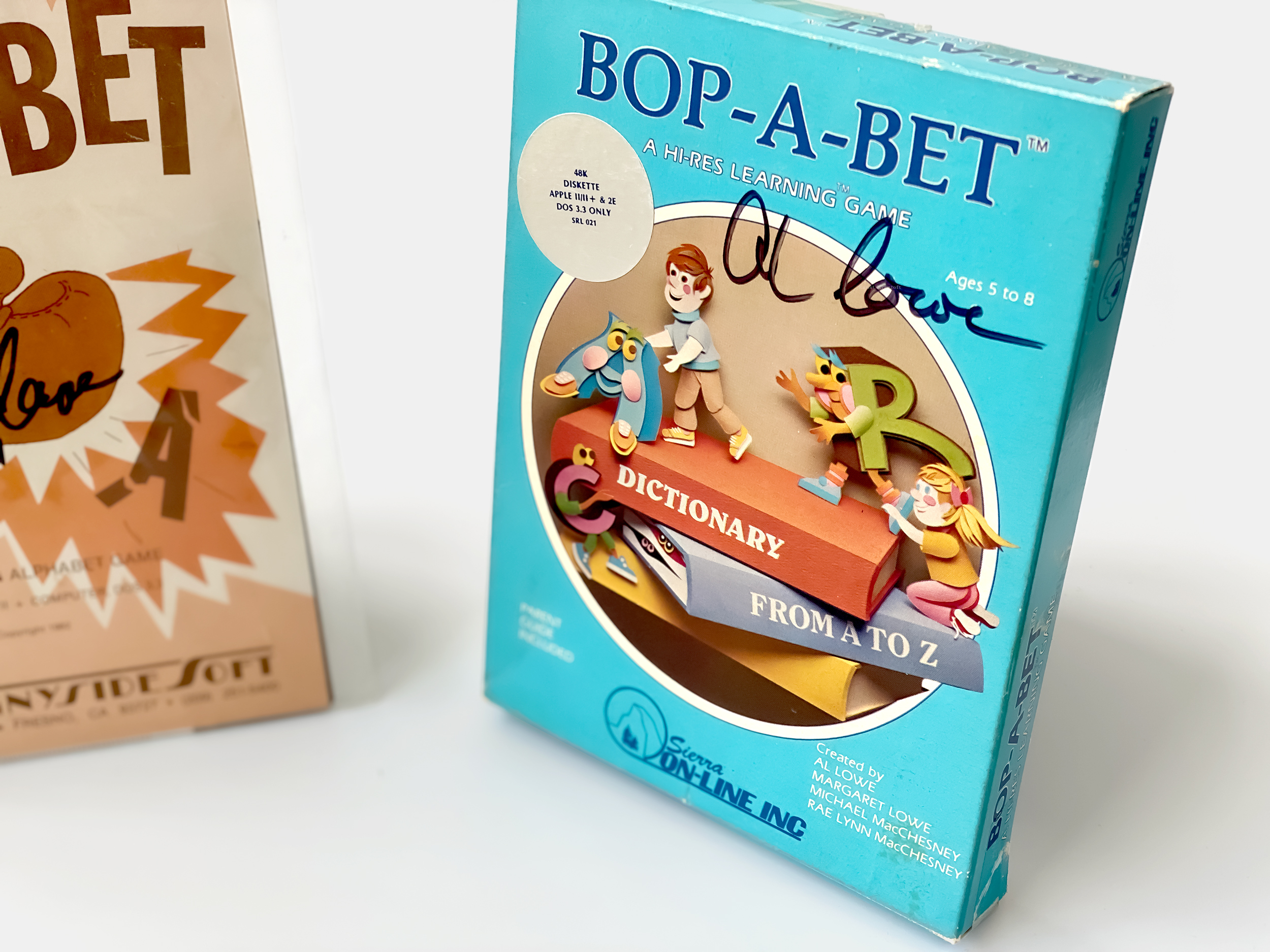
Al Lowe’s second game Bop-A-Bet, an educational game to teach kids letter recognition and alphabetization. It was released by Sunnyside Soft for the Apple II in the early autumn of 1982.
All but one of the 200 produced copies were sold. This was Al’s personal copy which he kept for almost 40 years before auctioning it off – I was lucky enough to acquire it
Sunnyside Soft’s modest yet well-visited booth featured a couple of Apple II computers, inviting visitors to experience Dragon’s Keep and Bop-A-Bet firsthand. During their tour of the show floor, Ken and Roberta Williams made their way by the booth and were immediately intrigued by the striking graphical resemblance the games appeared to their own highly successful Hi-Res Adventure titles.
Ken acknowledged the commercial prospects of expanding his company’s product offerings into the emerging home educational software market and recognized the potential value of the Sunnyside Soft titles, Ken and Roberta took the initiative to introduce themselves and subsequently proposed an offer to acquire the rights to the three games for marketing and publication through Sierra On-Line.
While Dragon’s Keep and Bop-A-Bet had enjoyed some minuscule degree of success, being marketed in educational magazines and sold for a few months from Al and Margaret’s home, the opportunity to have one of the industry’s leading publishers backing their products was an opportunity too good to pass up. The parties reached an agreement to join forces, to bring Sunnyside Soft’s games to a wider audience.
For Al, this was a pivotal moment that would end up changing the course of his life. He would soon be leaving his secure professional career behind, become a fully-fledged game designer, and on the side build a lifelong friendship with the Williamses.
Following the acquisition, Bob-A-Bet was re-released in 1983 in Sierra On-Line’s Hi-Res Learning series but only for the now-aging Apple II, which ultimately led to a very limited number of sold copies. Both Dragon’s Keep and Troll’s Tale were significantly more elaborate games, closer aligning with the style of games that Sierra had become renowned for. They both were released on multiple platforms and achieved notably more success in the subsequent years, than Bop-A-Bet.
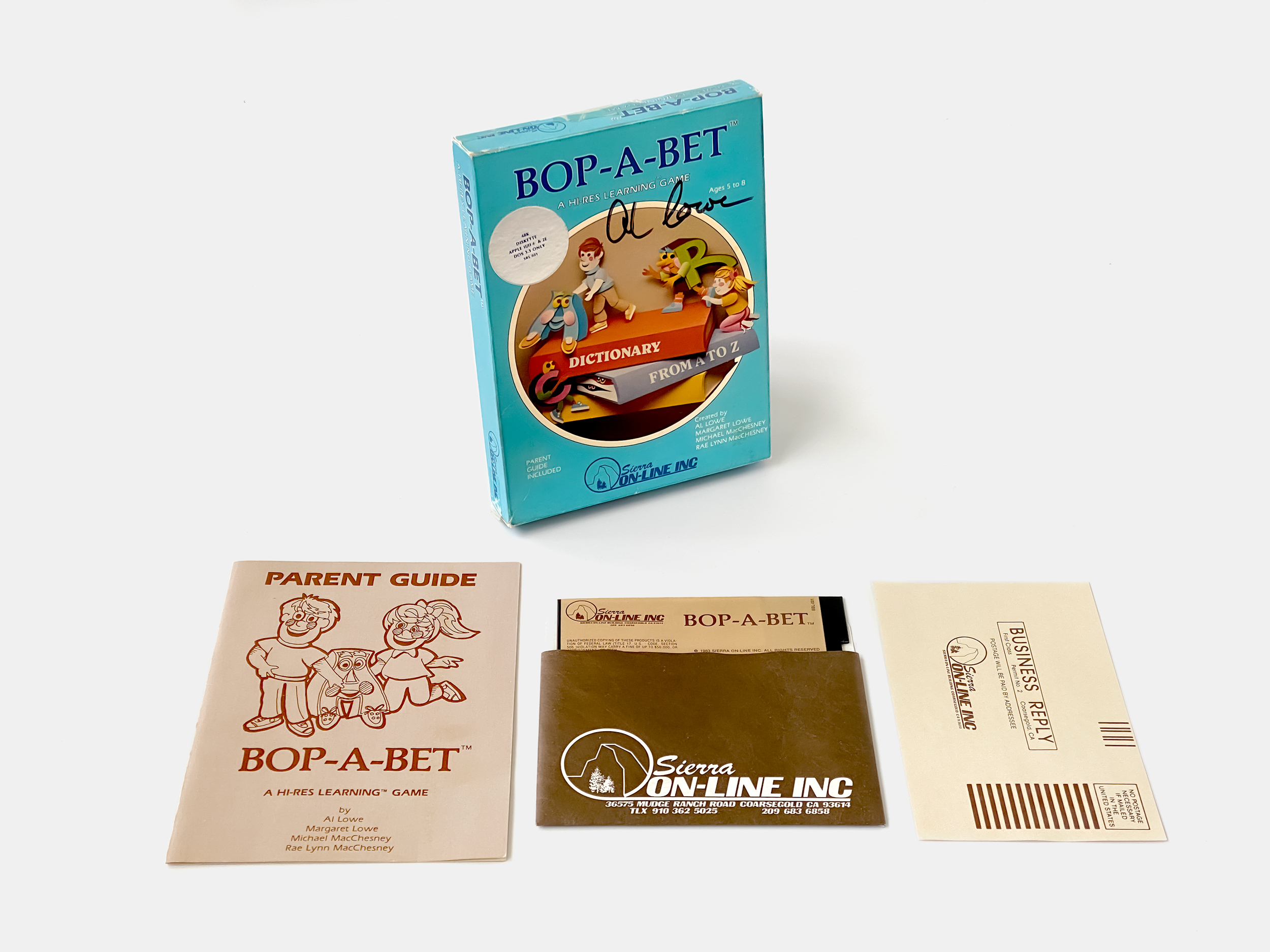
After Sierra On-Line had acquired the rights to all three of Sunnyside Soft’s titles, Bop-A-Bet was re-released, in 1983 but only for the aging Apple II. The game never became a commercial success and is today considerably rare.
This was Al’s personal copy he auctioned off in 2018
Bop-A-Bet, Unlike the other two Sunnyside Soft titles, was only released for the Apple II platform. The Sierra On-Line release was published in 1983 in the typical Sierra small box of the time. The game helped kids learn the letters and the alphabet in a Pac-Man-like maze
While Sierra On-Line would struggle around the time of the North American Video Game crash in 1983, a collaboration with IBM would prove a saving grace, making the company reinvent the adventure game and herald it into the mainstream with its hugely successful King’s Quest. The Company would come to an agreement with The Walt Disney Company to develop educational games based on different Disney characters. With Al’s background in music and experience with educational games positioned him as the ideal candidate to work on the new titles.
Al’s numerous skills were prominently showcased throughout the entire game design process while working on titles such as Winnie the Pooh in the Hundred Acre Wood, Donald Duck’s Playground, Mickey’s Space Adventure, and The Black Cauldron, all based on beloved Disney properties. When Sierra eventually lost the rights, Al moved on to take the lead programming role for King’s Quest III: To Heir Is Human and contributed to the development of the first installment in Jim Walls‘ Police Quest series. During the development, he and Ken discussed the idea of reimaging the early text-only adventure game, Softporn Adventure (the only text game released by Sierra), utilizing the company’s Adventure Game Interpreter framework that Sierra had employed in its King’s Quest games.
In 1987, the reimaging materialized as the first Leisure Suit Larry game, a resounding commercial success, spawning numerous sequels and archiving hundreds of thousands of sold copies. Leisure Suit Larry would solidify Al as one of the era’s most accomplished and humorously inclined game designers.
While the Applefest in San Francisco that November served as a celebration of the rapidly growing computer industry, the Apple community, and its ecosystem it marked a turning point, becoming the last significant Applefest. The landscape was changing, with the Apple computer no longer maintaining its dominant position. Competition intensified, and other platforms with superior capabilities were now receiving products that were previously exclusively focused on the Apple II.
The cost, efforts, and time required to participate in smaller focused open-to-end user conventions, like Applefest, were significant. Resources were way better spent attending the big trade-only shows, like the Consumer Electronics Show (CES) where the hero was not the hacker, but the man who wrote up sales, as Steven Levy would put it in his excellent book Hackers: Heroes of the Computer Revolution.
The industry was undergoing a transition from individual developers and small independent companies, where personal friendships and business relationships could coexist, to a corporate environment, where company secrets, million-dollar investments, and takeovers became commonplace. Personal friendships turned into competition, for the ones that managed to make it, that is.
Sources: Al Lowe, Steven Levy: Hackers: Heroes of the Computer Revolution, Ken Williams: Not All Fairy Tales Have Happy Endings, InfoWorld, Wikipedia, The ScreenSavers…

 Retro365