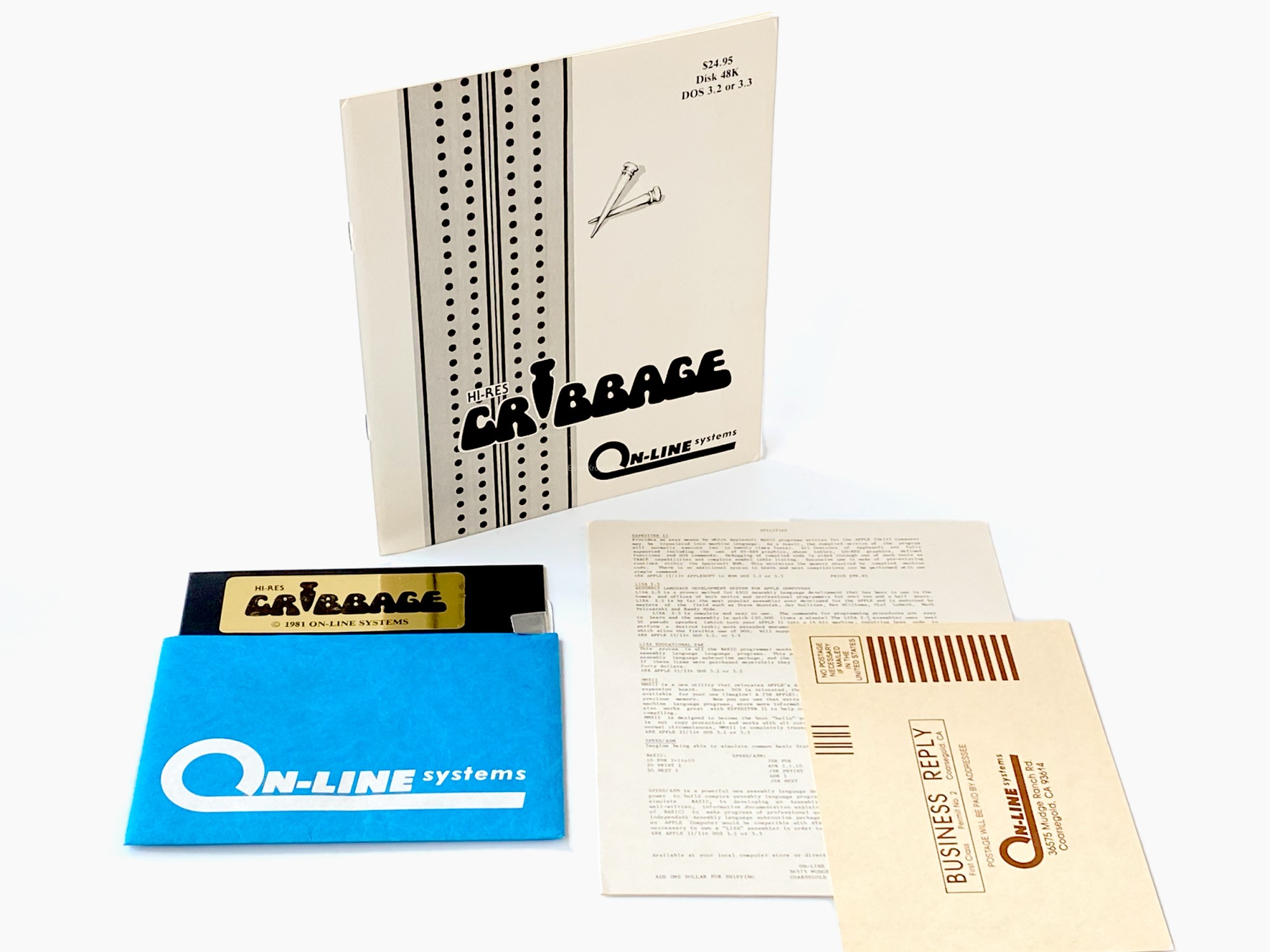
In 1980, when Ken and Roberta Williams, following the success of their first game, Mystery House, were hard at work creating The Wizard and the Princess, a cassette game reached Ken. The game was surprisingly well done with crisp graphics and well-crafted logic. At the time, only a few programmers had the knowledge, let alone the skills, to write effective and usable software in assembly language and utilize the Apple II’s Hi-Res graphics mode. The cassette game was the work of Warren Schwader, a 21-year-old from rural Wisconsin.
Schwader had been introduced to the wonderful world of computers in 1977 when his older brother, who had been paralyzed in a car accident and needed something to relieve his boredom, had bought one of the first Apple II computers. Schwader quickly became his brother’s extended hands and guided him with various computer operations, punching in commands, and bringing the computer to life. Schwader, being a meticulous and systematic person, the intriguing machine soon fully captured his fascination. Countless hours were spent exploring and debugging new software and experimenting with different graphics demos, unraveling their mysteries, bit by bit.
Being an avid player of arcade games, his debugging and simple routines soon turned into fully playable games. After writing Bustout, a simple Lo-Res Breakout clone, he dove into assembly language, where he spent the next couple of years trying to uncover the inner workings of the powerful language. At the time, there were no books to learn from, and magazine articles were few and far between. Nearly everything he learned was through trial and error.
His efforts resulted in Smash-Up, a Head-On clone, which he copied to cassettes and sent to local stores where it sold a few hundred copies, not a smashing success, but indeed proved that by taming the power of the computer, he could craft experiences others could enjoy, and earn a dime or two in the process.
At the time, Schwader was getting into cribbage, but the fact that he often didn’t have anyone to play against led him to his next project. In the Apple II’s simple and slow built-in mini-assembler, he wrote a program that essentially could be his cribbage partner. Over the next few months, his efforts produced a quite advanced cribbage game where the software’s algorithm could evaluate his hand by 12 major rules. The software worked flawlessly and was nearly as good at cribbage as Schwader himself. He copied the game to cassettes and started selling it alongside his earlier game. Surprisingly, one of the cassettes managed to reach Ken Williams of On-Line Systems out in California. Williams, impressed with the game, its Hi-Res graphics, and Schwader’s ability to produce something this technically impressive in the crude mini-assembler, reached out and extended a job offer.
Schwader faced a tough decision. Recently, his mother had passed, and he was now helping take care of his disabled brother. A journey halfway across the country, to a small software company in the foothills of the Sierra Nevada mountains, came with great risks but also certain opportunities.
Accepting the job offer, Schwader faced the decision of leaving his brother primarily in the care of day nurses. But with his brother’s blessing, he made the bold choice to leave Wisconsin and everything he knew for the West Coast and On-Line Systems, becoming the company’s second-hired programmer.
Schwader moved into one of Williams’ small 2-bedroom houses, free of charge. His cribbage game was re-released on floppy under the name Hi-Res Cribbage in early 1981 for the Apple II, marketed using the same naming convention as many of the early On-Line Systems’ titles. The game managed to sell around 2.000 copies, 10 times as many as his own cassette version, a pretty good feat being a niche product in a newly established market.

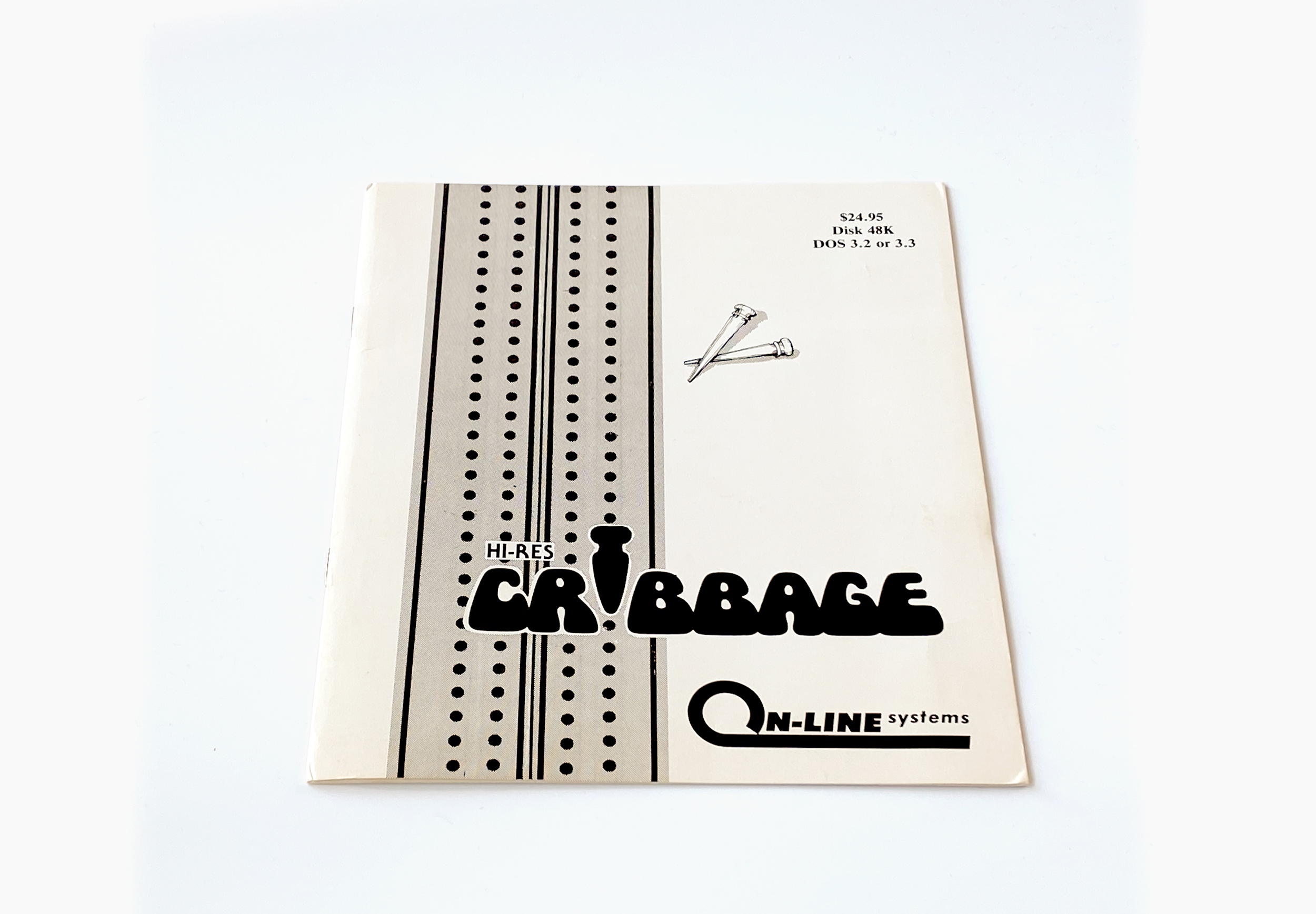
Warren Schwader’s 1980 Apple II cassette game Cribbage found its way to Ken Williams of On-Line Systems. Williams, impressed by the game, published it as Hi-Res Cribbage on a 5.25″ floppy for the Apple II in 1981. The Apple II version was the only version to be released


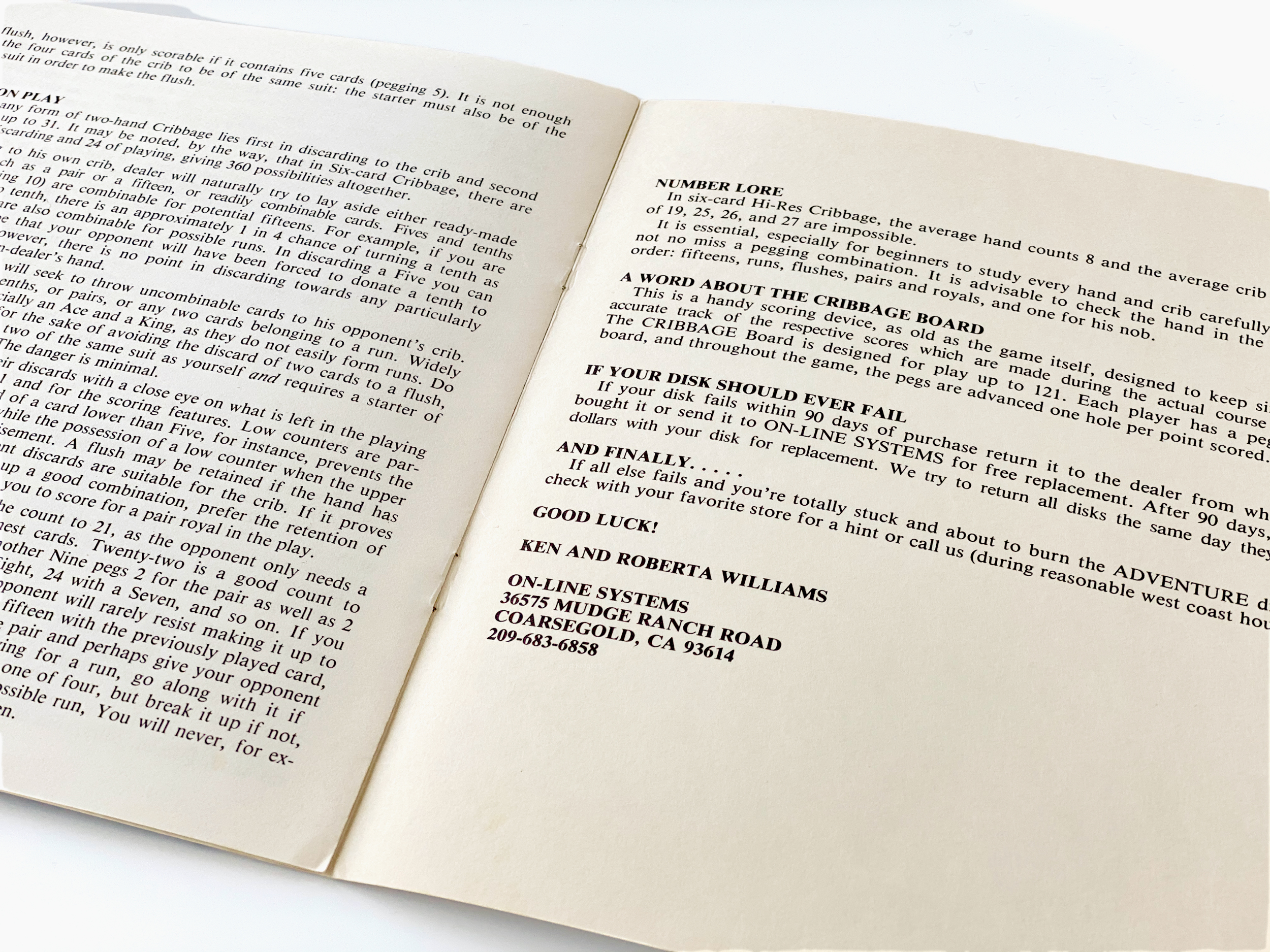
Hi-Res Cribbage for the Apple II allowed one player to play against the computer in a traditional game of cribbage. Cribbage was derived from an earlier game by Sir John Suckling in the 1600s England. The game, today, plays just like it did 400 years ago
Schwader stayed with On-Line Systems and went on the create one of the most beloved action games for the Apple II, Threshold. In the early ’90s, he would work on all three volumes of Hoyle: Official Book of Games alongside Jones in the Fast Lane.
To demystify the seemingly intricate game of cribbage, an introductory guide to Hi-Res Cribbage was featured in the first On-Line Letter in June 1981. The On-Line Letter served as On-Line Systems’ dedicated communication channel to its customers and software users, offering valuable insights into the company’s products and addressing inquiries. The On-Line Letter turned into the Sierra Newsletter in 1987 and into The Sierra Magazine in 1989 before becoming InterAction in 1991.
Sources: Hackers by Steven Levy, Halcyon Days, Moby Games, InfoWorld, Softtalk, LinkedIn…



 Retro365
Merely for the sake of trivia, hired between John and Warren were our office manager (who I *think* was named Paula) and myself.
Hi Eric
Thank you so much for commenting.
That’s interesting. I’ll need to revise some of my articles I see:)
You worked on Time Zone, as a programmer, right? Were you hired by On-Line as a programmer? did you work on other titles as well?
Thanks for your time.
Best
Ernst
Let me first correct myself. “Paula” was actually Jean Brown. I was after her then Warren and Terry Pierce, but I don’t recall the exact order.
With the help of Ken and some helpful folks at Apple, I worked mostly on the copy protection. The guts of Time Zone were reworked after I left so I don’t think much of what I did initially made it into the final product.
Let me correct myself first. “Paula” was actually Jean Brown. Next was me, then Warren and Terry Pierce but I forgot the order.
I did mostly copy protection work. Shortly after I left, much of the guts of Time Zone were reworked, so I’m not sure how much of my code made it into the final product.
Thanks for the invaluable insight, so much appreciated.
Still playing the Sierra online games. Well done.