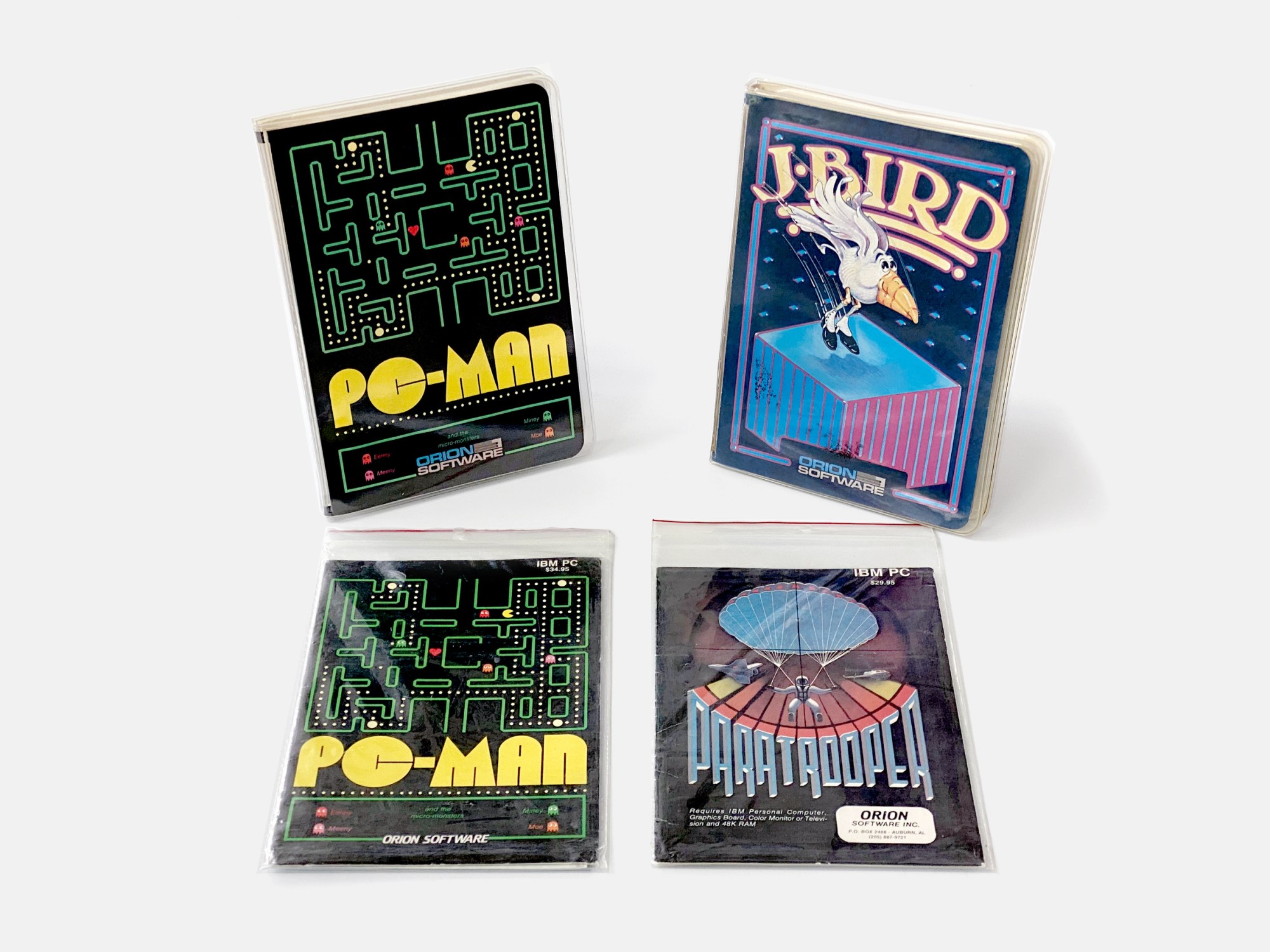
If, like me, you grew up in an IBM PC household in the early to mid-1980s, we likely share fond memories of some of the earliest games available. My father had worked for IBM in the 1960s, and when the first IBM PC launched in August 1981, he acquired one for his company. At launch, the IBM PC had only a handful of commercial game titles available. In this article, we’ll explore the IBM PC itself and some of the earliest commercially available games.
Before “PC” became synonymous with personal computing, the home computer market was a battleground. Companies like Apple, Atari, Texas Instruments, Tandy RadioShack, and Commodore fought to establish their systems as the choice of the consumers. Walking into a computer store in those days felt like stepping into the Wild West, you never knew which system was on the verge of obsolescence or which would claim the market. Buying a computer was a risky investment, often costing hundreds or even thousands of dollars, with no guarantee that the system would still be relevant in a few years.
At the time, these machines were primarily purchased by enthusiasts and hobbyists rather than average consumers. That would all start to change in 1981 when corporate giant IBM, a company synonymous with large-scale computing, introduced the IBM Model 5150, better known as the IBM PC. While IBM had long dominated the mainframe industry with systems costing millions of dollars and requiring teams of specialists to run and operate, the rise of microcomputers signaled a shift. By 1979, the microcomputer market had already reached $150 million in sales, with projections for rapid growth. IBM could no longer afford to ignore the emerging industry.
In Florida, former Apollo mission system programmer, Philip Estridge, now employed at the IBM Entry Level Division, along with 12 fellow engineers, started working on a personal computer, build with off the shelves parts and components. While doing research it became evidentially clear that retailers who would be selling the IBM computer, required the computer to be serviceable by the store’s employees and not only by a select few.
The team opted for an open architecture and wanted to make the design specification publicly available, to give third-party software and hardware developers an advantage, that would make the computer and ecosystem more attractive to the consumer.
When negotiations with Digital Research to include the CP/M operating system fell through Bill Gates of Microsoft, who IBM earlier had requested a BASIC interpreter from, acted swiftly and purchased the right to QDOS for $50.000. QDOS was quickly reworked to fit IBM’s needs and rebranded as PC-DOS. Gates, clever as he was, guessed that IBM’s open architecture would spawn other manufactures copying IBM’s design and then would be in need of an operating system, made a non-exclusive deal with IBM, giving him the opportunity to license his operating system to IBM’s upcoming rivals, and MS-DOS was born.
The IBM PC, released in August of 1981, would become IBM’s most profitable computer, and even though the base price was in line with the Apple II, to be really useful it had to be upgraded, costing at least double that, around $9.000 in 2019.
Nonetheless, the IBM PC was one of the most capable personal computers when released and the clever and $36 million expensive Charlie Chaplin marketing campaign solidified the term PC as a name everybody would recognize with an IBM Personal computer (and later compatible) running MS-DOS – even though the term PC really covers all personal computers no matter the architecture. It wouldn’t take long before IBM dominated the market. In 1984, Big Blue had $4 billion in annual PC revenue, more than twice that of Apple. Over 50% of all American companies that used microcomputers were using an IBM PC.
IBM’s decision to adopt an open architecture and grant non-exclusive rights to its operating system initially fueled the success of the IBM PC. However, in the long run, it proved detrimental to the company. The decision enabled third-party manufacturers to produce IBM-compatible systems that were not only more affordable but also more powerful. This unleashed a wave of competition, and within a few years, the market was flooded with IBM clones. The “clone wars” had begun, and IBM was losing control of the very market it captured and defined.
While the IBM PC was not originally designed with gaming in mind, the platform, like many before it, quickly became a significant driving force. At launch, IBM included Microsoft Adventure as the sole game in its initial software lineup.


IBM had Microsoft Adventure as a launch title for the IBM PC, in the coming months and years IBM would publish titles developed in-house and by third-party developers.
The first of these were all released in typical corporate IBM fashion, in dull and unattractive packaging.
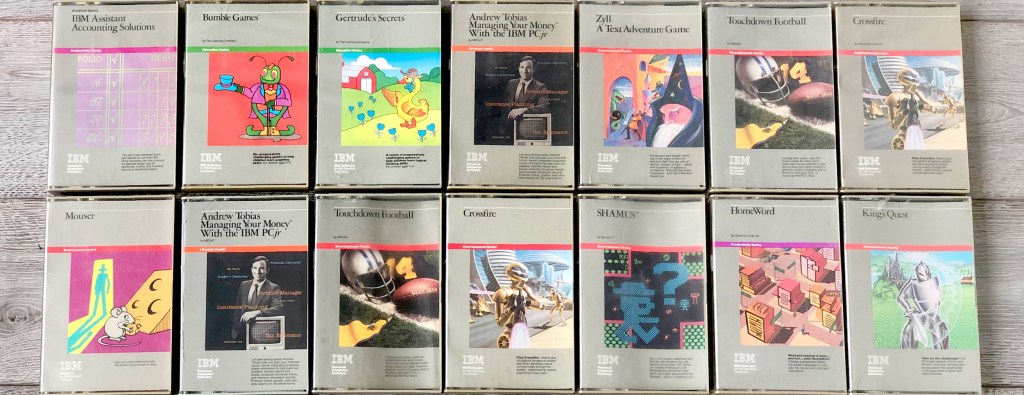
IBM would later on release software titles in plastic cases, here both for the IBM PC and IBM PCJr. IBM ended up only publishing game titles in the early to mid- ’80s and then again for a period of time in the latter part of the ’90s
Beyond the few titles published by IBM and Microsoft, commercial game releases were scarce in the IBM PC’s first year. One of the earliest companies to embrace the platform was Orion Software, among the first publishers to commercially release games for the new system.
Orion Software was founded in 1980 by Kevin Azzouz while he still was in college. The company, operating out of Auburn, Alabama, would focus on entertainment software for the Apple II and IBM personal computers. In its four year lifespan, Orion would only release a handful of titles. The company was acquired in 1984 by California based Paperback Software, started by Adam Osbourne, the creator of the first successful portable computer, with the notion of bringing software to bookstores at a cheap price – just like paperback books.
Paratrooper, released in 1982, was based upon On-Line Systems‘ title, Sabotage, developed by Mark Allen and released for the Apple II a year prior. Paratrooper was developed by math genius Greg Kuperberg when he was just 15 years old. Kuperberg would end up programming three games for the IBM PC before he enrolled at Harvard University in 1983. All of his titles were written in assembly language and ran silky smooth on the 4.77 MHz Intel 8088 CPU – and all titles were published by Orion Software and sold either in computer stores or as mail-order.

Paratrooper, Kuperberg’s first title, was published by Orion Software in 1982. Paratrooper, while a clone, inspired quite a few games itself, games often referred to as Paratrooper-like games.
Paratrooper like most of the early games was in 4-color CGA and with PC-speaker sound and “music”. It was released as a PC-Booter meaning it didn’t need an operating system to run. While Paratrooper was a clone, the title would go on and spawn many clones itself. Paratroopers was later released in the Master Blaster IBM compilation series from Keypunch.
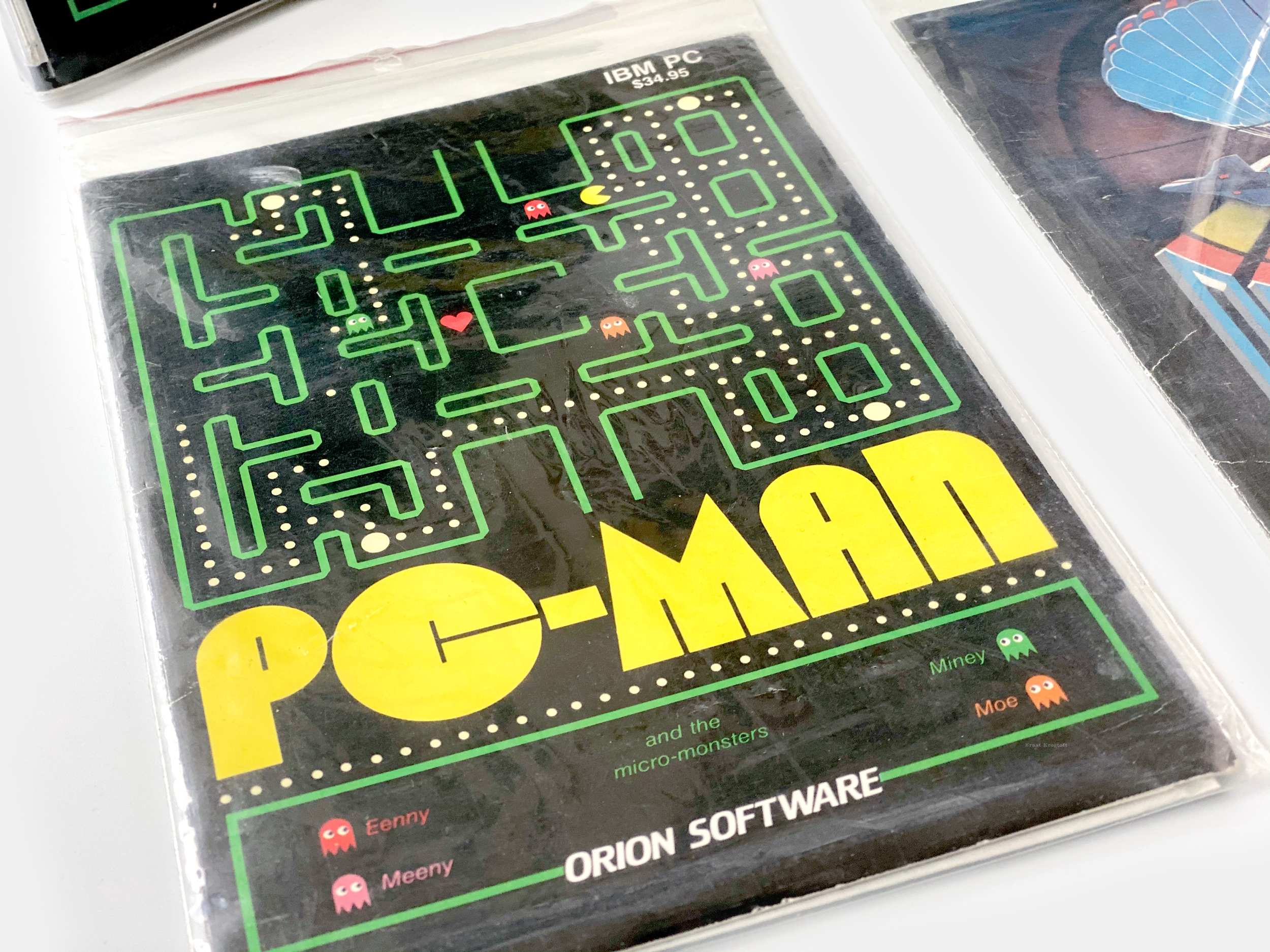
PC-MAN, released in 1982, was an unlicensed and unmistakable clone of Namco‘s 1980 arcade classic Pac-Man, also developed by Kuperberg. In a thinly veiled attempt to differentiate the game, Kuperberg simply dropped the first “a” from Pac-Man, resulting in PC-MAN, a name that did little to disguise its origins. Any remaining pretense of originality vanished with the game’s packaging, which prominently featured artwork nearly identical to Pac-Man.
Legal concerns aside, PC-MAN gave IBM PC owners their first opportunity to experience a version of the iconic arcade hit on their system, a welcome addition in an era when official ports were scarce.

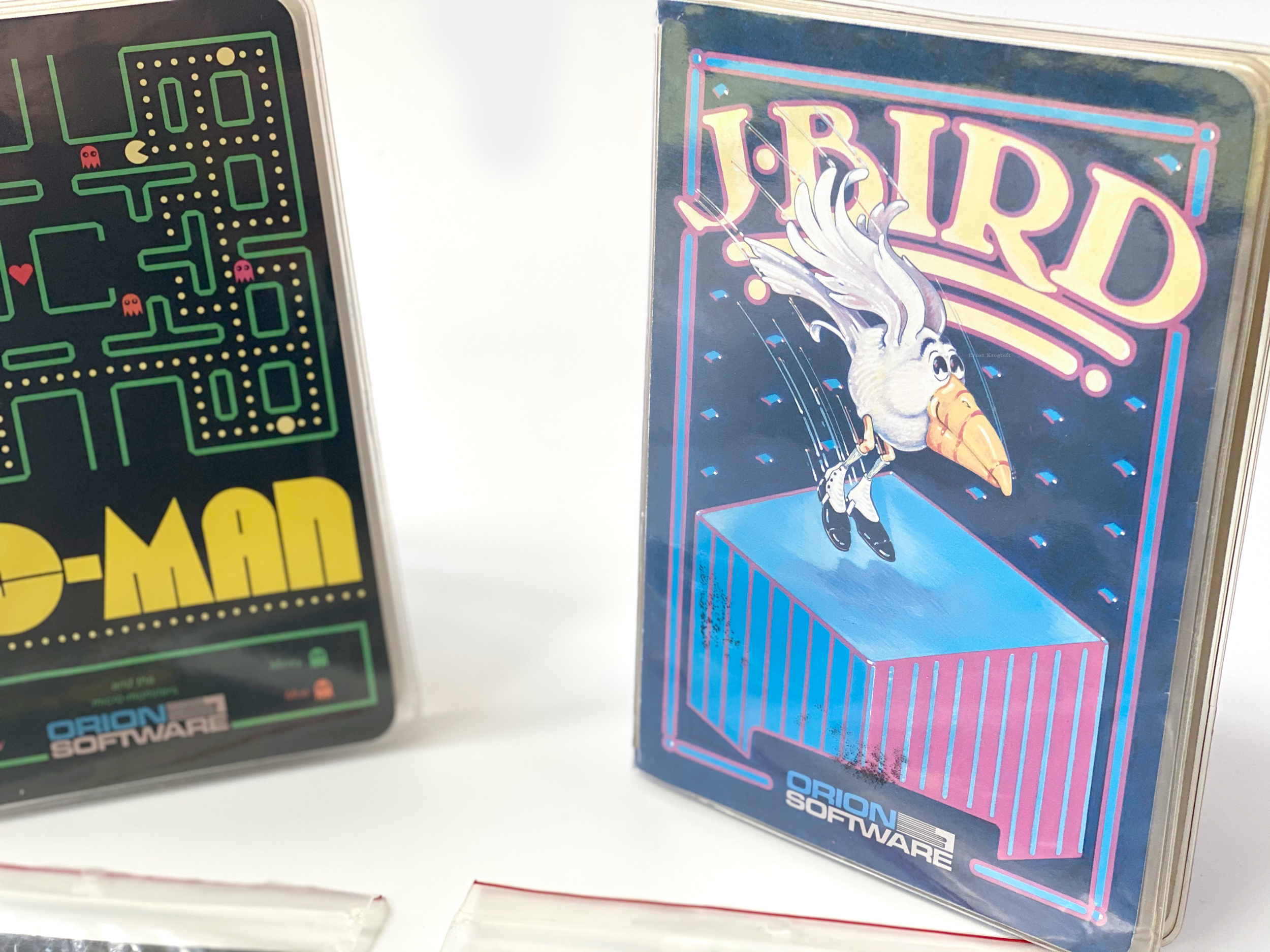
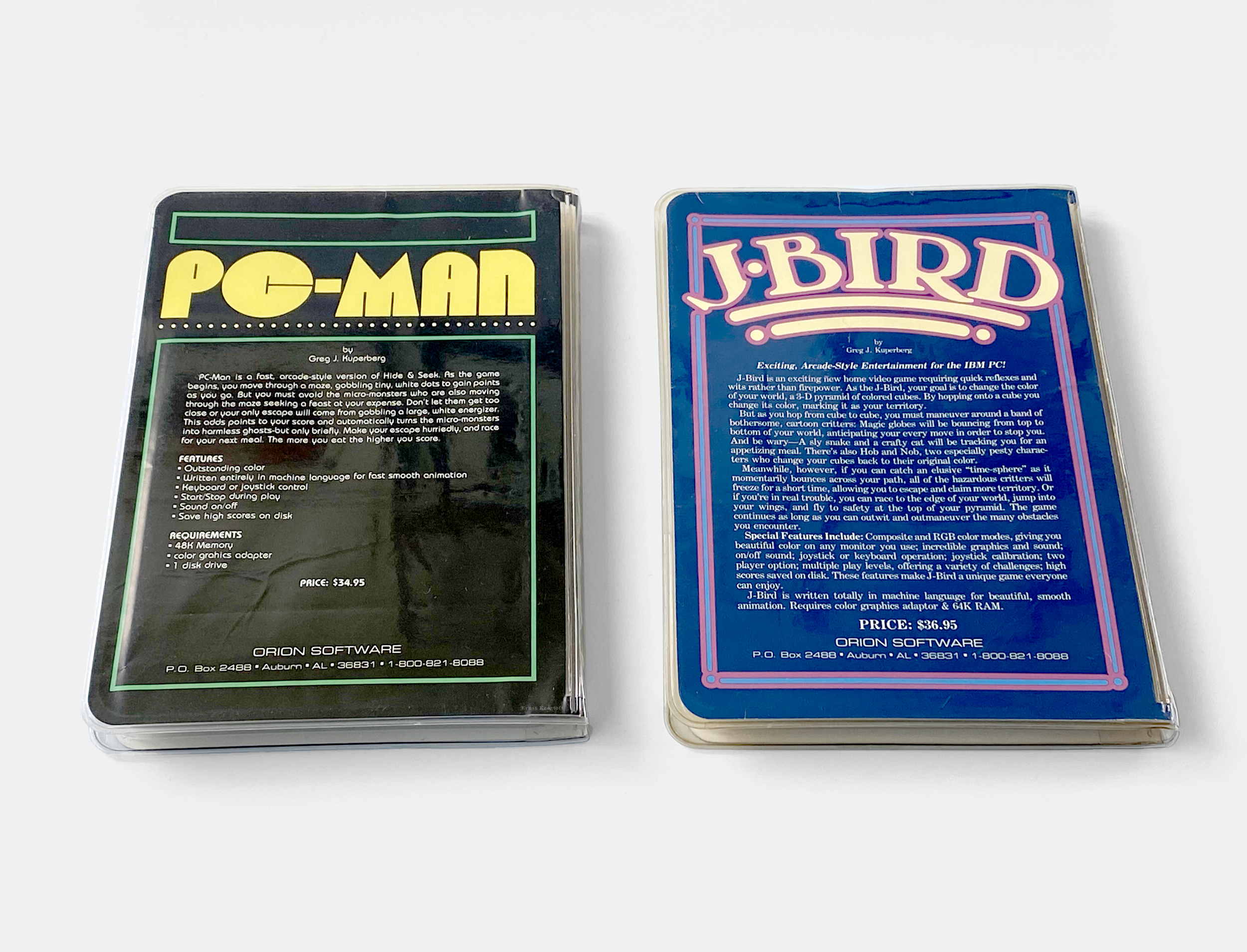
PC-Man from 1982, probably the best Pac-Man clone for the IBM/PC. It was initially, like Paratrooper, released in a Ziplock bag (right) but was rerelease later in a plastic case, just like J-Bird (left).
Released in 1983, J-Bird was reportedly Orion Software’s best-selling game and marked Kuperberg’s final contribution to the company before he moved on to university. A direct clone of QBert*, J-Bird was an impressive technical achievement, showcasing Kuperberg’s ability to push the limits of early IBM PC hardware. Its isometric perspective created a convincing 3D effect, arguably making it one of the first, if not the very first, isometric games for the IBM PC. Much like PC-MAN, J-Bird made only the slightest effort to distance itself from its inspiration, with a name just a few letters from the arcade original.

J-Bird, a Q*Bert clone, published by Orion Software in 1983. J-Bird became Kuperberg’s last game before heading off to University.
Today, Orion Software’s titles are exceedingly rare, and uncovering information about them remains a challenge. Nevertheless, these games, especially Paratrooper, played a significant role in shaping the early history of IBM PC gaming. In future articles, I’ll be exploring more of the defining titles from this formative era.



 Retro365
Nice collection!
I also have aobut 2000+ kinds of IBM 5.25″ games.
But I want to fix the following games due to be modified.
IBM Strategy Games.
Paratrooper
PC-MAN
This can be fixed by Teledisk dumped image.
I also have original J-Bird with 2-3 original disks.
Thanks:) do you have a website for your collection or somewhere else I can enjoy it.
I’m not sure what you mean by, you want to fix the listed games.
Are you interested in selling a J-Bird disk?
Best
Ernst
Been doing some research for the J.Bird game buy orion software, but is extremely hard to find much, how much do you think this game could be worth?
Any chance you can make some cover scans from those Orion games, in particular Paratrooper and J-Bird, and post them online?
Mobygames has cover scans for PC-MAN, but lacks the other two.
From the IBM games, it seems cover scans are also missing for Gertrude’s Secrets.
Hi Robert, sorry for the late answer. Please contact me on Twitter or Facebook.
Hi Ernst,
My God your collection is amazing!
I was just looking over PC gamed from 1982 and discovered Greg Kuperberg’s stuff. However, what I’m really looking for is another 1982 PC game named “Executive Suite” by Armonk Software. It’s their only game. I’ve been searching high and low for physical copy, but they don’t seem to exist. Have you ever seen one?
Thank you so much for your kind words.
Unfortunately, I haven’t come across a physical copy – I wish I had though:)
I’m still actively looking for early IBM PC software (both games and applications), a great quest but definitely challenging.
Thanks Ernst!